
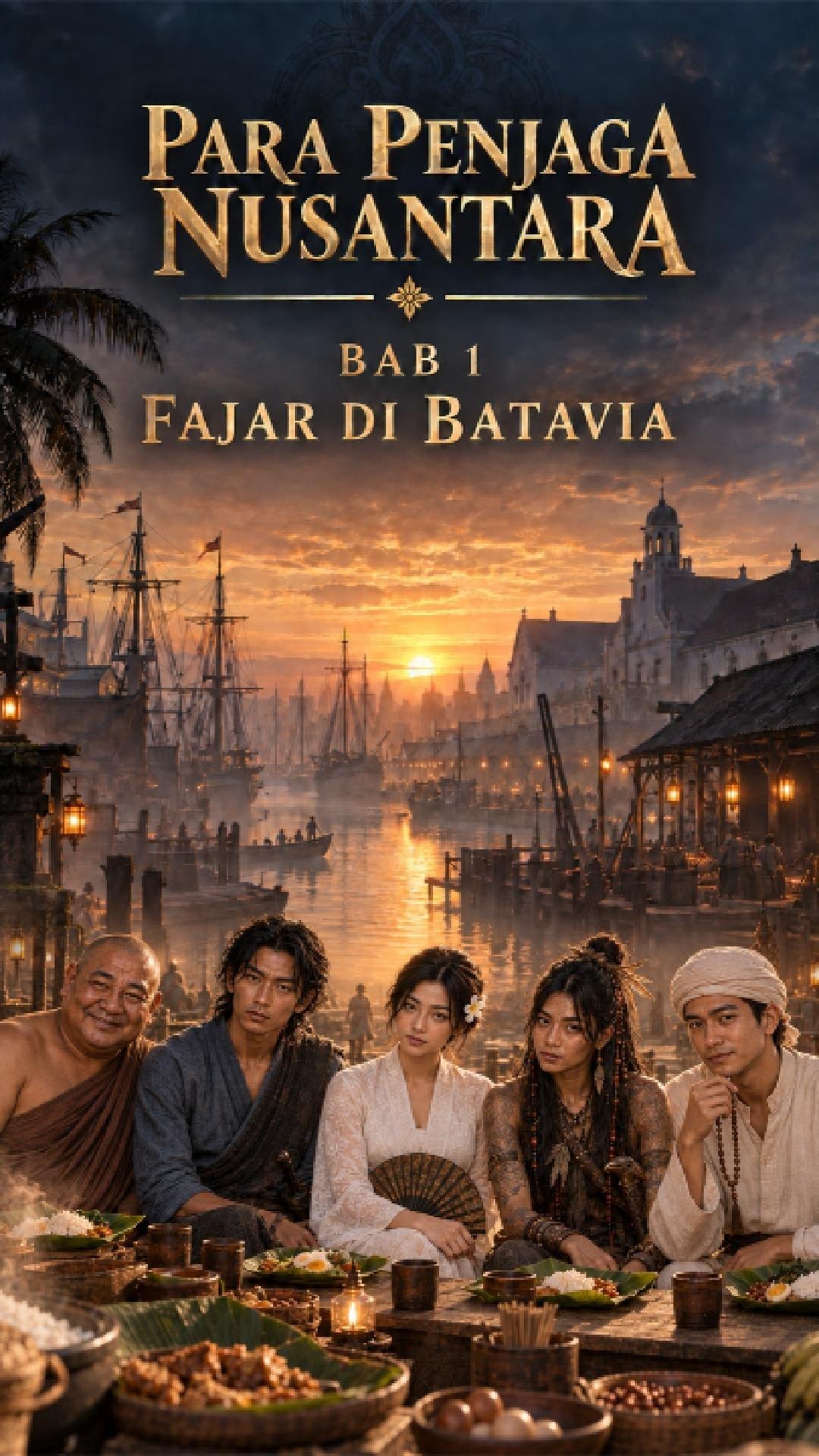
CHAPTER 1 · EPISODE 2/3
VOC Soldiers and the Pulse Beneath the City
The sun began to rise. Morning light spilled over the walls of Batavia. The VOC26 flag snapped in the wind atop the four bastions of Kasteel Batavia, and the white walls of the Stadhuis27 caught the new light and gleamed. The mist over the canal thinned, and the alley filled with the smells of people stirring. Mardijker28 servants hauled water from the canal, and Chinese merchants opened their shop fronts further down the alley. The city was waking.
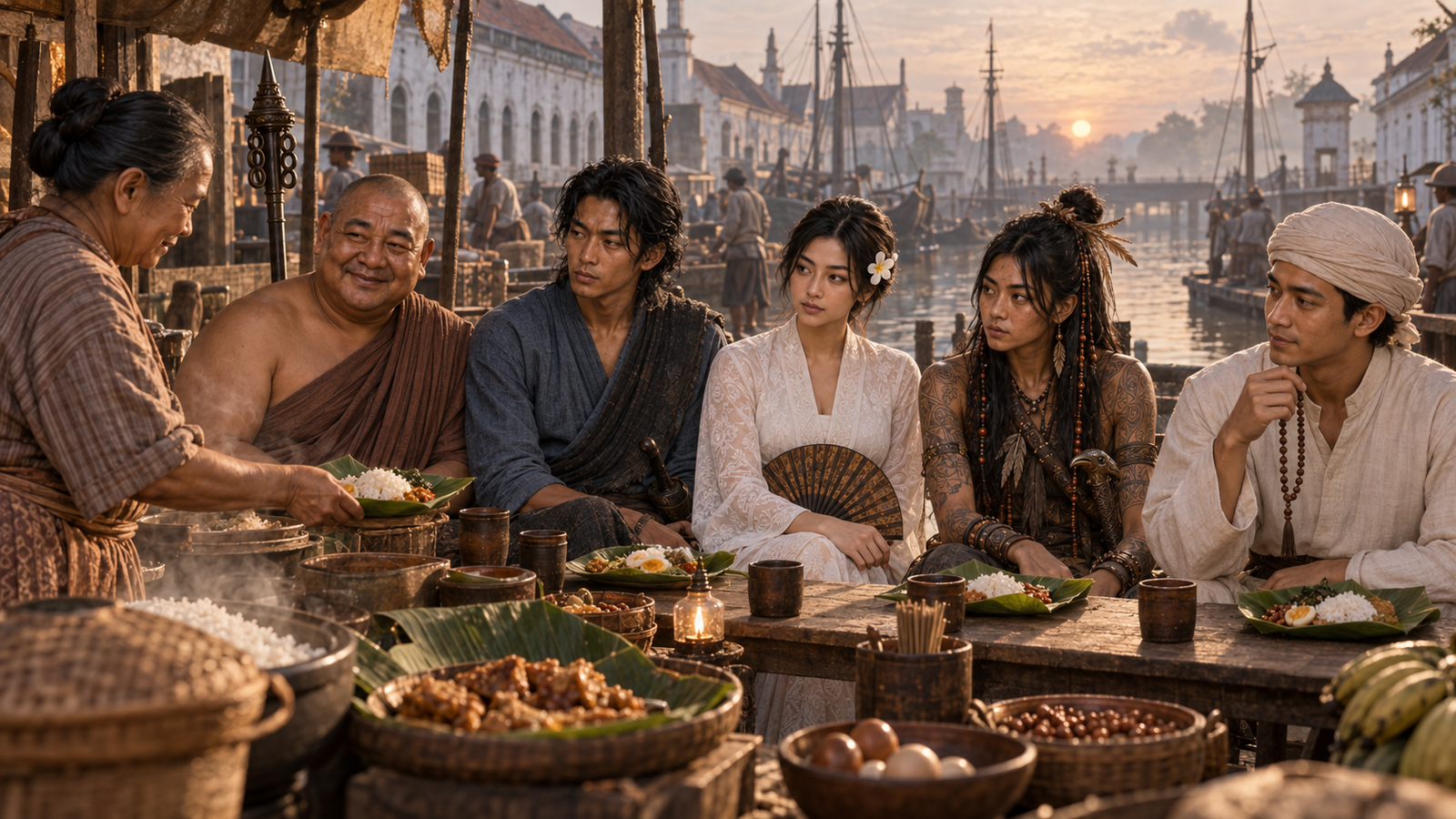
After they had finished eating, Surya spoke first. “Everyone—did you come because of a letter? A letter telling you to come to this alley?”
A brief silence. Hasan spoke first. “I received a letter from my teacher.”
“My teacher told me in person,” Dewi said.
“My teacher told me. Not a letter,” Intan said.
“A letter,” Arya said. Short. “No sender.”
Surya looked at each of them in turn. Slowly. Semeru, Bali, Banten, Kalimantan, Mataram—gathered from across the length of these islands. His expression changed, just for a moment. Not the cheerful face—something deeper, something thinking. But it passed in the blink of an eye.
“Then our being here together isn’t coincidence,” Surya said. “Five people, same place, same dawn, each called from a different part of these islands in a different way. And—the delightful thing is that all five of us know how to eat nasi uduk. That’s a good sign.”
“Bhante, do you judge everything by rice?” Intan looked at Surya.
“People who can share a meal are the best kind of people,” Surya said, and he meant it. “If someone makes you uncomfortable at the table—they’ll make you uncomfortable on the battlefield too. We just ate together, and no one was uncomfortable. That matters.”
Hasan nodded. “That’s right, Bhante. In Islam, too, sharing a meal is taught as the beginning of trust.”
Surya looked at Hasan. His eyes were glad. “Well said. Buddhist or Muslim—before rice, we are all the same. Now then, let’s know each other’s names. It seems we’ll be together for a while. I’ll go first—Surya. From the foothills of Mount Semeru, in eastern Java. I eat well, I sleep well, and from time to time, I chase the occasional ghost.”
“Intan. Kalimantan,” Intan said.
“Hasan. Banten,” Hasan said, fingers resting on his tasbih.
“Dewi. Ubud, Bali,” Dewi said.
All eyes turned to Arya. He paused a moment, then spoke. “Arya. Mataram.”
“A Javanese!” Surya’s face lit up. “I’m Javanese too. Three of us from Java—this must be because Javanese rice is the best. Obviously. Good to meet you, Arya.”
Arya looked at Surya. Did not reply. Surya did not mind. He picked up his vajra and began polishing it.
Arya had been like this since he sat down. He spoke only when words were absolutely necessary, and then in the fewest possible. The rest of the time he watched his surroundings or rested his hand on the Nagaraja—but his eyes missed nothing.
Heavy footsteps sounded from the mouth of the alley. Several people. The clink of military boots.
Intan reacted first. Before the sound reached her—she had already caught the smell. Leather, gunpowder, sweat. She rose soundlessly, her hand going to the mandau.
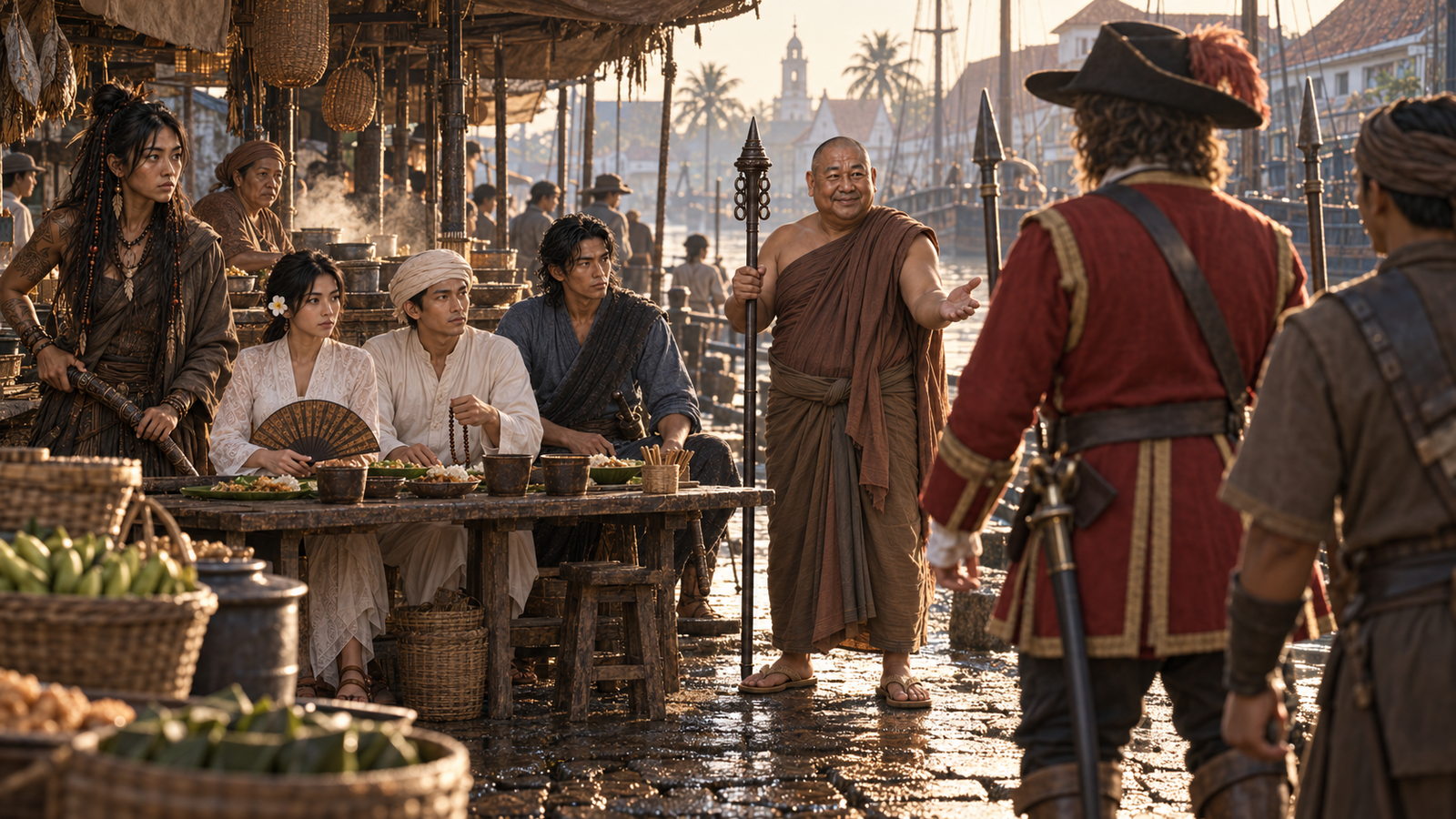
Three men entered the alley. The two in front were native auxiliaries carrying short spears, and behind them walked a Dutch sergeant in a red VOC uniform. He held a sheet of paper, scanning the alley and looking at the five in turn. Comparing them against whatever was written there.
“Intan, hand off the mandau,” Surya said without standing, still polishing his vajra.
“Those are warrant papers,” Hasan said quietly. “I saw them at the Banten harbor. VOC uses them for civilian inspections.”
“They don’t know who we are—they’re just checking.”
The soldiers approached slowly. Surya stood. Slowly, unhurried, leaning on his tongkat candi. A middle-aged monk with a belly, standing with a walking staff—nothing about him looked threatening. If anything, he looked slightly ridiculous.
The sergeant said something in Dutch. “Nuwun sewu—you must be working hard so early in the morning. Have you eaten? The nasi uduk here is truly exceptional. She uses three pandan leaves—three. That’s an entirely different realm from the two-leaf places. Please, have some before you go.” Surya smiled warmly and gestured toward the stall woman, speaking in Malay. The soldiers froze. They looked at each other. Their eyes said they had no idea how to handle this situation.
A round-bellied monk delivering an impassioned defense of pandan leaf ratios was, presumably, a first in their patrol experience.
Then someone shouted in Dutch from the far end of the alley. A mounted VOC officer. His voice was urgent, calling the soldiers. The soldiers looked at the five, then at the officer. The officer shouted again. The soldiers turned and walked toward him. The footsteps faded. The alley fell quiet again.
Surya planted his tongkat candi and sat back down. “Is there any left?” he asked the woman.
The woman stared at him in disbelief. “There is.”
“One more, please,” Surya said.
Intan looked at Surya. “Bhante, there were soldiers just now.”
“The soldiers left. The rice is still here,” Surya said.
Surya ate—but his eyes flicked, just once, toward the direction the officer had disappeared. Just for an instant. Then he returned to the rice as if nothing had happened. No one noticed.
Surya took a fourth nasi uduk and spoke. “Well then—we’ve come to the same alley, eaten together, even met soldiers together. If this isn’t coincidence, it means we have something to do together, yes?” He looked at Dewi. “Dewi, when you came in—you closed your eyes. Did you feel something?”
Dewi paused. There was surprise in her eyes—she had not expected Surya to have noticed that moment. “I felt it,” Dewi said. “There is something in this entire city. Something very old—and still alive. Something driven into the ground beneath this city is draining its spirit. In the sekala—the visible world—you cannot feel it. But read through the niskala, and it’s vivid. Spread out like a spider’s web.”
“How old?” Hasan asked, turning his tasbih.
“More than half a century, I think,” Dewi said. “It has its roots very deep.”
“Something in this land has been pulled in one direction for a very long time?” Arya asked. His voice was low. It was the first question he had asked since sitting down.
Dewi looked at Arya. “Yes.” She half-closed her eyes for a moment, then opened them again. “And it’s still happening. Right now, as we speak.”
Surya’s tongkat candi trembled—faintly. He lifted it and looked. The rings were vibrating, barely audible. His expression turned serious for a moment.
“Where is it strongest?” Surya asked.
“The far end of the canal,” Dewi said. “Where the old warehouse buildings are. Something is rising from below the ground there—as if something that was driven in long ago is still breathing.”
Intan’s hand went to the mandau without thinking. The Nagaraja—Arya’s keris—was vibrating strongly now, pointing toward the warehouses, toward the direction Dewi had indicated.
“Is it a good thing?” Hasan asked.
Dewi was quiet for a moment. “No.” Her voice was calm, but it was final.
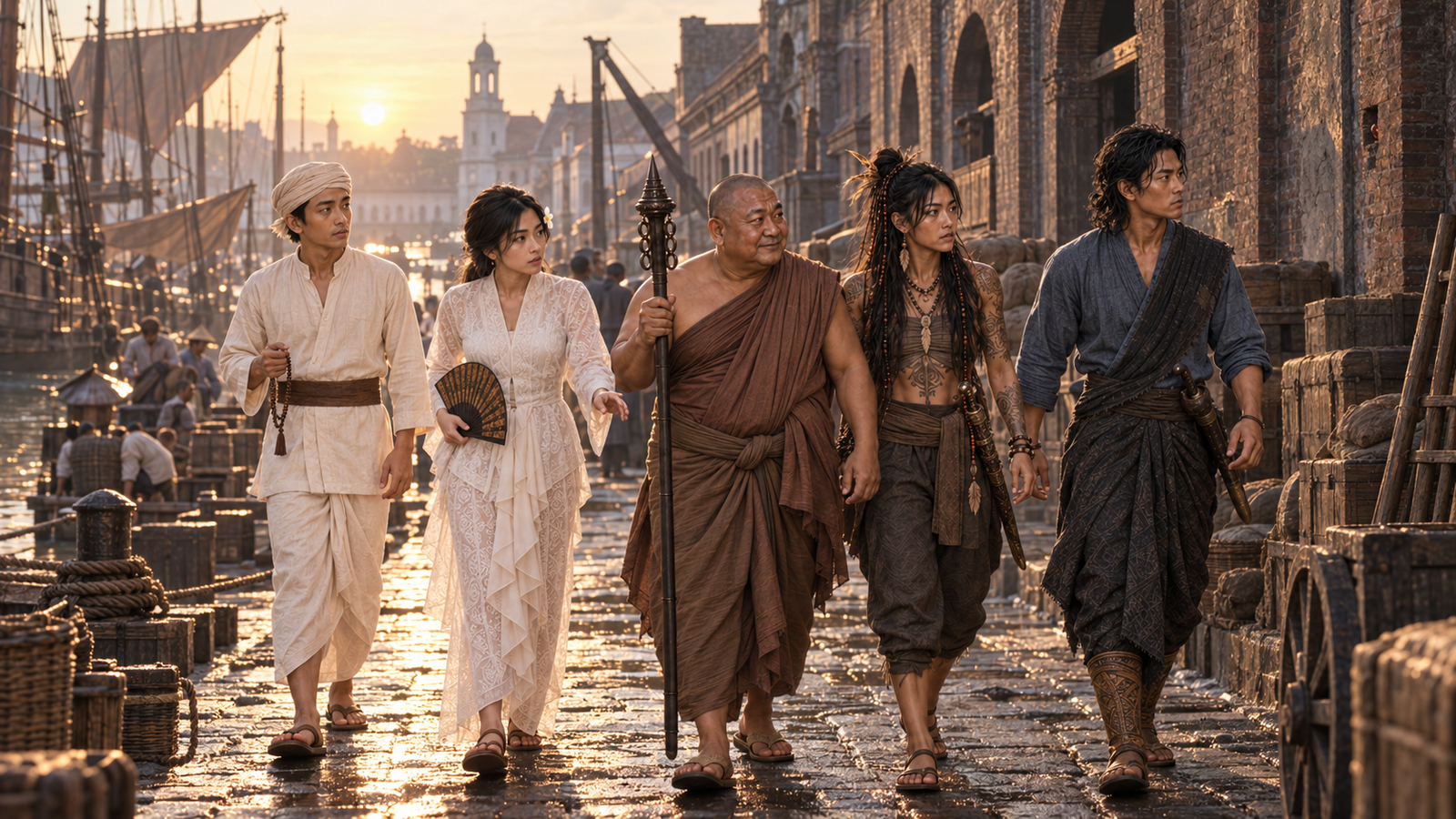
Surya put a mouthful of his fourth nasi uduk in and stood up. He was the kind of man who stood while still eating. “Then let’s go have a look. We won’t know what it is until we see it.”
“Right now?” Hasan said.
“Bellies are full, the sun is up, and the five of us are together,” Surya said, taking up his tongkat candi and tucking the vajra into his robe. “What more are we waiting for? The longer we wait, the hungrier I get.”
Notes
26. VOC
VOC: the Dutch East India Company, founded in 1602. It was a chartered joint-stock trading company with powers to maintain armed forces, make treaties and exercise colonial authority. It remained a company despite the unusually wide reach of its powers.
↩ Back to text27. Stadhuis
Stadhuis: Batavia had seventeenth-century town-hall buildings before the replacement constructed in 1707–1710. The 1683 scene refers to an earlier building, not today’s Jakarta History Museum. The scene’s rooms and atmosphere are fictional reconstruction.
↩ Back to text28. Mardijkers
Mardijkers: a community of free people, including formerly enslaved people. Former slaves brought by the VOC from Malacca, Ambon, and other eastern ports, who spoke Portuguese Creole and Malay. They were among the few non-European groups permitted to reside within Batavia's walls.
↩ Back to text