
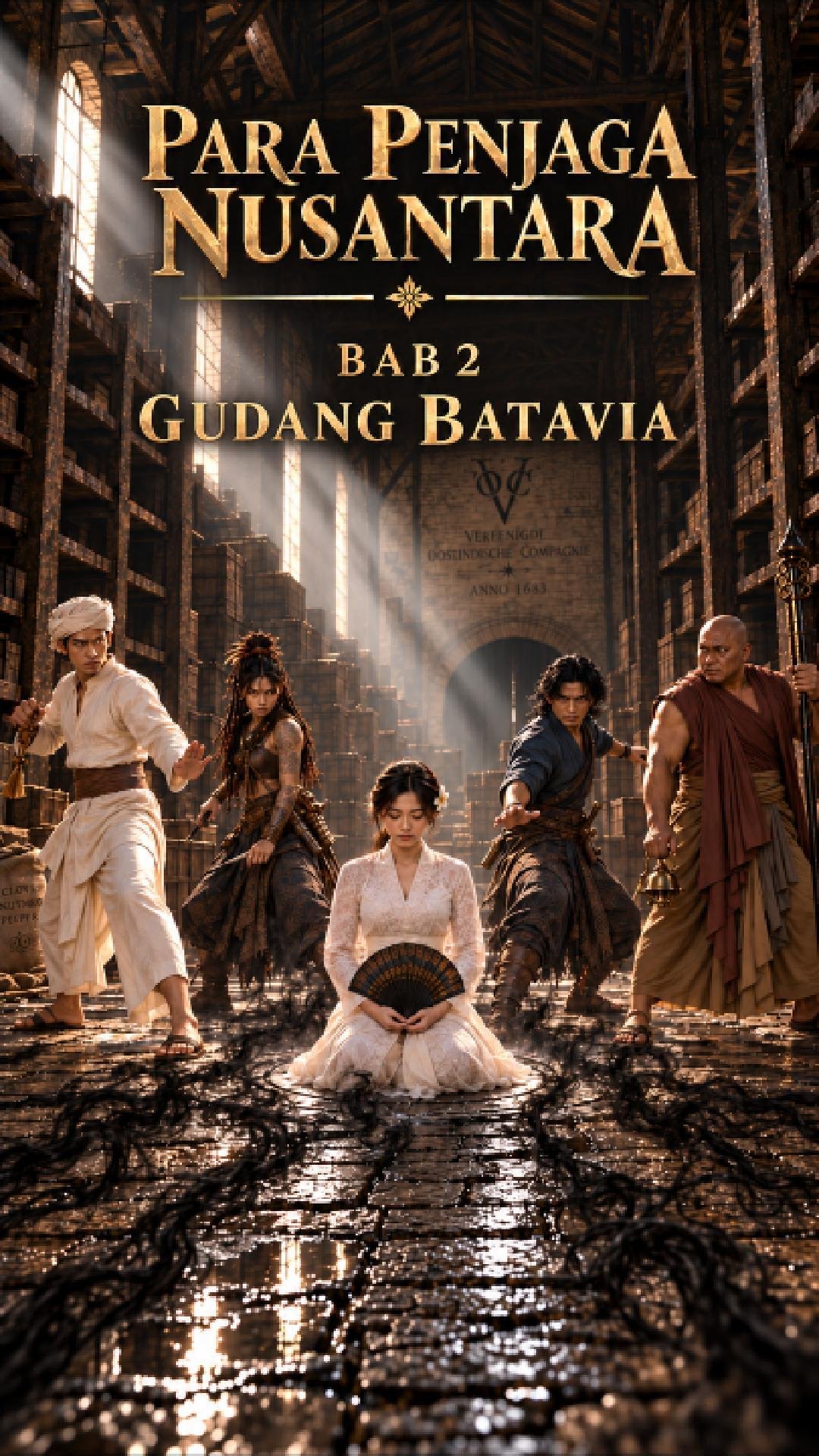
CHAPTER 2 · EPISODE 1/3
The Batavia Warehouse and the First Seal
The warehouses stood where Kali Besar1 ended.
Six of them. Built by the VOC to store spices2Catatan ↗, with thick stone walls and narrow windows, moss clinging to the rooftops and the stains of decades trailing down the brickwork like rain that had never dried. This close to the end of the canal, the sound of water was near, and the smell rising from it—Java’s mud, palm sap, cloves and pepper carried on ships from distant islands—had seeped into the stone itself. The building at the far end had clearly been abandoned for a long time. The padlock on its door had rusted to a deep red, and the rust had powdered and collected on the ground below—which meant no one had tried to open it in years. Or wanted to.
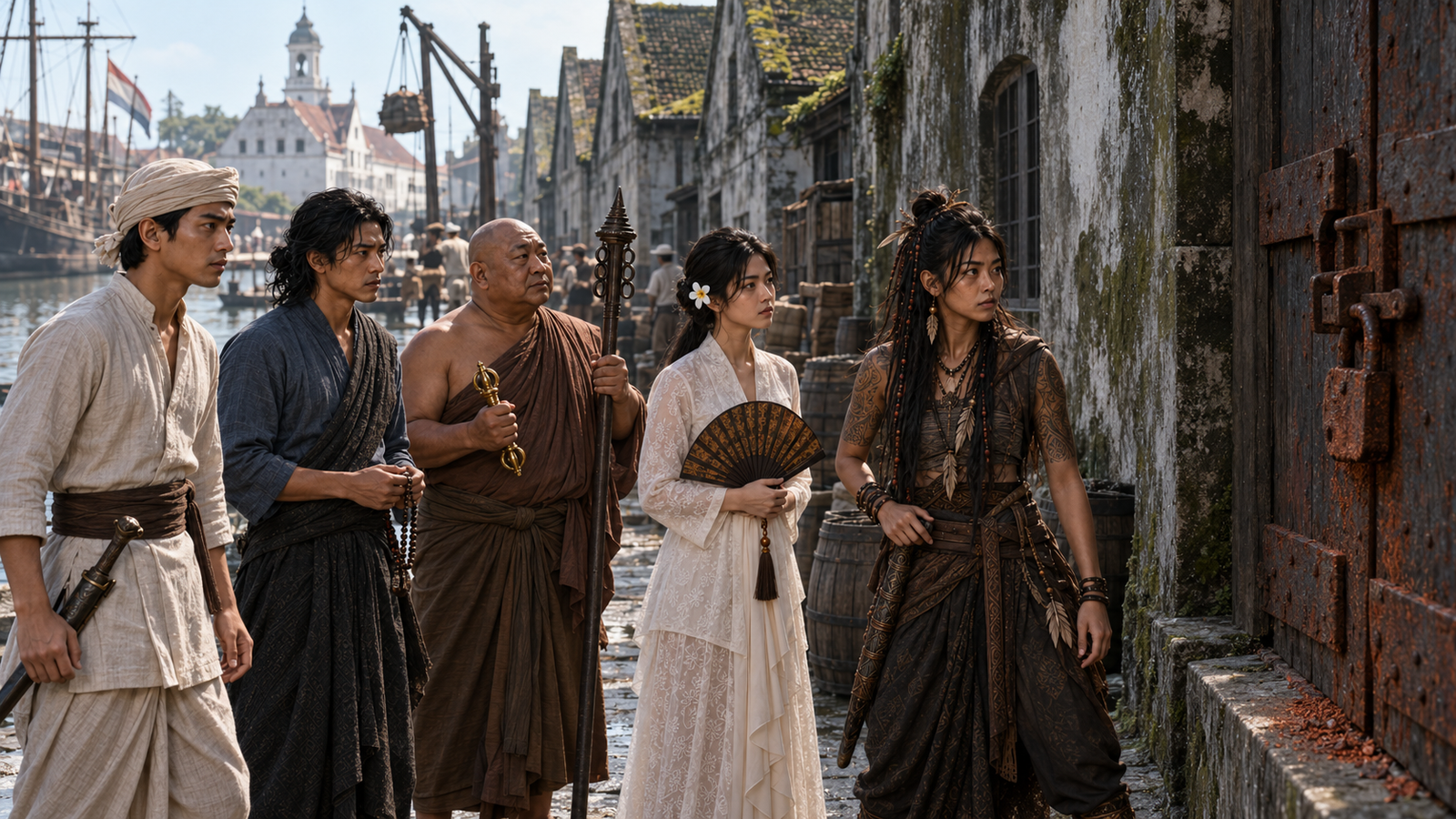
Intan smelled it first. The nose of a Dayak warrior raised in the jungles of Kalimantan. Dangerous places had a different smell—in the jungle and on the river both. What caught in Intan’s nose before this warehouse was the scent of something old and rotting, the smell that gathers when unseen things have been trapped in one place for too long. She put her hand on the mandau and looked at Dewi.
“This is it,” Dewi said. She held the Kipas Sakti against her chest and studied the warehouse. The morning light fell across Dewi’s pale, clear skin—she looked almost too luminous to belong in front of this decaying building. Her large, deep eyes were reading the warehouse. Reading the sekala—the visible world—and the niskala—the unseen spirit world—at the same time. The eyes of a medium.
“What’s inside?” Intan asked.
Dewi closed her eyes. In the brief silence, her expression shifted several times—and when she opened them again, her voice was quiet and precise.
“A seal. Something made of iron, driven deep beneath the floor. It has markings carved into it—European script mixed with Javanese patterns—and it is very old. There are many things trapped around it. Things that could not leave this city properly.” Dewi said.
“Very old?” Hasan repeated softly, turning his tasbih. Concern spread through his clear eyes.
“The seal is holding them. It’s been there a long time, so a great deal has accumulated. We need to pull the seal out—but when we go inside, the trapped things won’t be able to tell at first whether we’ve come to free them or not,” Dewi said.
“Meaning they’ll attack us?” Hasan asked.
“At first, they might,” Dewi said, plainly.
“How old is it—can you tell?” Intan asked, looking toward the warehouse door. Even from where she stood, the cold air leaking from the warehouse touched her face.
“Not precisely. But it’s about as old as this city itself—everything that has gathered in all that time,” Dewi said.
“Then there’s a lot,” Intan said, tightening her grip on the mandau.
“When was this city founded, Bhante?” Hasan looked at Surya.
“About sixty years ago. The VOC seized this harbor in 1619 and built the city around it. The land was here before that, of course—but that’s when things changed,” Surya said.
“Sixty years…” Hasan’s face became calculating.
“That’s a great many. The people who died in this harbor, the people who left this land with grievances unresolved—all of it has accumulated beneath the seal,” Surya said.
Arya said nothing. The Nagaraja was already vibrating toward whatever lay beyond the warehouse door.
Surya had been listening to all of this. He held the vajra in both hands—the same hands that had eaten four portions of nasi uduk, the same hands that had championed the difference three pandan leaves could make—but the way he held the vajra now was entirely different. This was not how a man held rice. The six rings on the tongkat candi chimed without any wind.
“Let’s go in. We can talk inside—standing at the door is as wasteful as letting nasi uduk go cold,” Surya said.
“Bhante, are you really making a nasi uduk comparison right now?” Intan looked at him.
“It’s not a comparison. It’s a fact. Standing at the door solves nothing, just like the pandan fragrance vanishes when the nasi uduk cools,” Surya said, his face entirely serious.
“…Let’s go in.” Arya was already walking toward the door.
Arya dealt with the lock.
One strike with the spine of the Nagaraja. The rusted padlock crumbled without a sound, red dust scattering, and when he pulled the door open the creak echoed all the way down the alley. Air came out. Cold—impossibly cold for a Batavian spring morning, as though it had risen from somewhere deep underground. And carried on that cold air was a smell, or rather the absence of one. Intan’s nostrils flared and she stepped back.
“The smell is wrong. It’s not a rotting smell—there’s no smell at all. That’s strange for a warehouse. Wood and stone should have a scent,” Intan said.
“The seal has been draining even the smell. It dislikes the scent of living things,” Dewi said.
“It dislikes the scent of living things?” Hasan repeated.
“Which means the moment we go in, it will know. Because we’re the things that carry scent,” Dewi said.
“So the instant we step inside, everything comes pouring out?” Intan asked.
“Probably,” Dewi said, evenly.
“‘Probably’ is somehow worse,” Intan said, lifting the mandau lightly.
Surya went in first. Tongkat candi in his left hand, vajra in his right, he walked into the darkness—and the silhouette of his back was so still and so solid that it was hard to believe it belonged to the same round-bellied monk who had been eating rice. The other four followed.
“It’s dark,” Hasan said, stepping inside.
“Your eyes will adjust. The light coming through the windows is enough,” Surya said.
“High ceiling. How much clove did they store in here to need ceilings this high?” Intan said, looking up.
“A great deal. Everything gathered from across these islands passed through here on its way to Europe. For decades,” Surya said.
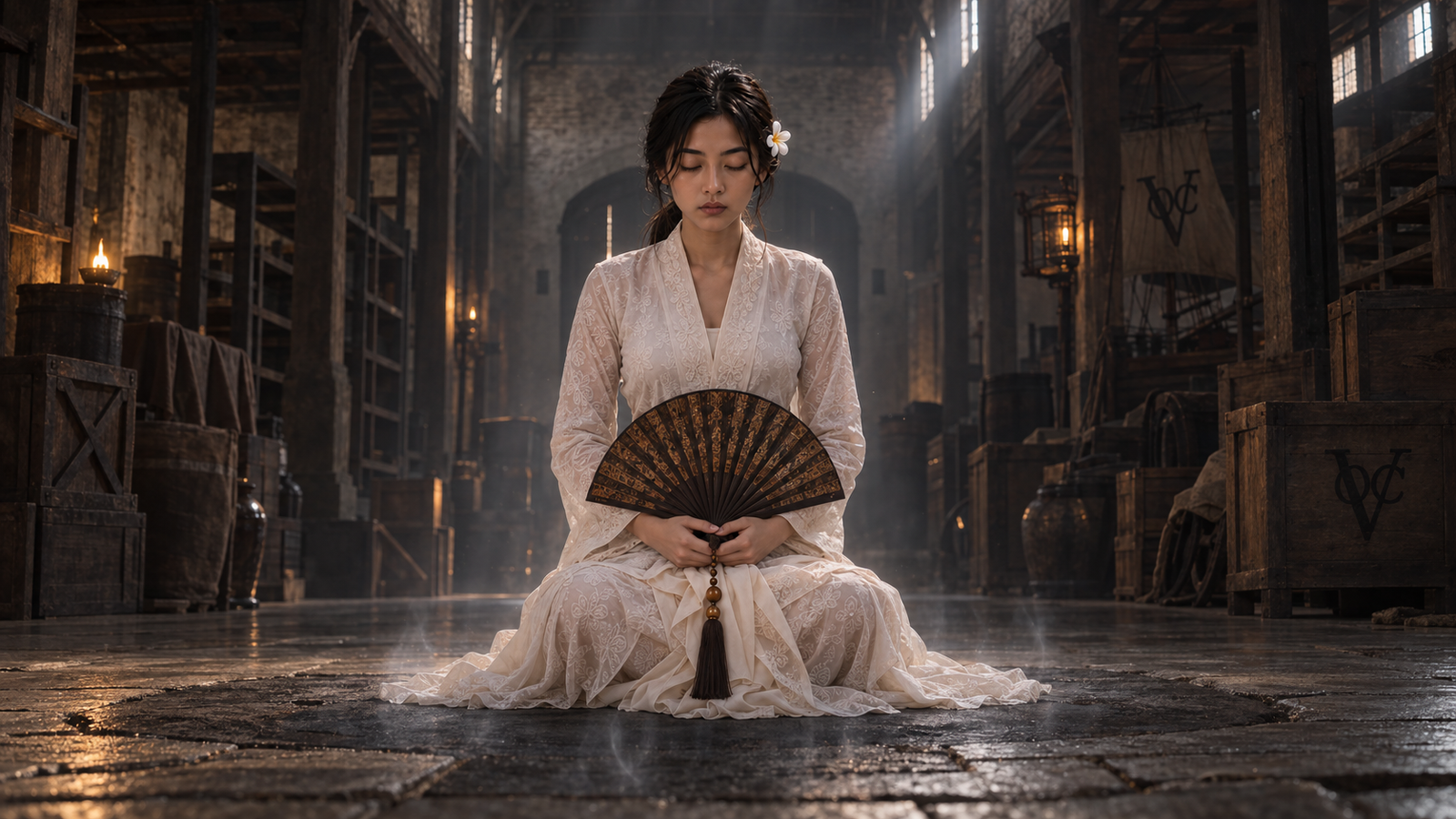
Dewi was reading the interior. Empty wooden shelves lined the walls, and stacks of hollow crates sat in one corner. The ghost-scent of cloves, nutmeg, and pepper that had once filled this place lingered between the bricks. The floor was stone. But the center of the floor was different. The color was subtly wrong—a difference invisible to ordinary eyes, but to Dewi it was vivid. The center stone was a shade darker.
“There,” Dewi pointed to the center of the floor.
Arya looked. The Nagaraja was vibrating strongly in that direction—but it was not the vibration of sensing a threat. It was the vibration of recognition, like encountering something of its own kind in the dark. Arya felt the tremor in his hand and said nothing.
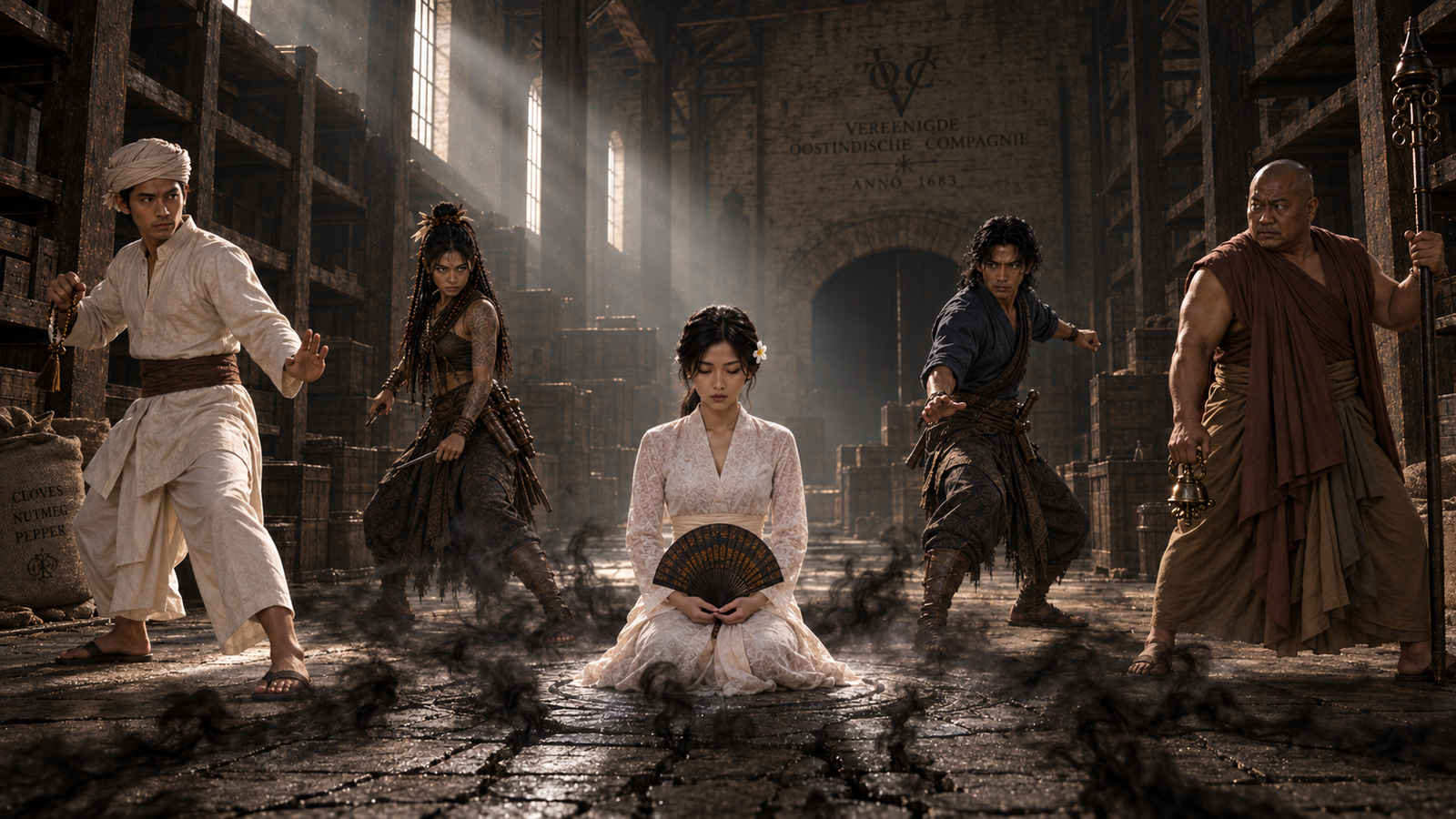
“Dewi needs to enter the spirit world and approach the seal. Hasan, take the left. Intan and Arya, guard the space around Dewi. When the seal senses her approach, the things trapped inside will come pouring out—you need to hold them off until she finishes.” Surya stood at the center of the five as he spoke.
“What about you, Bhante?” Hasan asked.
“I’ll take everything else. I prefer an open position—easier to move. Corners make me restless.” Surya held up the vajra with a grin. “Even at meals, I don’t like the corner seat.”
“Bhante, you’re taking on every remaining direction by yourself,” Intan said.
“I move best when all sides are open. Enclosed spaces are stifling—like eating in a corner. You can’t enjoy the food properly,” Surya said.
“Is this still about food?” Intan said.
“It’s a different way of focusing,” Surya said, his face showing not a trace of embarrassment.
“Dewi, has it already started?” Arya said.
Dewi looked at the center of the floor. The stone there had grown a shade darker since they entered.
“It’s started. We need to go in quickly,” Dewi said.
Dewi walked to the center and sat down. She held the Kipas Sakti in both hands, rested them on her knees, closed her eyes, steadied her breathing, and began chanting a mantra3. Her consciousness sank below the floor—her body remained in the warehouse, but the medium’s awareness was descending slowly into the darkness of the oldest seal.
Notes
1. Kali Besar
Kali Besar: Batavia's central canal, created by straightening the Ciliwung River between 1631 and 1632. VOC warehouses, shipyards, and trading offices lined both banks. The canal ran from the Sunda Kelapa harbor to the southern reaches of the city, and small vessels ferried cargo between the port and the warehouses. The Dutch called it de Groote Rivier—"the Great River."
↩ Back to text2. VOC Warehouses (Pakhuizen)
VOC Warehouses (Pakhuizen): the spice-storage buildings at the far end of the Kali Besar canal. Thick-walled and narrow-windowed, they held cloves, nutmeg, pepper, and other goods bound for Europe.
Read the illustrated Catatan Nusantara →
↩ Back to text3. Mantra
Mantra: sacred syllables or prayers chanted during ritual and meditation in the Hindu-Buddhist tradition. In these islands, Balinese Hindu priests (pedanda) employ Sanskrit mantras in their consecration rites.
↩ Back to text