

CHAPTER 6 · EPISODE 3/3
The Third Seal at Lake Toba
After leaving Kampung Tuga, they walked four more days between villages, with time for meals and rest. On the fifth day since leaving the southern shore they reached the northern side of the lake around midday. Sipiso-piso13Catatan ↗ fell about a hundred and twenty metres from the caldera cliff to the valley below; its water continued toward the lake.
Halfway down, the falls dissolved in the wind into mist, and that mist drifted down to the shoreline and touched their faces. Cold. The sound of the falls rang across the lake surface, and beneath that sound the lake was quiet. The water here was darker than elsewhere. Deeper.
Intan crouched at the water’s edge and put her hand in.
This time the primordial spirit came immediately. It had been waiting—that much was clear. It looked at the Dayak tattoos on Intan’s arm. It looked at the mandau. Then it looked at the five standing behind her. The spirit responded—and this time its response spread wider, reaching all six.
“Here,” Intan said.
“Begin. All five together. Abdul Rauf—please work alongside Hasan.” Surya nodded.
Surya stepped half a step into the water. It was cold, and it reached his feet. He took the vajra in both hands and closed his eyes toward the lakebed. What he had built on Mount Semeru flowed through the vajra and down into the lake—opening a path through the spirit world, wrapping the outside of the seal. So Dewi could enter safely. So it would not collapse.
Hasan knelt at the water’s edge and gripped his tasbih with both hands. Prayers passed down through centuries of Banten Islamic tradition. He aimed them toward the spirit world of the lake—applying what Abdul Rauf had taught him on the boat, directing them precisely—and sent the prayers down.
Abdul Rauf stood beside Hasan, his hands joined. Arabic ruqyah prayers flowed from him—twenty years of study in each line. Hasan’s prayer flowed into his, and the two merged and traveled across the water’s surface and down into the depths.

Arya drew Nagaraja. Light came. In the afternoon mist from the falls, that light spread. Arya pointed the blade toward the lakebed—toward the deepest point to the north. The light descended onto the surface and, where it touched, the water received it and trembled.
Dewi sat at the water’s edge, placed the Kipas Sakti before her, closed her eyes, and entered the spirit world. The direction was different from when she had sought out the begu—not up, but down. Down toward the seal in the lakebed. It was dark, but the path was visible. The primordial spirit was reaching through Intan from outside and opening the way, and the trembling of the mandau could be felt inside the spirit world.
Intan stepped into the water up to her knees. She drew the mandau—a blade made in the Dayak tradition, a blade that spans both the human world and the spirit world. She held the mandau horizontally above the surface, not touching the water.
The primordial spirit came. To Intan’s arm, to the mandau. Not cold. The primordial spirit was simply there.
Inside the spirit world, Dewi found the seal. Larger than the one in Batavia, more deeply set than the one in Palembang—but around this seal, there were traces of the primordial spirit having pushed against it for decades. Small fractures on the northern face, several of them.
When Dewi placed her hands on the fractures, the trembling of the mandau outside grew stronger. The primordial spirit was sending its last strength through Intan. What it had held in reserve for decades came all at once. Nagaraja’s light descended more forcefully onto the water, and the prayers of Hasan and Abdul Rauf seeped through the water into the spirit world, and what came from Surya’s vajra wrapped around the outside of the seal.
Dewi gripped the fractures and pulled. The primordial spirit pushed from inside, simultaneously. Exhausted, but moving in the same direction. Dewi pulled. The spirit pushed. The seal shuddered—

—and came free.
The lake shook. Water rang from the bottom upward. Not ripples. The entire lake rang. The surface went white and settled again, and the mist of the falls cleared all at once. Afternoon sunlight poured across the lake.
The mandau glowed. Intan had never seen that. The mandau was not a blade that glowed. But as the primordial spirit’s remaining strength poured through the mandau, a light came that was different from Nagaraja’s—redder, older in color. The color of the Kalimantan forest. That light spread across the water and, for a moment, met Nagaraja’s light—and then each went its own way and scattered.
The primordial spirit was gone. After decades, it had left the lake. What had been trapped was now free.
Dewi opened her eyes. Her breathing was labored, but it was different from Palembang—not torn away and dragged back, but something brought all the way through to its end. The hand holding the Kipas Sakti was trembling, but it did not let go.
Surya wiped the sweat from his forehead and stepped out of the water. Intan sheathed the mandau. Hasan straightened from his knees, and Arya quietly returned Nagaraja to its scabbard—Hasan watching with his eyes as the light inside it faded.
“This land is breathing.” Abdul Rauf finished his prayer and opened his eyes. Old eyes. Eyes that had waited twenty years. He looked at the lake and said it quietly.
The six sat on the lakeshore. The falls still rang, but now they were different—the old weight had gone, and it was simply the sound of water falling. Just water.
“The seal—is it released?” Surya asked, walking toward Dewi.
“Pulled.” Dewi answered. Her voice did not waver.
“Palembang?” Hasan asked.
“I can feel it weakening. The root has been cut. It’s still there—but fractures have formed now. We can enter.” Dewi read the niskala briefly as she spoke.
“The passage you were reading on the boat—do you understand it now?” Abdul Rauf sat beside Hasan.
“Prayer acquires direction through knowledge, you said—today, for the first time, I knew that in my body.” Hasan thought for a moment before he spoke.
“That’s it. What you know in your body cannot be forgotten.” Abdul Rauf nodded.
“I suppose what the tongue learns stays with us too. In the end, what the body knows is the true knowing,” Surya said.
Intan touched the water once more, her hand at the surface of the lake. Cold. But where the cold before had carried weight, now it was simply cold. Lake Toba was cold. This was how it was meant to be. She stood and said:
“The mandau glowed.”
“I know. The way Nagaraja glows when it meets a seal—the mandau seems to work the same way. There are things you don’t know until you go there.” Surya answered without any special ceremony, but Intan stood holding the mandau’s scabbard in her hand and thought for a long time.
“Whoever made the Toba seal understood the geology of this land. Not a simple practitioner of black magic—someone who has spent a long time studying the earth of this archipelago. And a practitioner of extraordinary power. The seal we all worked together to release was made and planted by one person.” Abdul Rauf paused, then spoke. Surya’s grip on the vajra tightened briefly.
“We need to understand where that knowledge originally came from. The remaining seals were likely built the same way,” Hasan said, quietly.
“Palembang is next,” Arya said, his hand resting on Nagaraja’s scabbard.
Silence. All three were right.
The parting was done before the sun tilted far. Abdul Rauf reached into his robe and brought out the scroll, then held it out to Hasan—with both hands, slowly.
“This scroll carries two things. One is what I wrote as I studied these seals—how certain Quranic verses operate against the structure of Acehnese black magic. The passages from a lifetime’s worth of Quranic interpretation that discuss the relationship between prayer and malevolent force. The other is my thoughts on King Solomon—on the methods by which he commanded the jinn and the wind. I believe this is not unrelated to the origins of this black magic, but I have not yet found the answer. You will have to find it.” He looked at Hasan.
Hasan received the scroll with both hands. It was wrapped in leather—and when he held it, he felt the weight of it. The weight of knowledge. He meant to say thank you, but his voice would not come.
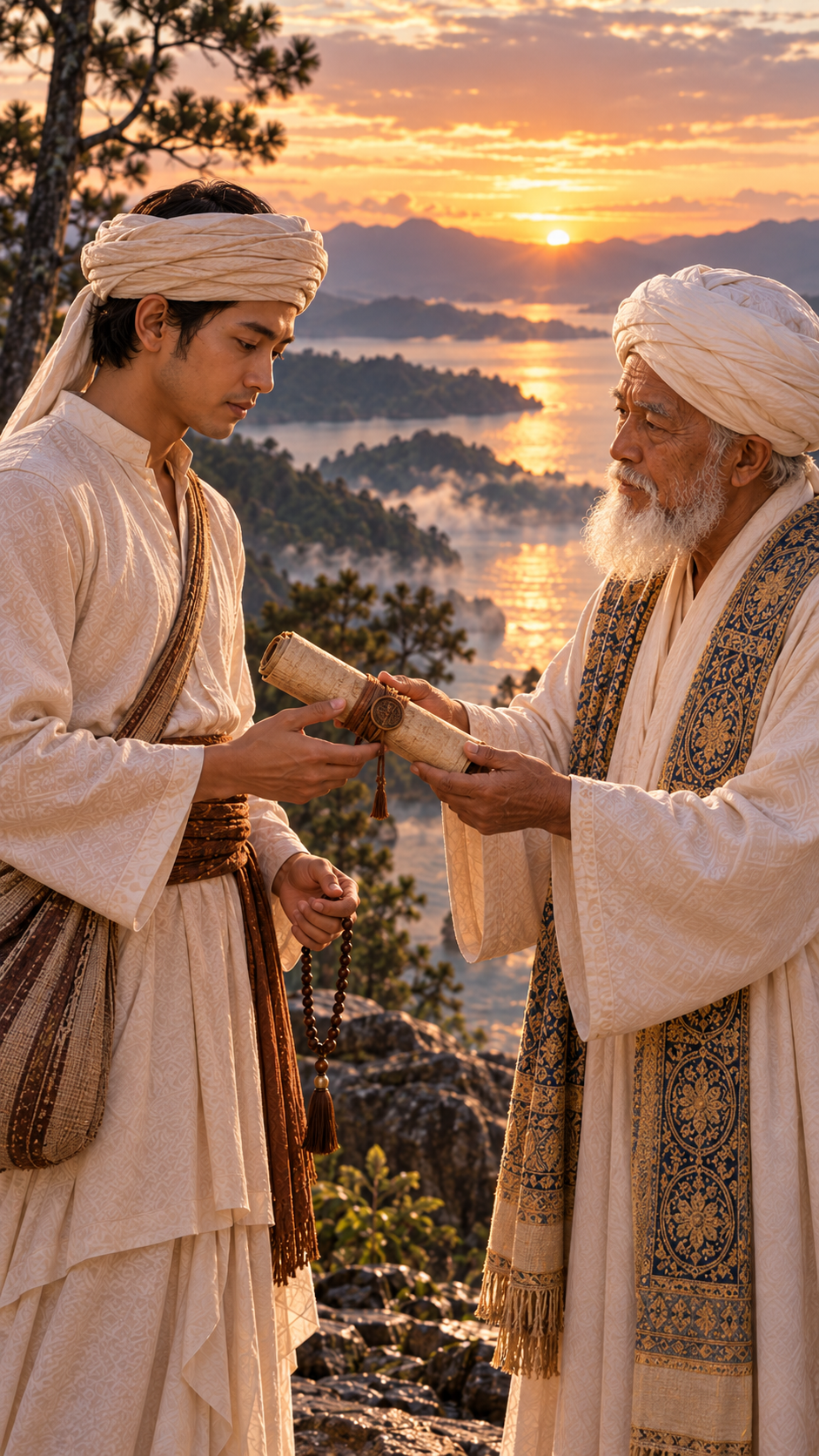
“Open it,” Abdul Rauf said.
Hasan unrolled the scroll to the first passage. Arabic. He began to read, and stopped.
The sentence was not unfamiliar. The fifth passage in the scroll his father had told him to read, in the early hours of the morning before his father left for the Banten Sea—it pointed toward the same thing. Not the exact same passage, but the same truth written another way.
His father’s scroll and Abdul Rauf’s scroll were looking at the same place. Hasan knew it. He could not explain it in words, but he felt it.
He pressed the scroll tightly in his hands.
“The vajra’s power is rooted in this land.” Abdul Rauf turned to Surya. “I am a scholar of Islam—but I know that your strength comes from the same source.”
“Different roads toward the same place, perhaps.” Surya bowed his head.
Abdul Rauf smiled and nodded.
“The mandau glowed. That means it is yours.” He said this to Intan.
“I know,” Intan said, her hand on the scabbard. Simply. There was no pride in it, and no unease. Just receiving it.
“The eyes that see two worlds are not a power. They are a responsibility. Use them well.” He said this to Dewi. Dewi nodded, and held the Kipas Sakti close against her chest.
To Arya, he said nothing—he simply looked. Arya looked back and nodded without a word. Abdul Rauf glanced at the scabbard of Nagaraja and nodded once more. That was enough.
Finally, he spoke to Hasan.
“I hope you find it. Whatever it turns out to be. You understand what I mean?”
Hasan bowed his head. Tears came. The hand holding the tasbih trembled once.
Abdul Rauf walked north, alone.
The white jubah moved between the pine trees and disappeared—slowly, the way things that are ending go slowly. His curved back was the last thing visible before the trees took him. Where he had been, afternoon sunlight fell for a moment, and then a wisp of cloud drifted across and withdrew even that light. The five stood there until he had disappeared entirely.

The lake shone behind them. Afternoon light lay across the surface, and except for the sound of the falls, everything was quiet—the kind of quiet that felt as though it had been there a very long time, and would be there again from now on.
“Let’s go. We eat first, then we leave.” Surya turned. “For Palembang.”
“Bhante—after pulling a seal, food is still the first thing,” Intan said, looking at him.
“Isn’t everyone hungry? It’s been a long while since we ate in Tuga.” Surya turned back and smiled, openly.
Hasan began walking, his tasbih moving through his fingers. Arya followed. Dewi looked back at the lake one last time. The primordial spirit was gone—the lake was just a lake now. A beautiful lake.
The five walked south.
Notes
13. Sipiso-piso
Sipiso-piso: a waterfall on the northern rim of Lake Toba, approximately 120 metres high. Water emerges from a cave in the caldera cliff and falls into a valley before flowing toward the lake; it does not drop straight into the lake.
↩ Back to text