

CHAPTER 7 · EPISODE 2/3
Suni and the Memory of the Musi
Sidakali9 stood where the side channel made one great bend. Twenty or so wooden houses on tall stilts lined the top of the bank, each with a ladder of steps running down to the water, and at the foot of every ladder one or two small boats lay tied. The tide was going out, baring the mud of the bank, and tiny crabs scuttled sideways across it, busy at something. The air was heavy and salt—the smell of a place where seawater and river water mix, and laid over it the grassy smell of nipah fronds drying and the smoke of rice cooking for the evening meal.
When the five of them climbed up the mud path, the people mending nets under the eaves raised their heads all at once. Wary eyes. Surya stepped forward and gave Nakhoda Usman’s name. At the sound of it, shoulders loosened a little. Soon a hard-built old man came down a ladder. He looked past sixty, but his forearms were thick and his palms were calloused from years of hauling nets. This was the village headman, Pak10 Lambo.
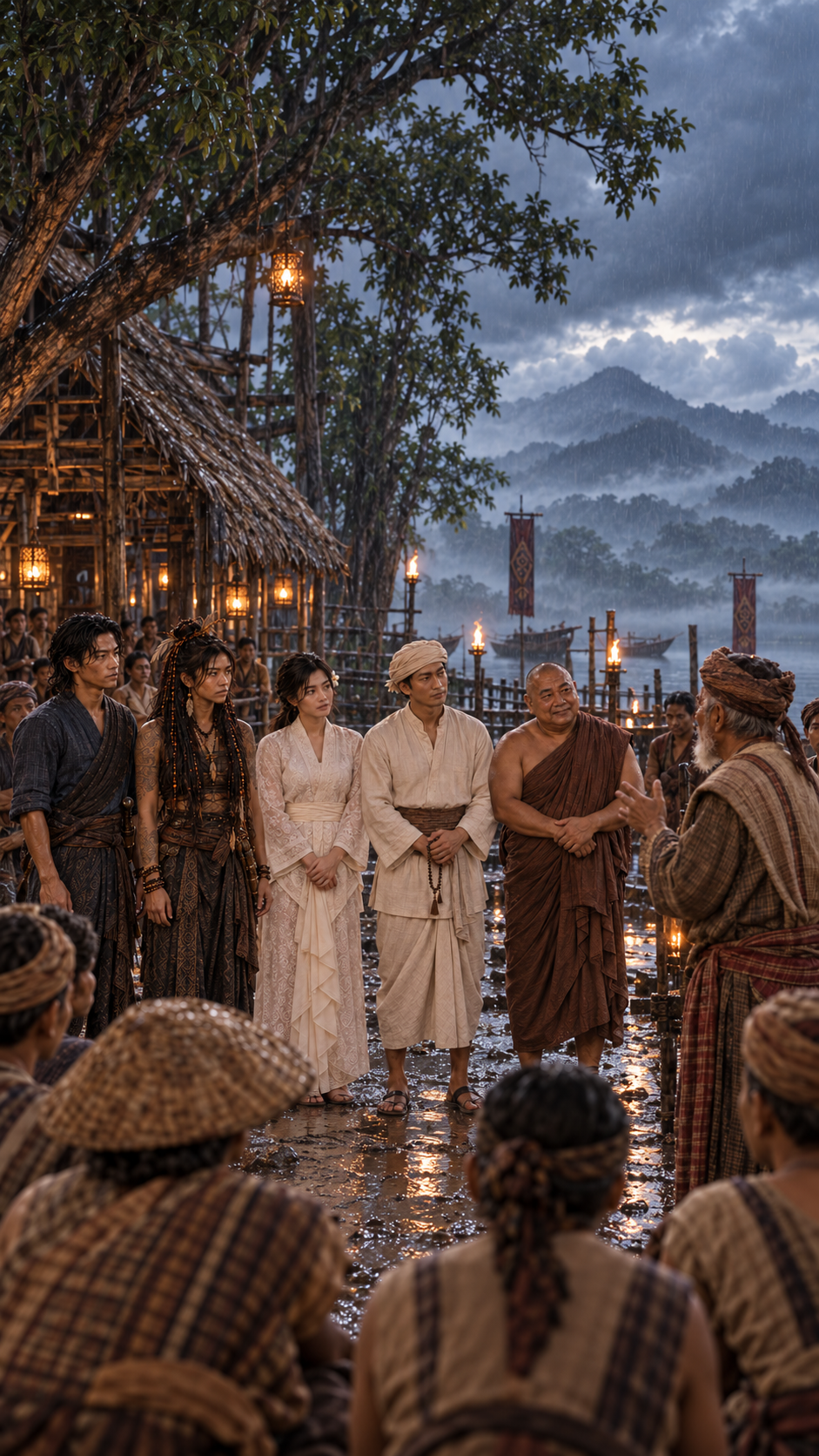
“Guests sent by Usman—come in, then. First time in ten years that man’s sent me guests. Usually he sends salt fish,” Pak Lambo said, looking them over one by one.
“We hope we’re a little less salty than salt fish,” Surya said, palms together.
Pak Lambo let out a short laugh and brought them into the house. Through the gaps in the bamboo floor the river showed below, and the lap of the water rose up from under their feet. Pak Lambo’s wife set out rice and braised fish without a word. But there was one strange thing. The sun had not yet set, and already the doors of the village were closing, one after another. There were no children’s voices.
“Bhante. Forgive me for troubling you at your meal, but don’t go down to the river tonight,” Pak Lambo said, setting down his spoon.
“What’s at the river?” Intan asked first. Her nose had been catching something ever since they entered the village: laid very thinly beneath the smell of the river, the smell of a cold, wet grief.
Pak Lambo looked at his wife. She turned her body toward the kitchen. He hesitated a long while before he spoke.
“The children wake up crying every night. At first it was one child. A girl, ten years old. She said someone kept calling her name in her dreams. In the dream she goes down to the river, and there’s a light floating on the water, and inside the light stands a man, soaking wet. Now eight of the twelve children in this village have the same dream. They say if they look toward the river from the window at night, they can see the light. But to grown eyes, there’s nothing there.”
“Has anyone died on the river lately?” Hasan asked carefully.
Pak Lambo looked at him. His eyes had gone wide.
“Three months ago. One of the village’s young men. Twenty-two. He misread the tide and went out to haul his nets, and the ebb swept him away. It took ten days to find the body.” He nodded toward the river. “Married only six months. His wife’s name is Suni. Suni still goes down to the river every night and calls his name. She goes in the rain, she goes in the wind. We try to stop her. It’s no use.”
Dewi set down her bowl. Then she half closed her eyes and reached toward the niskala on the river side. A moment later, she opened them.
“Her husband is still there. Standing among the mangroves on the far bank,” Dewi said quietly. “He isn’t something evil. He isn’t angry, either. He just can’t go. Because Suni calls him every night—because he can hear her calling—he can’t go. How could he turn his back on his wife when she’s crying like that? But when someone stays on this side too long, what’s left of him pools in the village. Children’s eyes are thinner than grown-ups’ eyes, so they can see it pooling. He isn’t calling the children. The children are seeing him.”
“Then the children aren’t in danger?” Pak Lambo asked. His voice cracked. One of the eight children was his granddaughter.
“Not now. But leave it long enough and they’ll lose their sleep, and when they lose their sleep, their bodies suffer,” Dewi answered.
“Then what must be done? Do I send for the datu? Do I send for the imam?” Pak Lambo looked from one of them to the next.
Surya looked at Hasan. Hasan nodded and closed his hand around his tasbih.
“Pak, this isn’t a matter of driving anyone out,” Hasan said calmly. “In our teaching, when a person dies, the soul goes to barzakh11 and waits there for the Last Day. But the people of this land have told stories, since long, long ago, of souls that cannot leave. I can’t tell you now which of the two is right. But one thing I know for certain: it is always right for the living to pray for the dead. And I don’t think this will be finished by prayer alone. I think there’s something Suni needs to say herself.”
Pak Lambo looked at Hasan for a long time, then slowly nodded. Outside, the sun was dropping behind the nipah forest.
Suni was sitting on the lowest step of the wooden ladder at the river’s edge, the water up to her ankles. Her wet hair clung to her shoulders, and on her knees lay a worn sarong, folded—a man’s, by the look of it. Over the river, emptied by the ebb, the evening mist lay low. The mangroves on the far bank had become a single black mass.
Surya went down the ladder and sat two steps above her. Not too close, not too far. Suni turned, startled. A monk she had never seen.
“Sorry to startle you. I’m just a potbellied monk passing through,” Surya said. “Your village’s braised fish was so good I came out to let it settle.”
Suni looked at him a moment, then turned back to the river. She didn’t answer. For a long time, Surya too only watched the river. Then he spoke again.
“This sarong is your husband’s, isn’t it? From the way it’s folded, I’d say you fold it again every day. The corners are too straight.”

Suni’s hand stopped on the sarong.
“He took it off before he went out to haul the nets. Said it mustn’t get wet. Said he’d be right back, so hang it out to air.” She spoke with her eyes on the river. Her voice did not shake. It was the voice of someone who had said the same words inside herself hundreds of times over three months. That made it heavier.
Dewi came down the ladder and sat beside Suni, on the same step. The hem of her skirt went dark in the water.
“Suni. I can see him too. Over there, where the mangroves part a little, someone is standing. Tall, his right shoulder sloping a little lower than his left. The shoulder of a man who hauled nets for a long time,” Dewi said.
Suni turned to her. For the first time, something stirred in her eyes.
“You can see him too? Nobody believed me. Everyone said I’d gone mad.”
“You haven’t gone mad. You only saw someone you love, standing there.” Dewi took Suni’s wet hand. “But Suni, do you know what his face looks like right now? He wants to go. He knows he has to go. But because you sit here calling him every night—because he knows you’re still not all right—he can’t bring himself to turn his back. It isn’t the river holding him. It’s your grief.”
“I’m holding him? Every day I tell him to go. I tell him I’m fine, he can go.” For the first time, Suni’s voice rose.
“Your mouth may have said that. But your face must have been saying something else,” Surya said quietly from above. “People trust a face before they trust a mouth. The dead even more so—their ears grow dim and their eyes grow bright. Every day he’s been reading ‘don’t go’ on your face.”
Suni bit her lip. The hand gripping the sarong went white.
“If he goes, what do I do? Who will ever wear this sarong again? What am I supposed to live for here, alone?”
Before Surya could answer, Hasan came down the ladder. He knelt in front of Suni, on the step under the water. His wet trousers clung to his knees, but he paid them no mind.
“Suni, I come from Banten. My father went out to sea too, and never came back. Four years ago,” Hasan said. His voice was low and quiet.
“I haven’t been able to let him go yet. I don’t even know for certain where he is. So I can’t tell you I understand everything in your heart. But there’s one thing I can tell you. Letting go doesn’t mean forgetting,” he went on. “In our teaching, when those who are left behind pray for the dead, the prayer reaches them. Instead of holding on to him, pray for him every day. Instead of calling his name at the river, put his name in your prayers. Then you won’t be alone. You’ll be someone who sends him something, every single day.”
Suni looked down at Hasan. His eyes were red. In them she saw the same thing that was in her own.
“I thought I was holding on because I loved him,” Suni whispered.
“It’s because you love him that you can let him go,” Dewi said, holding Suni’s hand tighter. “Holding on isn’t love. It’s fear. What you’re afraid of is being alone, isn’t it? You mustn’t make him carry that fear for you. He needs to rest now.”
Suni looked at the river for a long time. The mist drifted slowly over the water. At last she stood. Holding the sarong to her chest, she stepped down into the river. The water rose to her shins. Facing the gap in the mangroves on the far bank, she opened her mouth. Her voice was very low and very quiet. All five of them heard it, and yet it felt like words they should not have heard.
“You can go. This time I mean it. I’ll be all right. No—I’ll try every day to be all right. Every day I’ll pray with your name in it. So go now. Wait for me there.”
Dewi watched it through the niskala. The young man who had stood among the mangroves walked across the water until he was in front of Suni. Close enough to touch if either reached out, yet neither did. He looked at her face for a long time. This time, Suni’s face was saying the same thing as her mouth. His sloping shoulder slowly straightened.
Surya drew out his vajra and cupped it in both hands. Without a sound, a golden light spread and settled over the mist. Still kneeling, Hasan recited a prayer in a low voice—the prayer for the dead. It was the prayer he had learned from his father, and for the first time he was reciting it for a stranger. On the steps above, Intan gripped her mandau, sheath and all, and smelled toward the mangroves. The cold, wet smell of grief was thinning, little by little. Arya stood on the topmost step, keeping watch toward the village.
The man looked at Suni one last time, and turned. Then he walked into the mist and was gone.
Standing in the water, Suni began to cry. Without a sound—only her shoulders shook. Dewi went down into the river and took her in her arms. Suni buried her face in Dewi’s shoulder, and only then did she cry aloud. For the first time in three months.
Hasan sat on the steps hugging his wet knees. He had not said a word since he finished praying. Intan came down one step and dropped heavily beside him.
“What you said back there,” she asked, looking at the river. “Was that for Suni, or for you?”
Hasan raised his head. Intan didn’t turn to him.
“Both,” he answered after a long while. “While I was telling Suni to let go, all I could think about was my father. Could I let him go? If I ever do find him, could I say ‘you can go’ the way Suni did? Honestly, I don’t know if I could. I don’t even know where or how he died.”
“You don’t know, so of course you can’t do it yet,” Intan said. “It took Suni three months. You’ve gone four years not knowing where your father is. But today you taught someone else how to let go before you’ve done it yourself. That’s enough. Later, when it’s your turn, I’ll sit next to you and give you back exactly what you said today.”
Hasan looked at her. Only then did Intan turn her head and meet his eyes straight on.
“Don’t worry. I’ve memorized it, not a word wrong. ‘Instead of holding on to him, pray for him every day.’ Right?”
“Some of that was Dewi’s,” Hasan said, smiling with a wet face.
“Then I’ll give that back too. With interest.” Intan stood and held out her hand. Hasan took it and got to his feet. Her palm was hard and warm, the palm of someone who had held a mandau for a long time.
That night, not one child in Sidakali woke.
The next morning, children came crowding into Pak Lambo’s yard, with the faces of children who had slept the whole night through. They found the potbellied monk at once and surrounded him. One of them poked Surya’s belly hard with a finger.
“What’s inside your belly, Bhante?”
“It’s a secret, but I’ll tell only you. In here is every delicious food in all these islands. When it jiggles as I walk, that’s the foods fighting over who gets the best seat.” Surya whispered it and made his belly wobble on purpose, and the children shrieked with laughter.
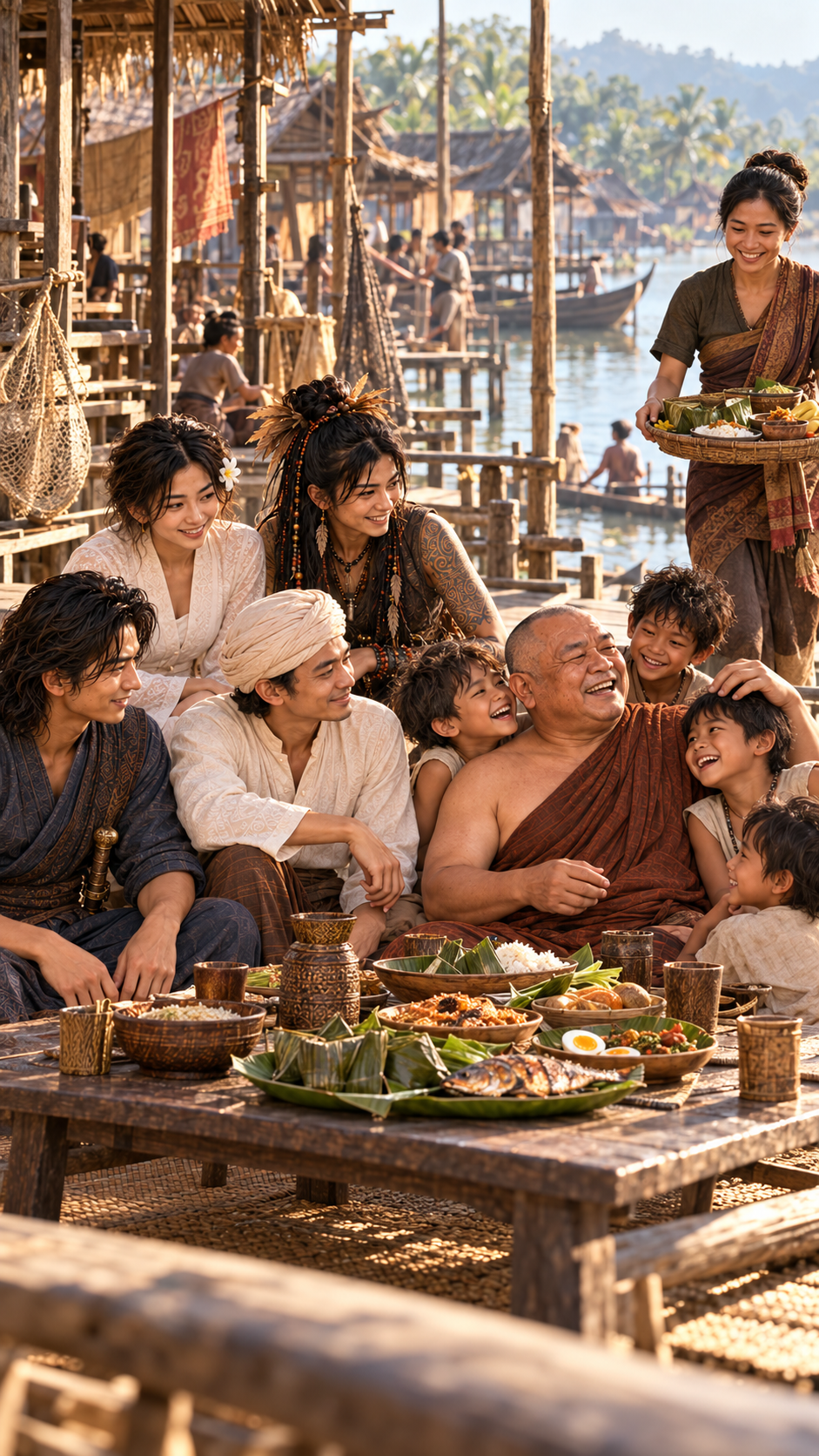
Suni came too, a basket of rice balanced on her head. Her eyes were swollen, but her hair was neatly combed back.
“Thank you for last night. Truly. I cooked the rice for all five of you myself,” she said to Dewi, setting the basket down.
“You didn’t go to the river this morning?” Dewi asked.
“I went. But this time I didn’t call his name. I only prayed and came back.” Suni paused. “And strangely, the river just looked like a river. Not frightening, not sad. Just the river where he used to haul his nets.”
Hearing her, Hasan turned his tasbih once. Suni bowed her head to him. Hasan bowed his. Nothing more needed to pass between them. Instead, Intan jabbed her elbow into his side.
“See? Your words got through. So eat a lot. If the one praying goes hungry, the prayer gets hungry too and can’t travel far.”
“That’s how Bhante talks,” Hasan said.
“Travel with Bhante long enough and everyone ends up like that. It’s a sickness.” Intan scooped rice onto her plate.
“I can hear all of that!” Surya called from across the yard.
Pak Lambo found them a boat. Its owner was his brother-in-law, Pak Darmano—a man past fifty, broad in the shoulder and thick in the arm, and sparing with words. For forty years, they said, he had gone up and down the Musi carrying fish and nipah thatch to Palembang. His boat was long and narrow, its prow tilted slightly upward, with an awning of woven nipah fronds amidships.
“To Palembang it’s a day and a half at the paddle. A day, if we ride the tide right,” Pak Darmano said, stowing their bundles under the awning. “When we pass Sungsang, all of you lie flat under here. They don’t look into river boats much, but you never know.”
The boat slipped out of the side channel and into the main stream. The Sungsang tower showed in the distance. The five lay flat beneath the awning and watched it through the gaps in the nipah. Before the palisade at the foot of the tower, a large ship from outside was being held. Among the men turning over her cargo stood a tall, red-faced man with a ledger, writing something down. Pak Darmano’s boat passed slowly in front of them. No one so much as glanced their way. Pak Darmano hummed a tune as he paddled, on purpose.
When the tower had disappeared behind them, the five crawled out from under the awning. Intan stretched.
“I felt like fishcake dough. Flattened.”
“Count yourself lucky to be dough. If they’d written us in that ledger, the five of us wouldn’t be fishcake, we’d be fish heads,” Surya said.
The river widened. The mangroves on either bank thinned and gave way to tall trees and rice fields. The water was the thick brown of mud. More boats appeared on the river, one after another—boats loaded with nipah thatch heaped like hills, bamboo rafts, little craft brimming with baskets of fish—all going up and down to the sound of paddles.
“Pak Darmano, forty years on this river—you must have seen it change,” Surya said from his seat at the bow.
For a long while, Pak Darmano only paddled. Then he said, low:
“The river’s grown heavy.”
“Heavy how?” Intan asked.
“The water catches the paddle differently.” Pak Darmano lifted his paddle and shook the water from it. “When my father paddled, he said the water pushed the paddle along. Now the water holds on to it. Same distance, and my arms ache more. The fish are fewer too. The other boatmen say it’s because I’m getting old. But I know. It’s the river that’s grown heavy.”
“Bhante, what kind of river was this to begin with?” Intan looked at Surya.
“That’s for Pak Darmano to tell, not me. This is his family’s river,” Surya said, opening a hand toward the boatman.
Pak Darmano looked at Surya for a moment. And for the first time, something like a smile passed across his face.
“My family has lived off this river for generations. My grandfather used to say that long ago, in the days of Srivijaya, this river was the center of the world. Chinese ships, Indian ships, Arab ships waited in line at the river mouth, and the banks were lined with temples roofed in gold.” He was looking upstream as he spoke.
“Then why did a kingdom that big fall?” Intan asked.
“Kalimantan folk don’t know even that?” Pak Darmano turned to look at her.
“In our forest they teach you why a tree falls. They don’t teach you why a kingdom falls,” Intan said, unembarrassed.
Pak Darmano laughed out loud. Then he stopped paddling a moment and looked at the river.
“Same as a tree. Let the wind keep blowing from outside, and it comes down in the end. After Majapahit12 hauled its warships up this river from Java, the golden roofs went out one by one. Then the Peringgi13 swallowed Malacca, and now the Kompeni have come. My grandfather always said: our river has never once fallen from within. It’s always been those who came from outside who brought it down.”
Hasan turned those words over for a long time. Banten had been the same. In his father’s generation, the Sultan’s own house had split apart, and through that crack the Kompeni had come in.
“Did your grandfather ever tell you about the Kompeni?” Hasan asked.
Instead of answering, Pak Darmano went back to paddling. But his strokes were slower than before. Surya noticed. So did Dewi. Dewi looked at Surya, and Surya gave the smallest of nods.
Around noon, the boat put in at a small landing on the bank. Pak Darmano said they would take on water and rest. On the bank beside the landing stood a stall of bamboo posts with a nipah roof. Steam rose from a pot, and on the steam a smell came drifting all the way down to the river: the deep, salty smell of prawn shells simmered for hours, laid over it the rich smell of coconut milk at the boil, and the sweetness of fried shallots.
Before Surya had even stepped off the boat, his nose had already turned that way.
“Lha—Pak Darmano, what is that? No, don’t tell me. Let me guess.” His nostrils flared. “Prawns. A great many prawns, boiled for a very long time. And coconut. But there’s no smell of fish. That isn’t fishcake.”
“Mie celor14. The noodles the river people eat for breakfast and again at noon,” Pak Darmano said, laughing.
The old woman at the stall dipped a handful of thick yellow noodles into boiling water, lifted them out, and set them in a bowl. On top she laid bean sprouts, then ladled thick broth over them from the pot. The broth was a pale orange, with little rounds of coconut oil floating on it. She added half a boiled egg and fried shallots, and scattered chopped celery leaves over all.
Surya took the bowl and spooned up the broth first. Then he froze where he sat. Once again, Intan waved a hand in front of his face.
“Bhante. Reborn again?”
“This time I wasn’t reborn. This time I died again. That’s how good it is.” He still held the spoon. “The broth is prawn itself. They’ve ground the prawn heads and put them in—that’s why it’s so deep. But the coconut wraps its arms around all that salt, so the tongue isn’t shocked. And these noodles—these aren’t rice noodles. This is wheat. Thick and chewy.”
“Wheat noodles is strange,” Hasan said, lifting some with his chopsticks. “Wheat doesn’t grow in this land.”
“The Chinese brought them. And over those noodles, the river people poured their own prawns and their own coconut. Chinese ships and this land’s river water, meeting in one pot,” Surya said.
“We don’t have broth like this in Bali,” Dewi said after carefully taking a mouthful, her eyes going round. “It holds the noodles so tightly.”
Arya ate without a word. But when his bowl was empty, he held it out to the old woman. One more, that meant. Intan saw and jabbed Dewi with her elbow. Trying not to laugh while swallowing broth, Dewi choked on it. Without any change of expression, Arya patted her twice on the back.
They left the landing and went on upstream. The afternoon sun shattered on the water. After paddling a long while, Pak Darmano spoke, though no one had asked him anything.
“Earlier the Banten lad asked whether my grandfather ever talked about the Kompeni.”
All five turned to him at once.
“He did. Only one story.” Pak Darmano kept his eyes upstream. “When my grandfather was young. He said it was around the time the Kompeni first opened a warehouse in Palembang and then shut it and left a few years later—so sixty years ago, give or take. A Kompeni ship came in, and off it stepped a man who was no trader. Very tall, hair that shone yellow, and a long scar down his left cheek, like a sword had opened it. That man hired my grandfather’s boat. Paid him in silver. My grandfather said it was the most he was ever paid for a passage in his whole life.”
Dewi’s hand went rigid on her knee. Hasan’s tasbih slipped from his fingers, and he caught it again. Surya’s face didn’t change, but his chest, where he kept the vajra, rose and fell once, heavily.
“The man told my grandfather to take him to a certain spot in the middle of the river. And strangely, he knew the spot without looking at any map. When the boat stopped, he took something big out of his baggage, muttered a long string of words nobody could understand, all by himself, and threw it into the river. My grandfather said it looked like a black iron stake. When it hit the water, the water didn’t splash. The water took it in as if swallowing it.” Pak Darmano’s paddle stopped. The boat drifted slowly back on the current.

“From that day on, my grandfather said the river had grown heavy. Nobody else felt it, only him. And until the day he died, he never cast a net anywhere near that spot,” he added.
For a long time there was no sound on the boat. Only the water slapping against the hull.
“Pieter van der Berg,” Hasan said, low. “The man Shaykh Abdul Rauf spoke of in Aceh. Tall, fair-haired, a scar on the left cheek. He said that right after the massacre at Banda, the man went about on Kompeni ships planting seals across these islands.”
“That’s the first I’ve heard the name. My grandfather just called him the yellow-haired ghost,” Pak Darmano said.
“Pak Darmano, do you know where that spot is?” Surya asked. His voice was lower than usual.
“Know it? My grandfather pointed it out to me more times than I can count. Upriver from Palembang, at the bend that looks straight at Siguntang Hill. The river swings wide there, like it’s drawing a deep breath.”
Dewi closed her eyes. Then she slowly opened them.
“Yes. That’s where I went in and got caught, months ago,” she said. “It was night then, I didn’t know where anything was. But hearing you now, I understand. At that bend the river’s strength gathers once and then flows on. If the river were a person, it’s the place where the heart beats.”
“The bend that faces Bukit Siguntang15Catatan ↗,” Surya repeated slowly. “He didn’t throw it just anywhere. Siguntang was the holiest hill the people of Srivijaya knew. Their kings swore their oaths on that hill, and on that hill they enshrined the Buddha. The place where the river’s heart beats, gazing at that holy hill—a place where the prayers of this land’s people have gathered for more than a thousand years. That man chose only the places where the spirit of this land pools deepest, and stabbed it there. Batavia, Aceh, Toba—every one. Not a single one was driven in at random.”
“Then how long did he study this land?” Intan asked. “To know the spot without a map.”
“He knew this land better than the people of this land. That’s the most frightening part,” Surya said.
Pak Darmano took up his paddle again. Then he turned to look at the five of them. On that face, burned dark by forty years on the river, there was, for the first time, the look of a man hoping for something.
“You’re going to pull out what the yellow-haired ghost threw in?”
“Yes,” Surya answered.
“Then I’ll bring the boat to the exact spot my grandfather showed me. The spot he avoided his whole life. And if you pull that thing out, I’ll be the first to cast a net there.” Pak Darmano drove his paddle deep into the water. The boat surged forward.
Notes
9. Sidakali
Sidakali: A village invented for this novel, set on one of the side channels of the Musi delta, not far from Sungsang.
↩ Back to text11. Barzakh
Barzakh: Arabic for “barrier” or “partition”; in the Qur’an (al-Mu’minun 23:100) it marks the boundary between this world and the Day of Resurrection, the place where souls wait between death and judgment. Orthodox Islam does not accept that the souls of the dead wander this world, but it teaches that the prayers of the living for the dead do reach them.
↩ Back to text12. Majapahit
Majapahit: A Hindu-Buddhist kingdom founded in East Java in 1293. In 1377, under King Hayam Wuruk—thirteen years after the death of his great minister Gajah Mada—a Majapahit fleet attacked Palembang and destroyed what remained of Srivijaya’s power. Chinese records tell that the city afterward fell into the hands of Chinese pirates under Chen Zuyi, until the fleet of Admiral Zheng He crushed them in 1407.
↩ Back to text13. Peringgi
Peringgi: What the people of these islands called the Portuguese, from the Arabic and Persian farangi, “Frank.” The Portuguese took Malacca in 1511 and lost it to the VOC in 1641. The same root lives on in Thai as farang, the word for Westerners to this day.
↩ Back to text14. Mie celor
Mie celor: Palembang’s signature noodle dish. Its name comes from the way it is cooked: thick yellow wheat noodles are dicelor, dipped again and again in boiling water, before a thick broth of prawn stock and coconut milk is poured over them, with bean sprouts, boiled egg, and fried shallots on top. The wheat noodles carry the trace of the Chinese communities who had lived along the Musi for centuries. When the dish first appeared is not recorded, and whether it existed in this form in 1683 cannot be said for certain.
↩ Back to text15. Bukit Siguntang
Bukit Siguntang: A low hill west of Palembang. A great granite Buddha, one of the most important relics of the Srivijaya age, was found on its slopes, and the hill was among Srivijaya’s holiest places. The Sejarah Melayu, the Malay Annals, names it as the place where Sang Sapurba, forefather of the Malay kings, descended to earth—the line that would go on to found Singapura and Malacca. That a seal lies buried in the river bend facing this hill is the novel’s invention.
↩ Back to text