
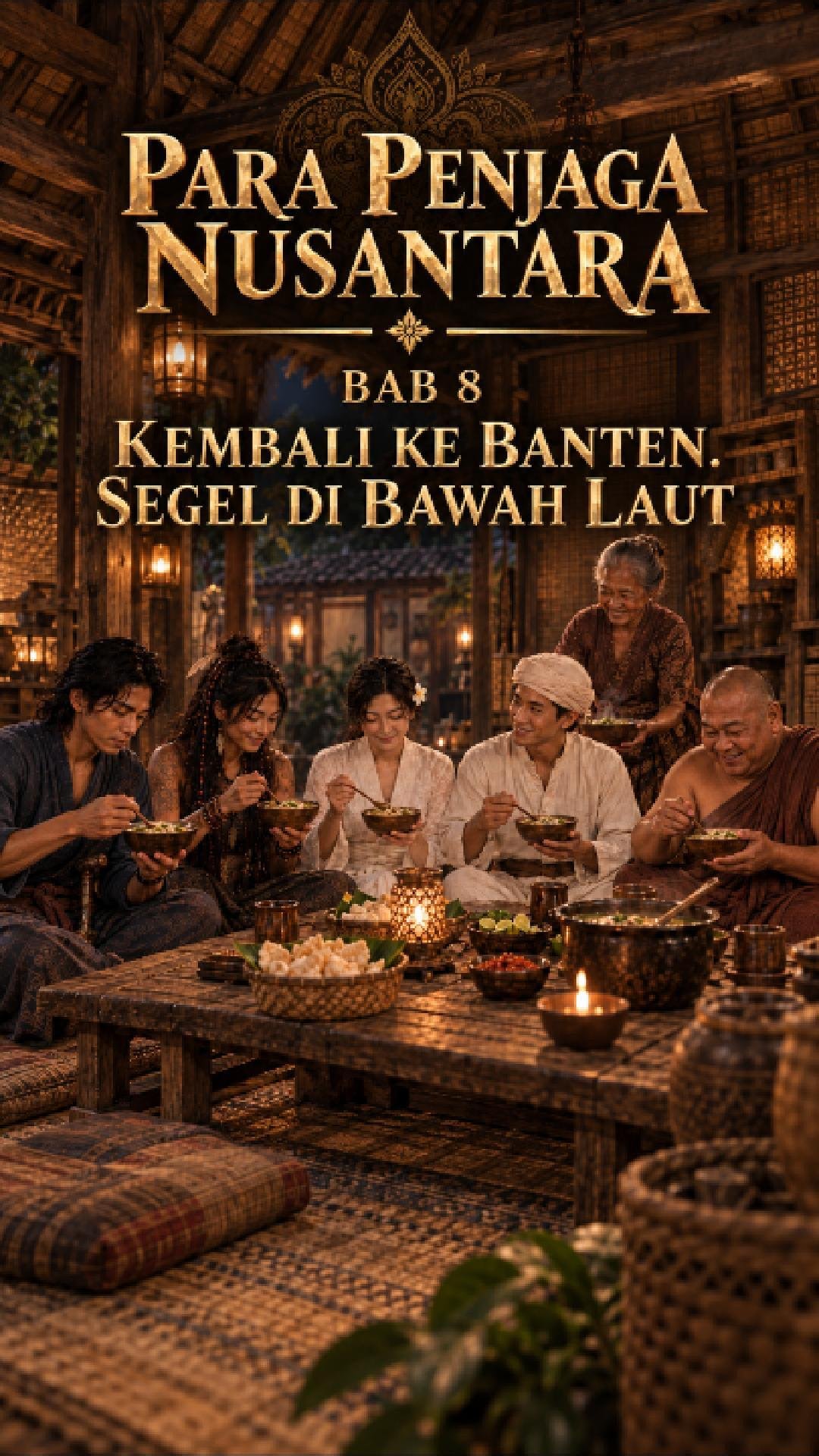
CHAPTER 8 · EPISODE 2/3
Home, Teacher, and Prayer by the Sea
The port of Banten was not the place Hasan remembered.
There were only a handful of ships at the Karangantu wharf. The building that had once been the English factory3Catatan ↗ stood empty, its doors torn from their hinges. On one side of the square before the harbor, a barracks for Kompeni soldiers had been put up, and in front of it soldiers from Batavia were playing cards. The market was open, but its sound was small. People bought and sold without meeting one another’s eyes. The air smelled of pepper—but far more faintly than the smell in Hasan’s memory.
“It wasn’t like this when I left,” Hasan said as he stepped onto the wharf. His voice was low. “This happened after Sultan Haji invited the Kompeni in. The son borrowed outside hands to beat his father. And now those hands have this port in their grip.”
“Hasan, are you all right?” Surya asked.
“I’m not all right. But I can walk,” Hasan answered. And he began to walk, leading the way.

He went through the market and into the lanes that ran along the Cibanten River4Catatan ↗. No one had to ask the way; his feet knew it. The five-tiered roof of the great mosque showed above the lane and was gone again. In front of an old wooden house by the river, Hasan stopped. Its eaves had sagged a little, and the grass in the yard stood knee-high. The door was shut, but not locked.
“Here. This is our house,” Hasan said.
He opened the door. There was a smell of dust. But the room was cleaner than he had expected. Someone had been coming by now and then to sweep and wipe. On the wall hung a board lettered in Arabic, and in one corner sat an old chest of books. Hasan stood in the middle of the room and for a long time could not move.
“Hasan? Is that you?”
The voice came from the doorway. It was the old woman from next door. Her back was bent and her hair had gone completely white, and she stood in the yard leaning on a stick. When Hasan turned, her face crumpled.
“It is. It’s Hasan, Teacher Yahya’s boy. Four years I’ve kept this house clean. I knew you’d come back.” She let go of her stick and pulled him into her arms. “If your mother were alive, she’d have been the first to hold you.”
Hasan held the old woman and could say nothing. His face was buried in her shoulder, and his back was shaking. The other four stood at the edge of the yard and watched. Intan turned her face toward the river. Her eyes were red.

That evening the old woman cooked for the five of them. From her kitchen came the smell of steaming rice—but not only rice. Over the sweet smell of sticky rice cooking lay the rich, toasty smell of coconut being dry-fried. She put the freshly steamed glutinous rice into a great mortar and pounded it. The thick, heavy thud of it carried all the way to the yard. She spread the pounded rice flat and cut it, then scattered toasted coconut over it with a generous hand. Beside it she set a bowl of beef gulai, stewed long and slow with spices.
“This is ketan bintul5Catatan ↗. When Hasan was small he loved it more than anything,” she said, laying a piece on a banana leaf before him. “Every evening in Ramadan, your mother made it.”
Hasan looked down at it. His hand did not go to it right away. After a long while, he picked up a piece and put it in his mouth. The sticky rice clung chewy to his teeth, and the toastiness of the coconut covered it. When he spooned up a little of the gulai to go with it, the scent of clove and nutmeg rose. Hasan stopped chewing.
“It’s my mother’s taste. Not exactly the same, but the same taste,” he said. His voice was wet.
“It couldn’t be exactly the same,” the old woman said, laughing. “When your mother toasted the coconut, she always threw in one more handful. Nobody can copy that.”
Surya took his share and ate a mouthful. Then he set down his spoon and pressed his palms together toward her.
“Nuwun sewu, Grandmother. This is what the sultans of Banten ate, isn’t it? Chewy sticky rice buried in toasted coconut, with a spiced gulai beside it. Humble, but it carries itself with dignity. A taste that came down from the palace all the way to the village kitchen,” he said earnestly.
“The reverend knows Banten food!” the old woman said, astonished. “That’s right. My mother used to say it was a favorite of the sultans of old.”
“I can tell where a dish comes from with my tongue. Forty years I’ve lived off this one tongue.” Surya stuck the tip of it out at her, and she cackled.

Eating her ketan bintul, Intan glanced at Hasan’s plate. He had stopped at his second piece. Without any change in her face, Intan moved a piece of gulai beef from her plate onto his.
“If it’s your mother’s taste, you have to eat a lot. If you leave some, Grandmother will be hurt.”
“You have a talent for feeding me with other people as the excuse,” Hasan said.
“Because you won’t eat with yourself as the excuse,” Intan answered.
The old woman looked from one to the other, then whispered something to Hasan in the Banten tongue. Hasan’s ears went red. Intan asked what she’d said, but to the very end Hasan wouldn’t tell her.
After the meal, Hasan asked the old woman where his teacher was. She pointed to the lane behind the great mosque. Since Sultan Ageng was taken, she said, Kyai6 Abdullah al-Bantani hardly ever went out.
Hasan said he would go alone. But Surya got up to go with him. This once, he said, it was only right to walk behind Hasan, who knew the way. The two of them went into the lane behind the mosque.
Kyai Abdullah was sitting in a small room. A single oil lamp was lit, and the Qur’an lay open on his knees. He was past seventy, white-bearded, with deep-set eyes. When Hasan stood at the threshold, the old man raised his head. He did not look surprised.
“You’ve come. I knew it the moment your tasbih entered this lane this evening,” Kyai Abdullah said.
Hasan knelt and kissed the old man’s hand. The kyai laid his hand on Hasan’s head.

“Kyai, Sultan Ageng—” Hasan couldn’t finish.
“I know. He went out at his son’s call, and that is what came of it. His only crime was a father trusting his son.” Kyai Abdullah closed the Qur’an. “Hasan. You didn’t come here to carry the grief of Banten, did you? You came to find your father.”
Hasan raised his head.
“The day your father left, I didn’t tell you everything about why he went out to sea. You were sixteen. Now I’ll tell you.” Kyai Abdullah glanced once at Surya, then looked back at Hasan. “At dawn that day, four years ago, your father said there was a place on the sea where the sound of prayer was being sucked down backward. Fishermen were disappearing near that place. And that same day, your father’s dearest friend disappeared as well. Your father took his scroll and went out to find his friend. He never came back. The boat he went out in came home overturned, and in it they found only this tasbih.”
“Do you know where that place is?” Hasan asked.
“The fishermen know. No one casts a net anywhere near it.” The kyai took Hasan’s hand. “But Hasan. Knowing the place is not the same as being able to enter it. Your father read more deeply than I do. A man like that did not come out. Don’t hurry.”
“You’re telling your student to be careful,” Surya said quietly.
“Reverend. Are you the one who leads this boy about?” Kyai Abdullah asked, looking straight at Surya for the first time.
“I don’t lead him. We walk together,” Surya answered, palms pressed together.
Kyai Abdullah looked at Surya for a long time. And then, for the first time, he smiled.
“A good companion. Hasan, don’t go alone. Your father went alone,” the old man said.
When the night grew deep, Hasan left the house. This time no one tried to stop him. The other four followed a little way behind. Past the estuary where the Cibanten met the sea, out onto the sand, Banten Bay lay black beneath the moon, emptied by the ebb. Low waves came in and drew back. The wind carried the smell of tidal mud and seaweed.
Where the waves reached the sand, Hasan took off his sandals. When his bare feet touched the wet sand, he closed his eyes. “Bismillah,” he whispered, and began, in a low voice, to recite the Ayat al-Kursi, the Verse of the Throne. His voice mingled with the sound of the waves. Once. Twice. On the third time, he stopped.
“Something’s there. But I can’t read it,” he said, eyes still closed. His voice trembled. “Down under that sea, someone is reading the same verse. Their rhythm matches my prayer.”

Dewi sat down beside him. A wave wet the hem of her skirt. Slowly, she opened the Kipas Sakti.
“I’ll go in. Into the seal,” she said.
“Then the spirit world is under the sea,” Arya said, taking a step forward. “Palembang was a river. This is sea. Deeper. Alone is dangerous.”
“That’s why I’m asking you, Arya. Call me, the way you did in Palembang. If I’m gone too long. That voice was the one I heard best.” Dewi looked up at him.
Arya looked at her. After a long moment, he nodded.
“I’ll call. I won’t wait long.”
Surya drew out the vajra and stood behind Hasan and Dewi. Intan drew her mandau and kept watch toward the sands. Dewi closed her eyes.
Notes
3. The English factory
The English factory: The trading post of the English East India Company at Banten, established by the Company’s first voyage under James Lancaster in 1602–1603, and one of England’s oldest footholds in Asia. For eighty years it was the VOC’s chief rival in the pepper trade. In 1682, after Sultan Haji took power with VOC help, the English were driven out of Banten; three years later they built a new post at Bengkulu, on Sumatra’s west coast.
↩ Back to textCatatan Nusantara: Karangantu, Cibanten, and the English Factory →
4. The Cibanten River
The Cibanten River: The river that runs through Banten Lama before emptying into Banten Bay. The Surosowan palace and the great mosque stood close to its course, and along it small boats carried the produce of the interior down to the port city.
↩ Back to textCatatan Nusantara: Karangantu, Cibanten, and the English Factory →
5. Ketan bintul
Ketan bintul: A dish of Banten. Steamed glutinous rice is pounded, pressed flat, and cut, then covered with serundeng, coconut dry-fried with spices, and eaten with beef gulai or semur. Local tradition holds that it has come down from the sixteenth century and was a favorite of the sultans; today it appears almost only in Ramadan, sold before the breaking of the fast around the great mosque of Banten and in Serang.
↩ Back to textCatatan Nusantara: Ketan Bintul: Banten Flavours and Ramadan Memory →
6. Kyai
Kyai: In Java and Banten, the honorific for a teacher of great Islamic learning and virtue. Kyai Abdullah al-Bantani is a character invented for this novel, Hasan’s teacher. The nisba “al-Bantani,” “of Banten,” was borne by many real scholars from the region, but this kyai refers to no historical figure.
↩ Back to text