
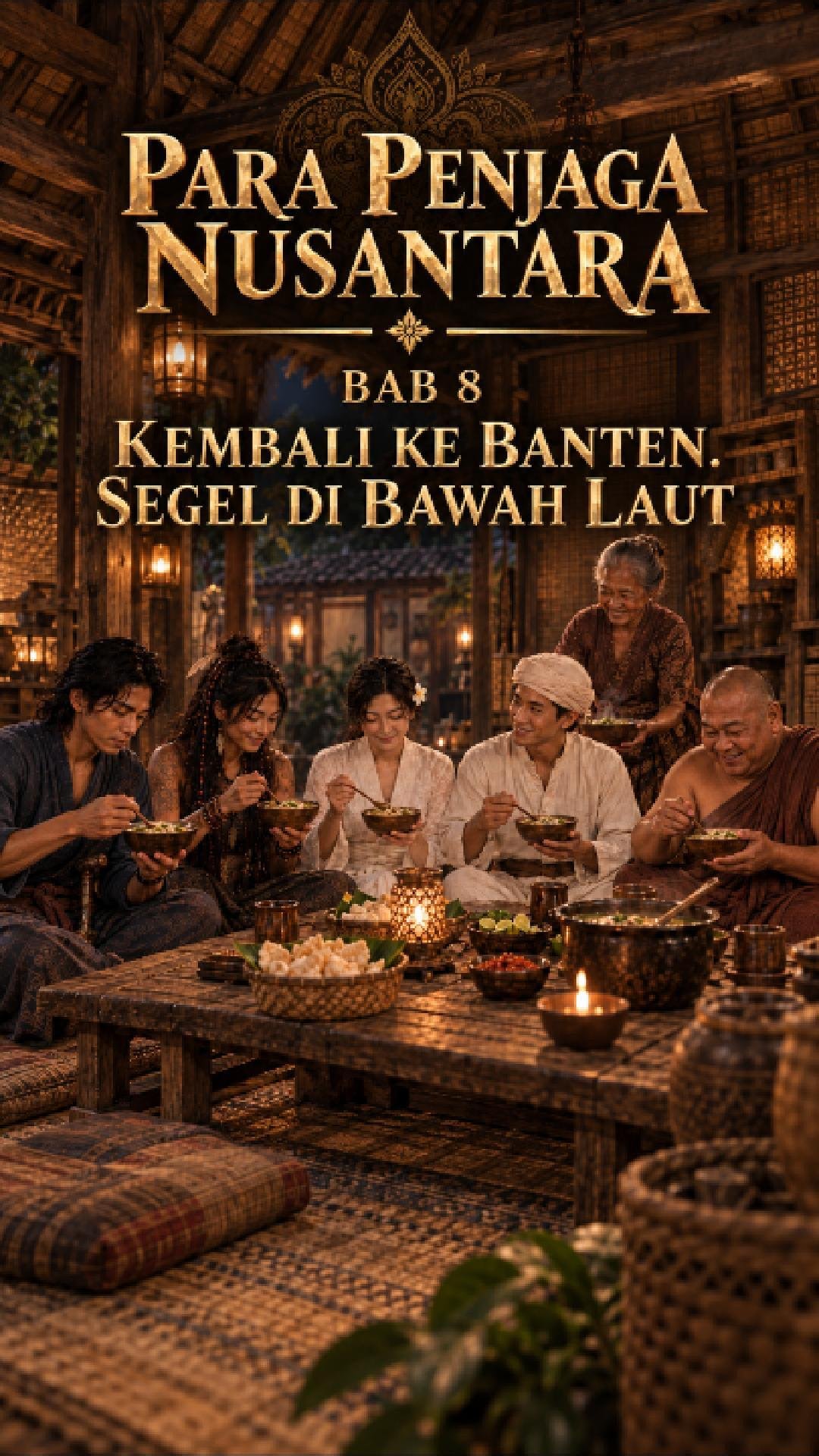
CHAPTER 8 · EPISODE 3/3
The Father Waiting Inside the Seal
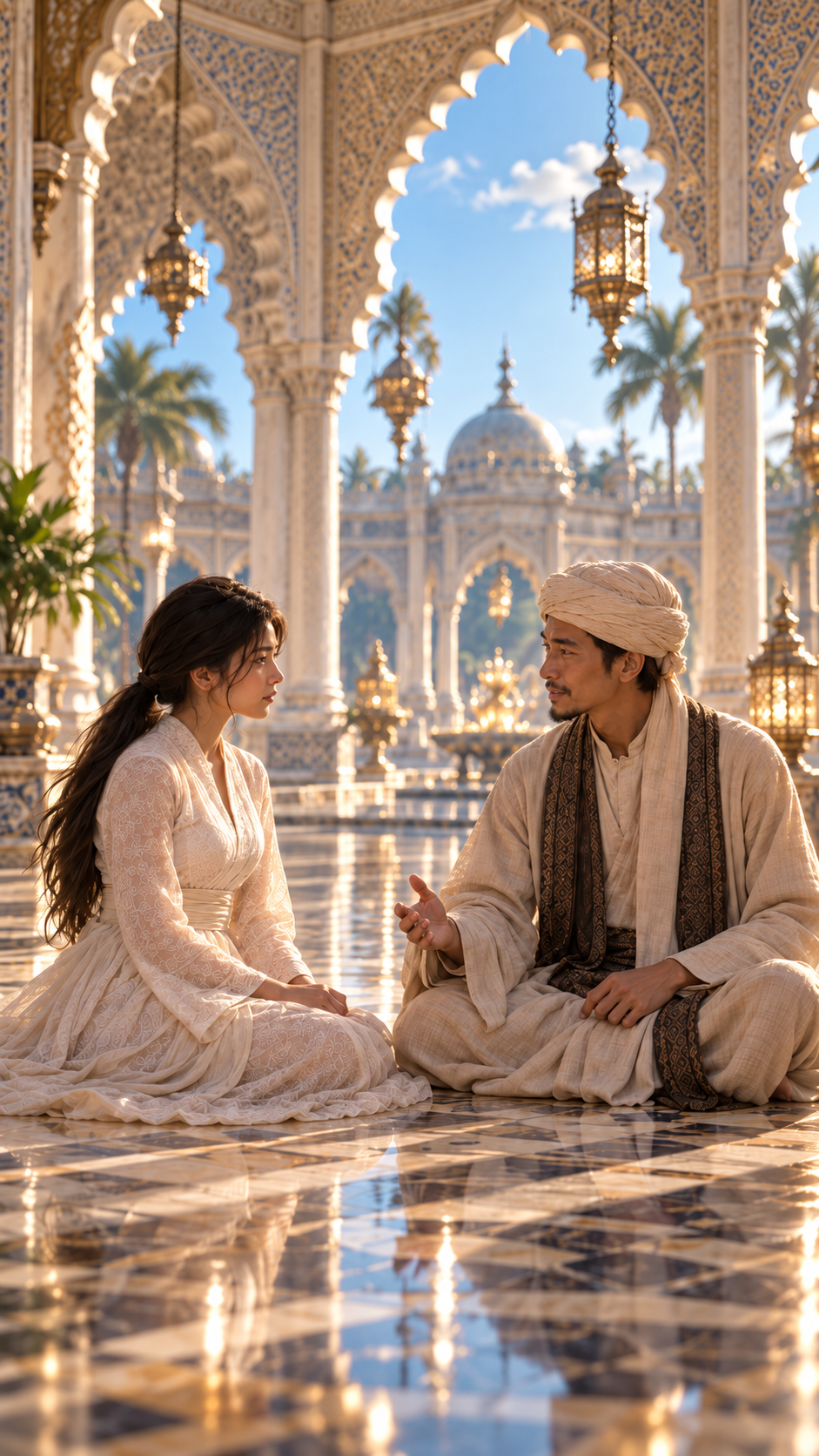
The spirit world Dewi went down into beneath the sea was not dark.
She had braced herself for a cold, narrow darkness, but light had gathered there. A wide courtyard paved with stone. The shade of coconut palms fell across it, and from far away came the lingering echo of the call to prayer. It was the forecourt of the great mosque of Banten. Yet it was not the real courtyard. It was a courtyard someone had built up out of memory, a little at a time, over a very long time. Beyond its edges, everything was black water. The black water surged in from every side to gnaw the courtyard away, and at its edges was pushed back, again and again.

In the middle of the courtyard sat a man. A scroll lay open across his knees, and he was reading something. His lips never stopped moving. Dewi’s footsteps sounded as she came near, yet he did not raise his head. He did not stop reading.
“Excuse me,” Dewi said.
Only after he had read the last line through to its end did the man look up. The set of his eyes was like Hasan’s. But what lived in those eyes was different—a stillness only those who have held on for a very long time possess.
“A living person,” Yahya said, after looking at her for a long while. “For four years I’ve watched what comes in here. All of them were souls coming apart. But you—you have no body, and yet your breath is warm.”
“My name is Dewi. I’m from Bali. I can draw my soul out of my body for a little while. My body is on the shore,” Dewi said.
“Who sent you?” Yahya asked.
“Hasan is on the shore. He’s reading the Ayat al-Kursi right now.”
For the first time, Yahya’s lips stopped. The fingers resting on the scroll trembled. Then his lips began to move again. He went on reading, very softly, like a man who must not let his prayer stop.
“So that was why. Now I understand why the prayer had two rhythms tonight,” Yahya said. “Is Hasan well?”
“He’s well. He’s courteous, he laughs easily, and he always looks after others first,” Dewi said. “And when he comforts someone, he tells them his own story. Even though it’s the story that hurts him most.”
Yahya closed his eyes. His face was full of other questions, but he held them back.
“You’ve come to pull the seal, haven’t you? Even in here, I’ve felt the five of you pulling them out one by one since Batavia. The seals are linked to one another. Every time one was pulled, this black water drew back a little,” Yahya said.
“Yes. This is the fifth,” Dewi said.
“This one can’t be pulled yet.” Yahya shook his head. It was the conclusion of a man who had thought about it for a long time.
“Why not? If the five of us together—”
“It isn’t that you lack the strength. This seal is not like the others.” Yahya laid his palm over the scroll on his knees. “This scroll is in here with me. In it is everything I read in my life—a record tracing where the knowledge of the man who made these seals came from, all the way to its root. Break the seal from outside now, and as it collapses it will scatter everything inside it. Me, and this scroll too. And there’s something more dangerous. This seal feeds on strong prayer, and it seizes the one who prays. It never let me go because my prayer was strong. Hasan’s prayer grows from the same stem as mine—you heard how our rhythms matched tonight. If Hasan pours his prayer into breaking this seal now, it will pull him in the way it pulled me. Not until he knows what to read so the seal can’t devour him. Never before. And even if the scroll survived, Hasan as he is now could not read it to the end. He has to know first where the seal came from.”
“Can you tell me where it came from?” Dewi asked.
“While I was reading Scripture, the seal answered to one verse. Very faintly, but without doubt. Verse 102 of al-Baqarah7Catatan ↗. The verse that says that in the time of Sulaiman, devils taught men sorcery, and that whoever sells himself to gain it has no share in the life to come. The man who made this seal is one who sold himself. With the knowledge he got in return, he planted it. That’s why the seal answers to that verse. They share a root.” He paused. “But what that knowledge truly is, the Qur’an doesn’t say. It says only that devils taught it. Four years I’ve read and read again in here, and I have not reached what lies beyond. What lies beyond is outside the Qur’an. Hasan is a boy who can read farther than I can. He has to walk this land and find what lies beyond. If he finds it and comes back, then the seal can be broken without the scroll scattering. Hasan will be able to take this scroll from my hands.”
Dewi held her breath.
“Tell Hasan. Verse 102 of al-Baqarah. Tell him to begin there,” Yahya said.
“I will. I promise. Is there anything else I should tell him?”
For a long while Yahya said nothing. He didn’t seem to be looking at Dewi, but at somewhere far away.
“That dawn, I knew it might be the last time. But I couldn’t bring myself to tell Hasan, and I left. He was sixteen. A boy who had already lost his mother, and I left him alone.” For the first time, his voice wavered. “For four years that has been the heaviest thing. Heavier than this black water. Tell him I’m sorry. And that not a single day went by without my thinking of him.”
Dewi could not speak.
“At first I held on in here to pass this secret to someone. I thought that once it was passed on, it wouldn’t matter if I came apart. But tonight Hasan is out there. He’s matching his rhythm to my prayer. And now I’ve grown greedy. I want to see that boy’s face, just once. I want to see him with my own eyes and tell him that I love him. I never once said it to him properly.” He breathed. “So I’ll wait. Until Hasan finds what lies beyond and comes back. I’ll go on reading in here.” On that still face, for the first time, there was a glint of wet.
“Should I tell Hasan that too? That you love him?” Dewi asked.
“No. I’ll say that myself. That way I still have a reason to wait.” Yahya smiled.
Just then, a sound came down from outside. Piercing the black water, a single voice, very low and very steady, called Dewi’s name. Yahya raised his head and listened to it.
“Someone is calling you. Go, quickly. Stay in here too long and your breath will grow cold too.” He turned his gaze back to his scroll. Then he added, as if to himself:
“So Hasan has come this far.”
When Dewi opened her eyes, Arya was kneeling right in front of her. His hand was reaching out, stopped just short of her shoulder. When their eyes met, he drew his hand back and slowly stood.
“I called. You were long,” Arya said.
“I heard. That’s how I got out,” Dewi said, catching her breath.
Hasan knelt before her. The hand gripping his tasbih had gone white.
“Dewi,” he said. The next word didn’t come.
“Your father was there, Hasan.” Dewi looked straight into his eyes. “He isn’t alive. But his soul is still there. For four years he’s been reading Scripture and holding himself together so he wouldn’t come apart. Tonight he heard you reading the Ayat al-Kursi. He said there were two rhythms.”
Hasan opened his mouth, then closed it. Dewi gave him Yahya’s words, one after another. That if the seal were broken now, his father and the scroll would scatter together. That if Hasan tried to break the seal with prayer, it would pull him in as it had pulled his father. That the key to opening the scroll’s last part was not yet inside him. That the seal had answered to verse 102 of al-Baqarah. That the maker of the seal was a man who had sold himself to devils. That what lay beyond was outside the Qur’an. That Hasan had to walk this land, find it, and come back.
And then Dewi paused.
“Leaving that dawn without a word—for four years, that was the heaviest thing for him. He said he’s sorry. He said not a single day went by without his thinking of you. And he wants so much to see your face himself. There’s something he wants to tell you, but he’ll say it himself. So that he still has a reason to wait.”
Hasan bowed his head. His shoulders shook. A wave came in and drew back. After a long while, Dewi added, very softly:
“At the end, he said it almost to himself. ‘So Hasan has come this far.’”
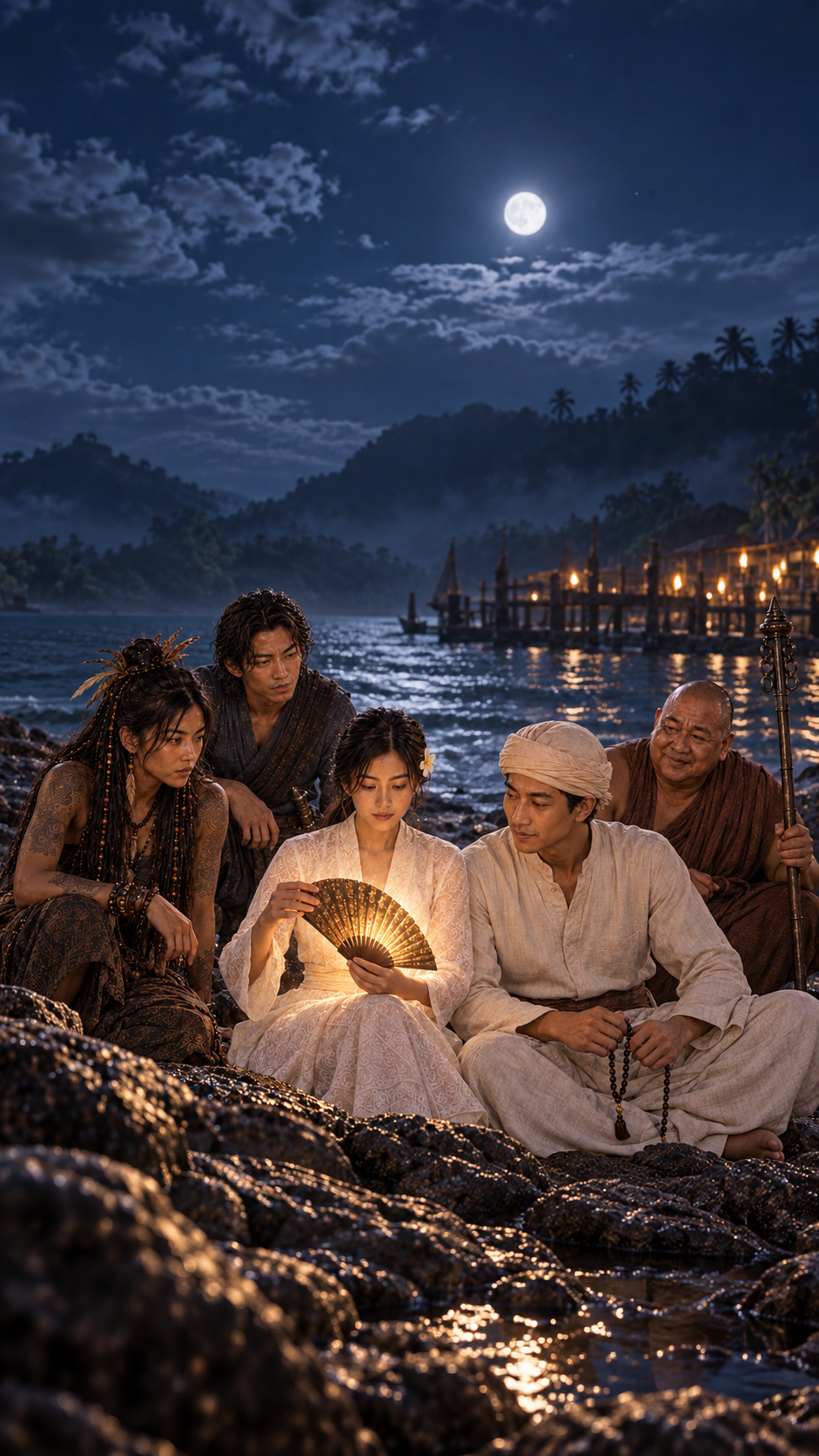
Only then did Hasan lift his head. His eyes were red. He drew the tasbih to his chest and held it tight.
The five sat on the sand. For a while Hasan only looked at the sea. At last he spoke.
“In Sidakali I told Suni, didn’t I? That letting go is love. That holding on is fear.” He swallowed. “But my father won’t go. Not before he sees me. That makes me glad. And it frightens me. If I can’t find what lies beyond, how long does he have to keep reading in that black water? What if I’m the one holding him? Like Suni?”
Intan turned her whole body toward him.
“Hasan. Look at me. In Sidakali I said that when your turn came, I’d give you back exactly what you said that day. But those aren’t the words to give back now,” she said. “Suni’s husband wanted to go and couldn’t. Your father is waiting because he wants to wait. They’re opposites. This isn’t holding on. It’s a promise. And a promise, you just keep.”
Hasan looked at her for a long time. Then he slowly nodded.
“Insha’Allah,” he whispered. Then, his voice wet: “You made that part up, didn’t you? It wasn’t in anything I said.”
“That’s the interest. You’ve had the loan a few days now,” Intan said.
Hasan laughed. Laughed while he cried.
“The seal in Banten’s sea is the fifth,” Surya said, looking out at the water. “And it’s the first one we’re leaving in place instead of pulling. But leaving it isn’t losing. Besides, we can’t lose Hasan to that sea. Your father holds on from inside, and we go find the key from outside. Inside and outside, together. In Aceh, Shaykh Abdul Rauf told us a prayer travels as far as you know. The more Hasan comes to know, the weaker this seal will grow from within.”
“Bhante, are you ever afraid?” Hasan asked.
“Of course. When the food is bad. And on nights like this one, when I’ve come out without checking whether there’s any of Grandmother’s ketan bintul left,” Surya said, laughing.
Hasan burst out laughing. Dewi laughed too. Arya didn’t laugh, but he sat down beside Dewi and asked, low:
“In there. Were you scared?”
“No. His courtyard was so warm I wasn’t scared at all. If anything, I didn’t want to leave,” Dewi answered.
“That’s why I called,” Arya said.
Dewi turned to look at him. Arya was looking at the sea. Smiling, Dewi hugged her knees.
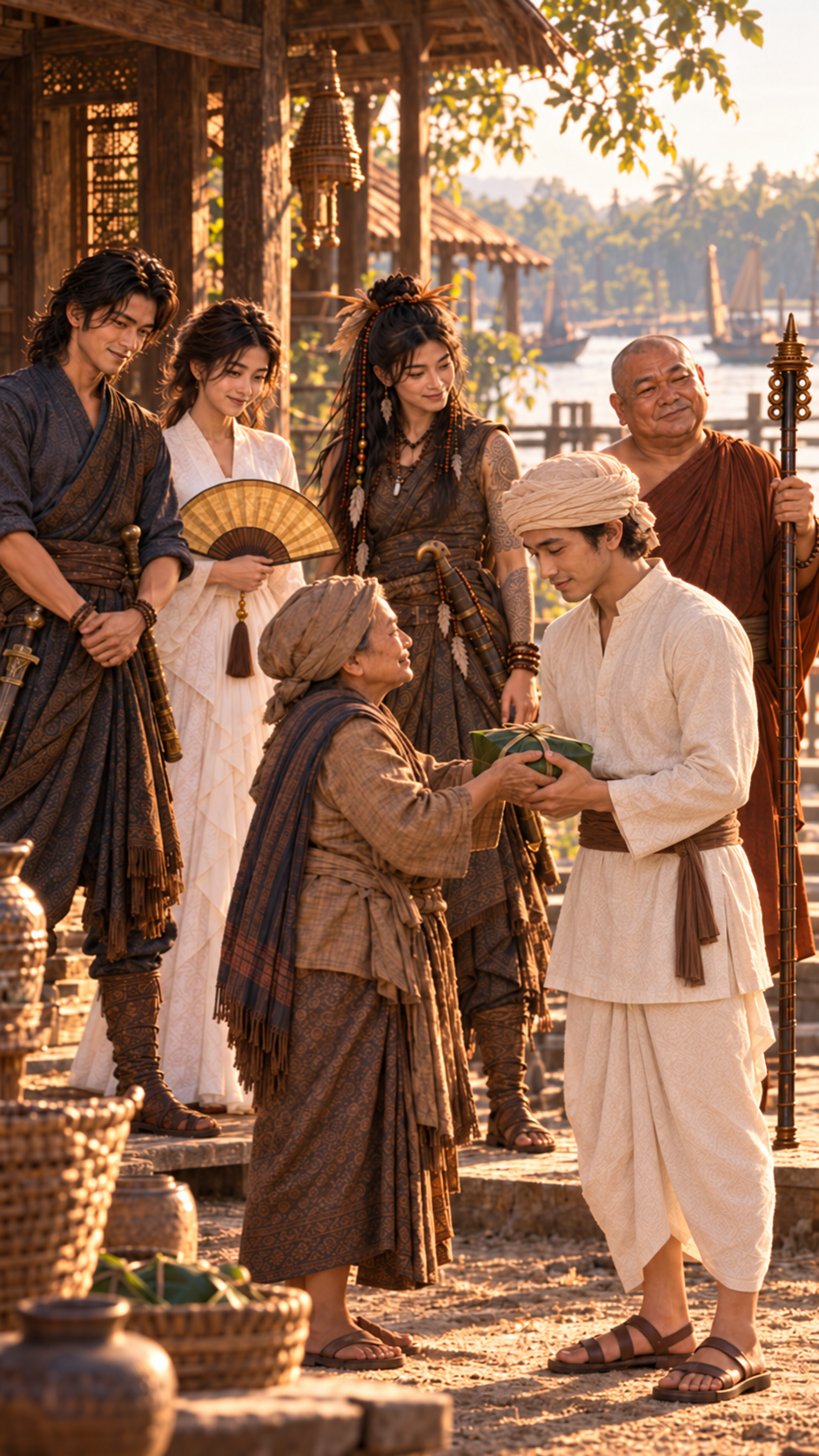
The next morning, the five left Banten. The old woman came out to her door and pressed a banana-leaf parcel into Hasan’s hand. The last of the ketan bintul. She whispered something to him, and Hasan bowed his head deeply.
Coming out of the lane, Hasan looked back once at the five-tiered roof of the great mosque. The morning sun had caught on its topmost tier. And beyond it, Banten Bay was glittering. Hasan looked at that sea for a long time. Then he faced forward and walked.
“What did Grandmother say?” Intan asked, falling in close beside him. “The same thing as last night, when your ears went red?”
“No. Something different today,” Hasan answered.
“What, then?”
“To come back with my father. She says then she’ll make two whole pots of ketan bintul.”
“Then one pot’s for Bhante,” Intan said.
“Both pots are mine,” Surya said from behind them. “I’ll order your father’s share separately.”
The five turned onto the road that led south, into the interior.
Notes
7. Verse 102 of al-Baqarah (Qur'an 2
Verse 102 of al-Baqarah (Qur’an 2:102): The verse declares that Sulaiman—Solomon—never practiced sorcery; it was the devils who taught it to men. It tells also of two angels at Babylon, Harut and Marut, who before teaching anything always warned: “We are only a trial, so do not disbelieve.” And it says that whoever buys this knowledge has no share in the life to come. Classical commentators read the verse as a hard boundary: such knowledge may exist, but its price is faith.
↩ Back to textCatatan Nusantara: Al-Baqarah 102: Knowledge, Trial, and Responsibility →