

CHAPTER 9-2 · EPISODE 1/3
Citarum and the Soldiers Who Never Came Home
They left Ratna’s village just as the sun cleared the rim of the valley. The headman walked with them as far as the edge of the village. In a single night he seemed to have aged several years, and yet his eyes had grown clearer. He took Hasan’s hand in both of his and shook it for a long time. Then he pointed east and said something.
“Two days east, he says, there’s a great river,” Hasan translated. “There’s a place where the river hides itself among the rocks—not there. A little farther upstream there’s a crossing by boat. If we give his name to the people who live there, they’ll take us over.”
“The river hides?” Intan asked. “How does a river hide?”
“He says we’ll understand when we see it. And near there, we’re not to go down to the water at night. Voices come out of the holes in the rock.”
“Why tell stories like that first thing in the morning?” Surya rubbed his belly. “We haven’t even eaten.”
“Bhante, the headman packed food for us.” Dewi smiled and held up the bundles. “Three of them, wrapped in banana leaves.”
“Then it’s all right.” Surya took one from her. “A frightening story is less frightening on a full stomach.”
At the top of the first rise beyond the village, Surya stopped. He slipped off his sandals and stood barefoot on earth still wet with dew. The morning soil of Priangan was cold and damp. He closed his eyes. When at last he opened them, the laughter had gone out of his face.
“East. Something heavy,” he said. “Not a seal. A seal drains the strength out of the land by force—you feel it pulling at the soles of your feet. This is different. This is pressed down. A great many things, all pressed into the earth at once, unable to move. Yesterday Ratna was one person. This is hundreds.”
“Hundreds?” Hasan asked. “You mean there’s a place where hundreds of people died at once?”
“I think so. And not so long ago. Fifty years, perhaps. Not yet a hundred.” Surya worked his sandals back on. “After a hundred years the shape comes loose and soaks into the ground. These are still holding on to theirs.”
Arya stood a long while looking at the line of mountains to the east. His hand rested on Nagaraja’s sheath, and the knuckles had gone pale.
“If hundreds died on this plateau fifty years ago,” he said quietly, “there is only one thing it can be.”
“You know?” Dewi asked.
“I’ll tell you at the river. It should be said where the river can be seen.” He started walking, ahead of them all.
On the afternoon of the second day, the forest ended and the river appeared. It was the Citarum1Catatan ↗. What they met first was not the river itself but its throat. Brown water that had been running broad and easy suddenly crowded between limestone cliffs and churned to foam, and one whole branch of the current was being swallowed into an enormous hole in the rock. The fall of water boomed out of the cave mouth. Between the booms came the wind, moving in and out of the cave with a low moan. It truly sounded like a human voice.
“The river’s being eaten,” Intan said, peering down from the edge of the cliff. “That hole is swallowing it.”
“Sanghyang Tikoro2Catatan ↗.” Dewi glanced at Hasan. “Hasan heard it from the headman. In Sundanese it means the Throat of the Gods.”
“Subhanallah,” Hasan murmured. Then: “The headman said that long, long ago, all the land up there was a lake, and every drop of it drained away through this throat. That’s why, even now, if you drop something in, you hear people screaming inside the cave. The things that lived in the lake are still down there.”

Surya set his bare foot against the rock at the cliff’s edge. Then he turned to Hasan, startled.
“The headman is right. I can feel it in my feet. The grain of this rock, where the water cut it, runs a long way upstream. That is the trace of an enormous weight of water pouring out this way for a very long time. The lake up there isn’t just a story. This rock remembers it.”
“So the place we’re going is the bottom of an old lake?” Intan asked.
“Yes. It will be shaped like a bowl—what’s left when all the water has gone. You’ll see it once we’re across.”
As the headman had told them, they followed the river upstream, above the throat. After an hour or so the cliffs fell away and the river widened. It was the dry season, and the water had dropped a long way. Wherever it had pulled back from the banks, dried mud lay bare in tiers, like stripes. The brown water moved slowly, but it was deep, and more than fifty paces across. A stand of bamboo rose on the far bank.
Arya stopped at the water’s edge. He watched the river for a long time before he spoke.
“Dipati Ukur3Catatan ↗. Fifty-five years ago, he ruled this plateau. Sultan Agung of Mataram commanded an attack on Batavia. Dipati Ukur gathered warriors from these highlands and marched for Batavia. They crossed this river and went north. Hundreds of them.”
“And lost at Batavia?” Intan asked.
“The whole army of Mataram lost. It could not get over the Kompeni’s walls. But Dipati Ukur did not go back to the Sultan. In Mataram, a commander who loses a battle loses his head. So he came back to this plateau and turned his blade on Mataram. Mataram sent an army to put him down. They fought for three years. Four. In that time, a great many people of this plateau died. In the end Dipati Ukur was taken, carried to Mataram, and executed. That is how the chronicles of Mataram record it.”
He paused.
“The man is gone. But his name stayed in the ground. The people here still call this land Tatar Ukur4Catatan ↗. The land of Ukur. The village of Bandung, where we sleep tonight, lies at the very center of it.”
“How do you know Mataram’s records so well?” Dewi asked.
Arya hesitated before he answered. He always did that before he spoke about himself—drew one breath, and steadied it.
“My father was an official at the kraton in Plered5Catatan ↗. He kept the records. I grew up in Plered. In his study, the war chronicles of Mataram were stacked up in scrolls. That is where I first read about Dipati Ukur. Back then it was the story of a rebel. A bad man who defied the king’s command. After Plered fell, I went to Kartasura with my grandfather. The scrolls all burned.”
“And your father?” Dewi asked, carefully.
“He died before that. Because of the records.” A short silence. “I’ll tell that another time.”
Dewi asked nothing more. Instead she took one step closer and stood at his side.
“Then tell me another time,” she said, low. “I’ll listen. You can go as slowly as you need. That’s how we did it for Ratna.”
Arya turned to look at her. Then he nodded, once.
On the bank stood a small hamlet of six houses. When Hasan gave the name of the headman of Ratna’s village, the faces around them softened. The village elder called over two young men. They righted two narrow dugouts that lay overturned on the bank, slid them into the water, and brought them side by side. Across both hulls they laid a broad mat of woven split bamboo and lashed it down hard with rattan cord. Either canoe alone was narrow and unsteady. Bound together, they made a deck as flat as a little yard.
“What do you call that?” Intan asked, studying the lashed boats. “We build something like it in Kalimantan.”
Hasan asked the elder. The old man smiled as he answered, and halfway through translating, Hasan’s eyes went wide.
“A bandungan6Catatan ↗. Two boats tied side by side are a bandungan, and setting them side by side is ngabandung. And the land across this river is called Bandung. Because people always cross it like this, with two boats bound together.”
“Bandung.” Surya turned the name over in his mouth. “Boats tied side by side. That’s how the land got its name?”
“So the elder says. There are other stories. Since this land was once a broad lake, some say the name means wide. But the people on this bank believe in the boats. It’s what they do every day.”
“One boat alone can overturn. Two bound together won’t,” Surya said. “A good name. The way the people live is folded right into the name of their land.”
Intan went over and tugged at the rattan that held the bamboo deck. It did not give at all.

“Good lashing. That’s the knot of someone who knows rivers. My adik tied them like this—the younger one at home. When I took the paddle, my adik would be down below, winding the rattan. It never once came loose.”
“You have a younger sibling?” Hasan asked. “That’s the first I’ve heard of it.”
“I do. Better at knots than me.” Intan shrugged. “Better at nothing else.”
“Hasan,” Surya said, turning to him, “isn’t there something like that in the Qur’an, or the hadith? About two being harder to overturn?”
“There’s a hadith7Catatan ↗.” Hasan smiled. “A man who travels alone is like a devil, two traveling together are two devils, and only three make a caravan. Alone, if you fall on the road, there’s no one to lift you up. With two, when one falls, the other may be too spent to help. But this river says two are enough to cross. It seems this river is a little more forgiving than the Arabian desert.”
“Then there are five of us,” Dewi said. “We have nothing to fear, in the desert or on the river.”
“Five makes a caravan in the desert,” Surya said, “and two and a half boats on the river. And regulars at any rice stall.”
“Two and a half boats?” Intan asked. “Who’s the half?”
“Me, of course.” Surya patted his belly. “I take up half a boat all by myself.”
The five of them climbed onto the lashed boats. From either end, the two young men pushed off against the riverbed with bamboo poles. The raft eased out toward the middle of the river. Brown water slid along beneath them. The farther out they went, the less the poles found bottom, until the young men drew them in and took up paddles. Each time a blade went under, it made a dull sound. The afternoon sun fell slantwise across the water, and yet, strangely, the middle of the river lay dark, as though something were casting a shadow there.
About halfway across, Intan’s nostrils twitched. She turned her head and looked down at the water.
“The smell has changed,” she said, low. “That’s not the river. Something that isn’t mud is coming up from below. Bones. The smell of human bones that have lain in water a long time. Like lime, and like rusted iron. In Kalimantan, after the big rains, when the old graves upstream wash out, you smell it. But this is far more than that.”
Surya took out the vajra. It was trembling, very faintly, in his hand.
Dewi let her eyes half close—the eyes that opened onto the niskala, the unseen world. A moment later, her lips began to tremble.
“They’re here. On the riverbed. So many. Some in armor, some gripping spears. Warriors. All of them down on the bottom. They can’t rise, and they can’t sink into the earth. They just stay.”
“Dipati Ukur’s soldiers,” Arya said, closing his hand around Nagaraja’s sheath. “Or the soldiers of Mataram who hunted them.”
“Something’s coming up. The smell is getting stronger. It’s coming closer!” Intan drew her mandau.
Ten paces from the boats, something surfaced. A mat. An old mat of woven bamboo, floating flat on the water. Its strips had gone black with soaking, and they rippled on the swell. It moved toward the boats. Against the current. It was not drifting. It was coming.
“Don’t let it touch the boat!” Hasan shouted. “It’s a lulun samak8Catatan ↗! A water ghost of the Sundanese rivers. It floats like a mat, and when it touches a boat, it rolls a person up underneath and drags them down!”
“How do you know that?” Intan asked, without taking her eyes off it.
“The Sundanese porters in the Banten market used to tell it to frighten children. Play in the river too long and the lulun samak will come and roll you up. I didn’t know it was real.”
The young boatmen screamed. One of them started to let go of his paddle. Hasan seized both of them by the shoulder, one in each hand.
“Don’t let go,” he said in Sundanese, each word clear. “If you let go, the boat stops. If the boat stops, that thing catches us. I’ll pray. Keep paddling. Just to the other side. Please.”
The young men looked into Hasan’s eyes. Then, with shaking hands, they took up their paddles again.
Hasan drew out his tasbih. “Bismillah.” He began to pray—a prayer of warding. The sound of it spread around the boats like a wall. Inside that wall, the water went still.
The mat stopped three paces away. And from beneath it, a hand rose. A hand swollen white with water. Blackened nails gripped the edge of the mat. One hand, then two. Five. Ten. From under the mat, more hands than anyone could count came reaching toward the boats. Water ran between their fingers.
“Cut off the hands!” Intan raised her mandau high.
“Intan, no!” Dewi caught her arm. “They’re not attacking!”
“They’re reaching the boat!”
“They want to hold on,” Dewi said, her eyes still on the niskala. “When they drowned in this river, at the very last, they reached out for anything at all. That last moment has been happening over and over for fifty years. If you cut off those hands, they’ll sink one more time with nothing to hold.”

Intan set her jaw and lowered the mandau. But the point of the blade stayed turned toward the mat.
“Arya, put Nagaraja into the water,” Surya said. “Just the tip. These men fought under Mataram’s orders. Whether they were Dipati Ukur’s or the ones who hunted him, every one of them once stood under Mataram’s banner. Nagaraja is a blade that carries the memory of Mataram. They’ll know it.”
Arya drew Nagaraja. The nine-curved blade wavered in the light off the water, and its pamor glinted like the scales of a snake. Kneeling at the edge of the boat, he lowered the point into the river. The instant it touched the water, Nagaraja sang. Arya’s whole arm shook. A faint gold light spread downward through the water and drew itself into a ring.
The hands stopped. The fingers stretched toward the boats slowly loosened.
“The fighting is over,” Arya said, low. He was speaking down to the riverbed, through the point of the blade.
“It ended fifty-five years ago. Batavia, Mataram, Dipati Ukur, the man you hunted, the men who hunted you—all of it has ended. No one asks anymore whose side you were on. You can let go of this river now.”
“They’re moving,” Dewi said. “They’re laying down their spears. But they can’t let go of everything yet. It’s as if they’re still waiting for something.”
“Hasan, change the prayer,” Surya said, lifting the vajra. “From a prayer that wards to a prayer that sends. They’re here because they never managed to cross the river. We have to help them across.”
Hasan changed his prayer. It was the same grain of prayer he had offered the night before, to send Ratna on: a prayer for souls that were leaving. His voice spread out over the water, and the current carried it downstream. Surya’s vajra opened its light upward. Nagaraja rang in the river. A Muslim’s prayer, the Buddha’s light, and a blade of kejawen, the old Javanese way, overlapped on the same water. The light went down into the river.
The mat began to sink. One by one, the hands went under. Just before the last of them slipped below, its fingers opened, easy and slow. It was not a hand reaching for something anymore. It was a hand letting go.
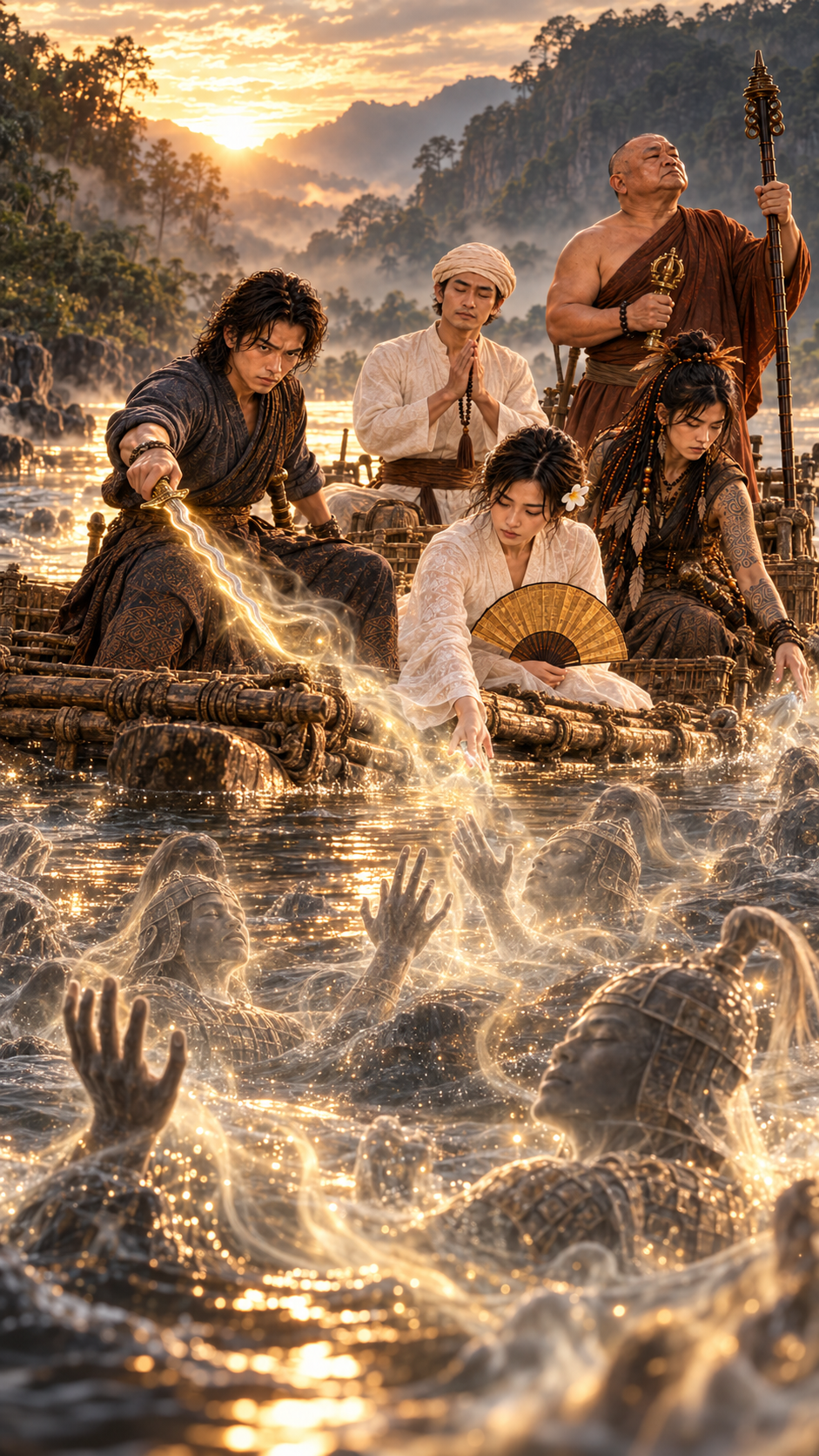
The river swirled once, hugely. Then it lay still. The shadow that had hung over the middle of the water lifted, and the afternoon light settled evenly across the river.
“They’re gone.” Intan lifted her nose to the air. “The bone smell is gone. Only the river now. A clean river smell.”
The young boatmen paddled as though they had forgotten how to stop. The boats nosed into the far bank. The five of them stepped off. The young men swung the raft around and hurried back. Somewhere near the middle of the river, one of them looked over his shoulder and waved, wide and long.
“They must have been terrified, and they never let go of their paddles,” Surya said, waving back. “You held them there with your eyes, Hasan.”
“I was terrified too.” Hasan was looking at the river.
“I was afraid the whole time I was praying. When those hands came up out of the water, I thought of my father. Is he reaching out like that, down at the bottom of the sea off Banten? He told us, didn’t he? That seal feeds on strong prayer. I kept thinking—the stronger my prayers get, the more likely it is that I’ll be dragged off somewhere too. Like those hands.”
Intan came and stood in front of him. She looked him straight in the face.
“Hasan. What did I tell you in Banten? Not holding on—a promise. And I told you that part was the interest. Your prayer today didn’t drag anyone anywhere. It let them go. A prayer that gets dragged and a prayer that lets go are different things. Today, you prayed the kind that lets go.”
“But what if, someday, I do get dragged?”
“Then I’ll hold on to you. I’ll be right behind you with a fist in your belt. Like those boats. One alone overturns, two bound together don’t—that’s what they said, isn’t it? So don’t pray alone. The big prayers, you only pray when I’m next to you.”
Hasan looked at her for a long time. Then he smiled.
“So we’re a bandungan,” he said.
“A what?”
“Two boats tied side by side. A bandungan.”
The tips of Intan’s ears went red. She thumped his arm with her fist.
“Where does a Banten santri learn talk like that?” She turned her head away. “If the Kyai heard you, you’d be in trouble.”
Behind the two of them, Surya gazed up at the sky and stretched, long and loud. It was the stretch of a man who had seen nothing at all.
Notes
1. The Citarum
The Citarum—the longest river in western Java, running some three hundred kilometers from the southern mountains of Priangan north to the Java Sea. In Sundanese, ci means water, and tarum is the indigo plant that yields a deep blue dye. Tarumanagara, the oldest kingdom recorded on Sundanese soil, whose stone inscriptions date to the fifth century, is said to have taken its name from the same plant.
↩ Back to textCatatan Nusantara: Citarum, Sanghyang Tikoro, and Ancient Lake Bandung →
2. Sanghyang Tikoro
Sanghyang Tikoro—near Rajamandala, west of present-day Bandung, one branch of the Citarum is drawn into a limestone cave and flows on as an underground river. The name means “the sacred throat.” The Dutch geologist R. W. van Bemmelen read the site as the outlet through which the ancient Lake Bandung drained away, a view long and widely accepted, though later studies have proposed other breach points upstream. Local tradition holds that anything dropped into the cave is answered by a scream.
↩ Back to textCatatan Nusantara: Citarum, Sanghyang Tikoro, and Ancient Lake Bandung →
3. Dipati Ukur
Dipati Ukur—a Sundanese leader who governed the Priangan highlands in the early seventeenth century. He joined Sultan Agung of Mataram’s 1628 assault on Batavia; after its failure, rather than face the punishment that awaited defeated commanders, he rose against Mataram itself. Mataram’s chronicles say he was captured after years of resistance and executed. Yet nearly everything known of him comes from babad and wawacan, verse chronicles written long afterward, on the Mataram side and in the Priangan alike, and historians still disagree about the year of his revolt, the place of his capture, and whether the man put to death was truly he. Priangan tradition holds that he was not. A street in Bandung bears his name today.
↩ Back to textCatatan Nusantara: Dipati Ukur, Tatar Ukur, and Gunung Lumbung →
4. Tatar Ukur
Tatar Ukur—the old name for the Priangan lands Dipati Ukur ruled: the Bandung basin and the country around it. Tatar means land or region in Sundanese. Once the revolt was crushed, Mataram broke Tatar Ukur into several regencies, among them Bandung, Parakanmuncang, and Sukapura, and gave them to the local chiefs who had helped hunt Dipati Ukur down. The Sundanese have gone on using the old name all the same.
↩ Back to textCatatan Nusantara: Dipati Ukur, Tatar Ukur, and Gunung Lumbung →
5. Plered
Plered—capital of the Mataram Sultanate from 1647, under Amangkurat I. It fell to the rebel forces of Trunajaya in 1677, and Amangkurat II built a new court at Kartasura in 1680.
↩ Back to text6. Bandungan
Bandungan—in old Sundanese dictionaries, where it is spelled bandoengan, a pair of boats lashed side by side beneath a deck of woven bamboo, from ngabandung, “to set side by side.” It is one of several proposed origins for the name Bandung; others trace it to a dam, or to the wide standing water of the ancient lake, or to the name of a tree. In Sundanese, ngabandungan also means to listen closely.
↩ Back to text7. Hadith
Hadith—the recorded sayings and deeds of the Prophet Muhammad. The saying Hasan quotes, “One rider is a devil, two riders are two devils, and three riders are a caravan,” is preserved in the collections of Abu Dawud and al-Tirmidhi. Scholars have read it as a warning against long journeys made alone, in an age when roads were empty and deserts killed.
↩ Back to text8. Lulun samak
Lulun samak—a water ghost of Sundanese belief. It floats on rivers and lakes like a mat (samak) and rolls (lulun) its victims up, dragging them under. Parents told the tale to keep children from playing too long by the water—an old way of guarding them against currents and whirlpools that were deadly enough on their own.
↩ Back to text