

CHAPTER 2 · EPISODE 3/3
Dewi Pulls Out the First Seal
Dewi seized the seal. In the spirit world, she gripped the fracture with both hands and pulled. The seal fought back—it had been driven into this land for so long that its roots ran deep. Dewi did not retreat. She chanted louder and pulled again. The seal shuddered. Once more. Sweat covered her body—even in the spirit world, her hands trembled, but she did not let go.
Her teacher had once said: Only those who feel sorrow, not fear, when they approach a seal can truly open it.
What Dewi felt now was sorrow. The sorrow of what had been trapped inside this seal—things born in this land, dead in this land, unable to return to this land, locked away nameless for so long. That sorrow passed through Dewi’s hands. She held it, and pulled harder.
The seal—came free.
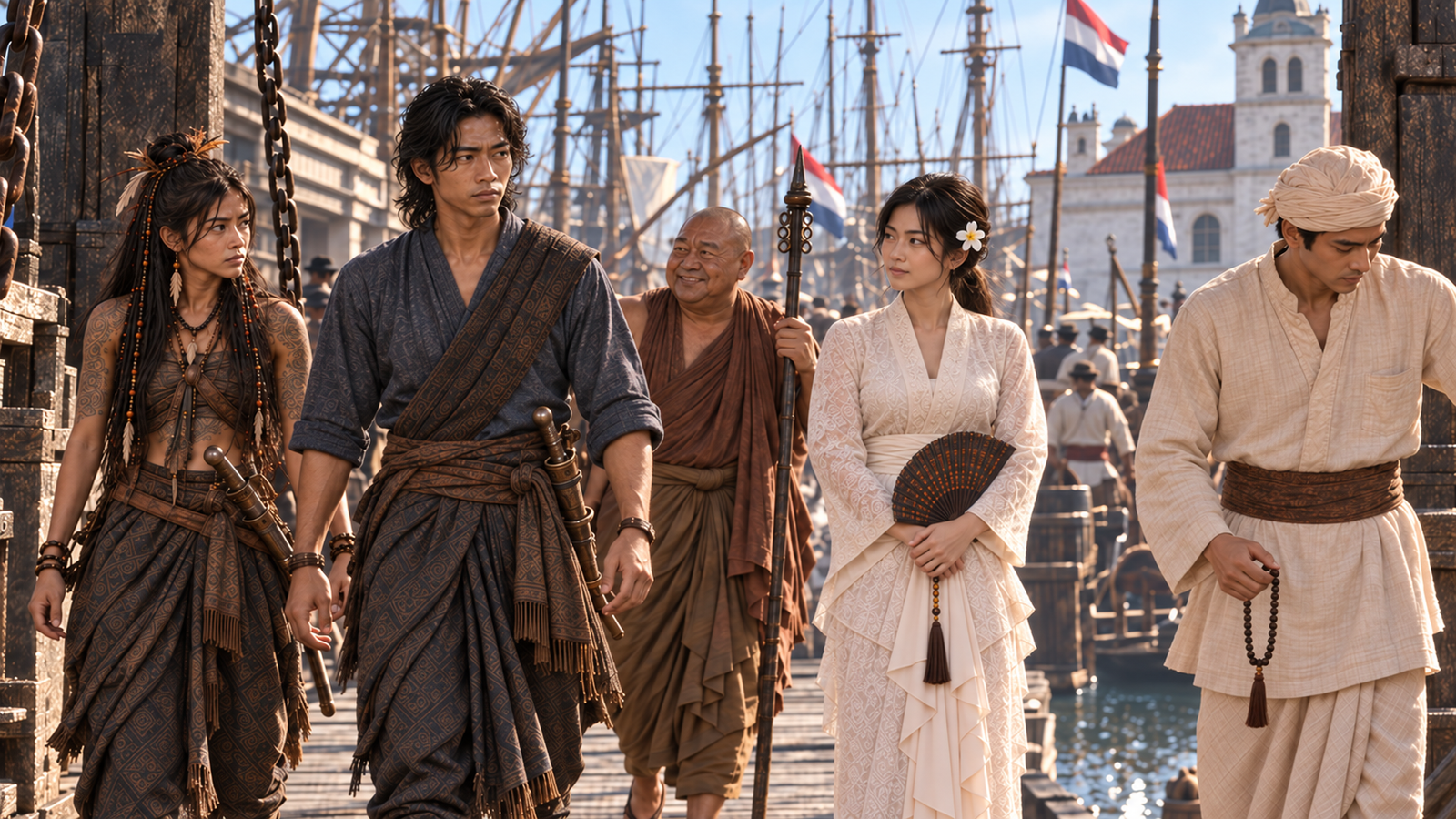
The entire warehouse rang. The floor shook, and empty crates toppled from the shelves. The morning light coming through the narrow windows flared suddenly stronger, and as it spread across the warehouse the dark shapes did not resist—they rose toward the ceiling all at once, like things that had been trapped behind a door that had finally opened, and they passed through the ceiling and scattered into somewhere beyond. The last of them—were weeping. Only Dewi heard the sound. It sounded like thank you.
The warehouse brightened. The heavy air was gone. The cold was gone.
“There’s a smell now,” Intan said, nostrils flaring.
“What smell?” Hasan asked, wiping the sweat from his forehead.
“Warehouse smell. Wood, old things. Before, there was nothing—now there’s the smell of something alive,” Intan said.
“That’s it. What the seal was blocking has been released,” Surya said.
Dewi opened her eyes and looked around. She was sitting on the floor, the Kipas Sakti in front of her. The other four stood at their positions, all catching their breath—sweat ran down Intan’s forehead, and Hasan was slowly opening his eyes, straightening his knees, rising.
Surya lowered the vajra, wiped the sweat from his forehead with his sleeve, then walked over to Dewi and offered his hand. Dewi took it. Surya pulled her to her feet.
“Done?” Surya asked.
“Done,” Dewi said. Her voice shook, just a little.
“Well done, Dewi. Opening the first seal is no small thing—that was remarkable,” Surya said.
Dewi looked at Surya and smiled. A smile with exhaustion still written across it.
“What was in there?” Hasan asked softly, turning his tasbih.
“Many things. People who died unjustly in this land long ago—the seal had been holding them. At the very end, they were weeping,” Dewi said, looking at the warehouse floor.
“Have they all gone now?” Hasan asked.
“Yes. They’ve gone,” Dewi said.
Hasan bowed his head briefly. A short prayer for people whose names he would never know.
“Dewi, how do you feel after entering the spirit world and coming back?” Intan asked.
“A bit heavy. But I’m all right,” Dewi said.
Intan looked at Dewi once and said nothing more. It was the expression Intan wore when she was worried.
“What did you see inside?” Arya asked. It was unusual for Arya to ask Dewi something first.
“Trapped things. Things that had been there a long time, with no names. The seal was holding them—but at the end, when I pulled, they let go willingly. They had grievances, but they didn’t want to stay trapped any longer,” Dewi said, looking at Arya for a moment before she spoke.
“No names?” Hasan asked quietly.
“I think the seal had locked their memories away too. They didn’t know who they had been, or even that they were there,” Dewi said.
A silence fell.
“But they’ve gone now. No names, but they went,” Surya said.
Intan sheathed her mandau and looked at Surya. She could still see him moving through the warehouse as he had moments before.
“Bhante.”
“Yes?”
“How long have you been practicing?”
“About forty years,” Surya said. “Since I was a child. For more than forty years, at the foot of Mount Semeru, I have received what this land gives. Its vital spirit—well, eating regularly makes the body strong. Sit before the land long enough, and it gives you something too. That is what has gathered in me.”
“Then eating well is part of your practice?” Hasan asked, turning his tasbih.
“Of course.” Surya looked entirely unashamed. “The body is a vessel. The stronger the vessel, the more it can hold. Skip meals, and you put cracks in it. A practitioner who skips meals is neglecting his duties.”
Hasan let out a small laugh. The corners of Intan’s mouth rose too, then quickly settled.
Surya’s expression changed for a moment. Not the cheerful face—something focused, listening. He tapped the tip of the tongkat candi against the warehouse floor. Slowly. He was feeling through the soles of his feet. This was the ground where the seal had been pulled. When something blocked was opened, the land sent a signal—he had felt it countless times in over forty years of practice on Mount Semeru. When what was blocked was freed, the land breathed. Very faintly, but unmistakably. Yet here, on this warehouse floor—the signal did not come. The seal had been removed, but the land was as silent as if nothing had happened. Strange. Surya kept his face blank and began polishing the vajra.
Arya looked at the floor. The stone that had been darker before was now the same color as the rest—the mark of something old that had departed.
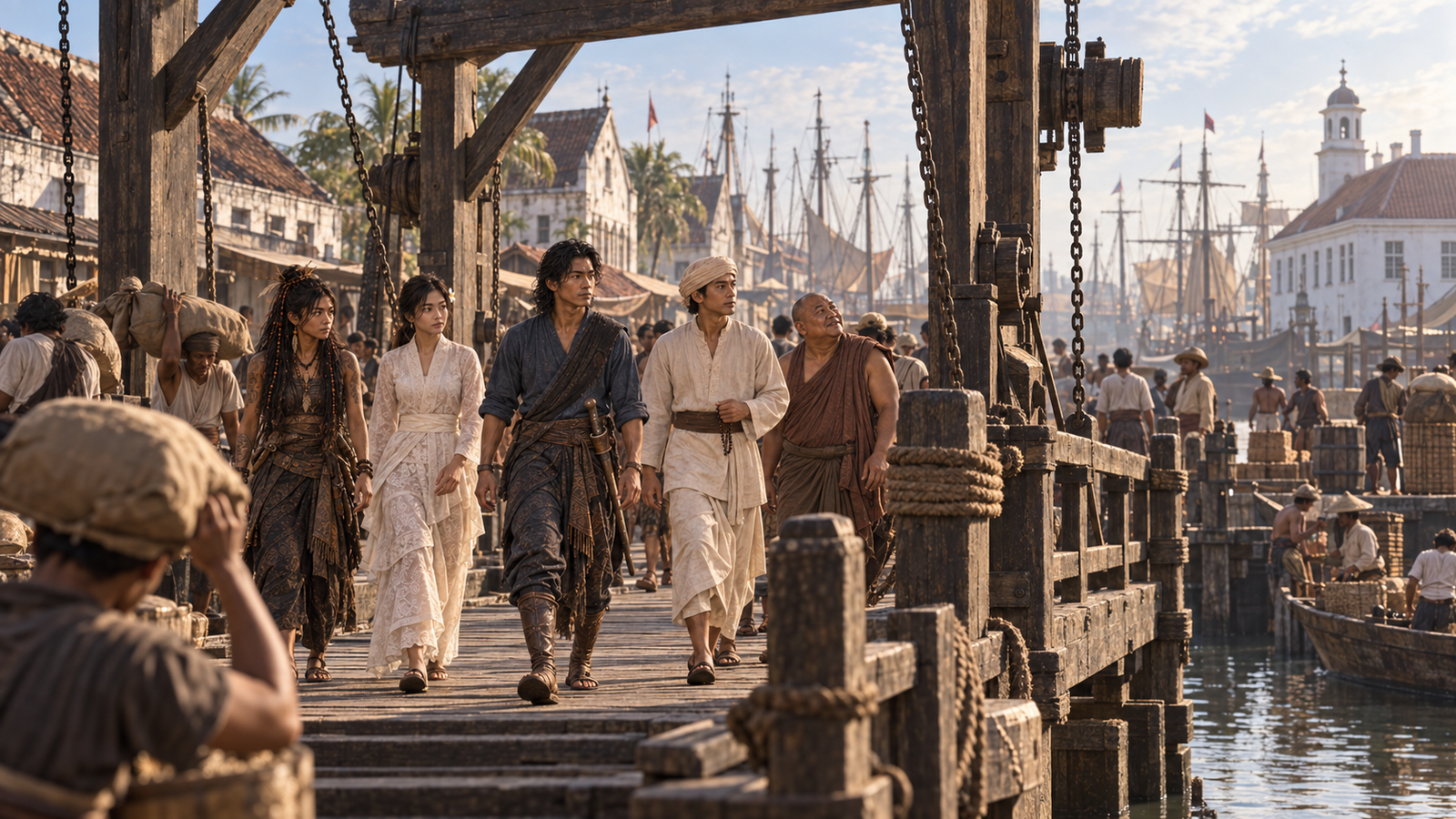
The five stepped outside.
Morning Batavia. Merchants shouted beyond the walls of Kasteel Batavia, Mardijker servants hauled water from the canal, and Chinese shopkeepers opened their doors down the alley.
“Aren’t you hungry?” Surya said.
All five looked at him.
“After a fight, you get hungry. Let’s eat—we can figure out where to go while we eat. There’s coconut-milk beef soup4 near the Sunda Kelapa harbor—beef broth with coconut milk. There’s a place by the harbor morning market that has the pot on since before dawn. The walk will clear our heads,” Surya said, wearing the expression of a man stating the obvious.
“Is that really the priority right now?” Intan looked at Surya.
“Always the priority. Decisions made on an empty stomach are never good ones,” Surya said.
Hasan opened his mouth, then closed it. The argument was difficult to counter.
“Let’s go,” Arya said, and started walking first.
The five walked north along the Kali Besar canal. Once they passed the warehouse district, the surroundings changed—the scent of the spice warehouses fell away, and the morning breeze coming off the canal grew saltier. The sea was getting closer. The water of Kali Besar flowed toward the harbor, and small cargo vessels moved along it in the early morning light. Each time a boat cut through the current, the smell of water splashed from its hull, mingling with the scent of palm oil and rice sacks piled on deck. Boatmen called to each other in a tangle of Malay and Javanese.
“It’s fresh out here,” Dewi said, looking around. After the heavy air inside the warehouse, the wind on her face felt extraordinary.
“This is the real smell of this city. Java mud, palm, the sea—the scents of this land. Near the warehouse, it was all pressed down,” Intan said, sniffing the air as she walked.
“So the seal was blocking the smell too,” Hasan said, gazing at the canal.
“Only around the warehouse. A strong seal dulls the senses around it—so that nothing living comes near. Where there is no scent, living things stay away,” Dewi said as she walked.
“Clever,” Intan said, as though she resented admitting it.
“Whoever made it was clever. It wasn’t made carelessly,” Surya said.
“Is there any way to know who made it?” Hasan looked at Surya.
“Later. Dewi saw things inside the seal. Let’s hear about it over food,” Surya said.
Morning commerce was opening along both sides of the canal. Stall vendors spread banana leaves, a sate seller laid skewers over charcoal, a Chinese merchant pulled a cart of tofu and tempe—each corner of this city opening the day in its own way. Mardijker children sat at the canal’s edge with their feet in the water, and on the far bank Javanese porters ran with heavy sacks toward the warehouses.
Surya sniffed the air as he walked. Something in a side alley had caught his nose. Galangal and turmeric, the sizzle of meat on charcoal—Surya’s stride slowed by half a beat.
“Aren’t we going to the harbor?” Intan looked at him from the side.
“Going. I’m going,” Surya said.
“Your feet were about to stop.”
“When the nose encounters something good, the feet slow down. It’s instinct. A warrior freezes at danger—I freeze at delicious things. Same principle,” Surya said.
Intan looked at him. She began to form a retort—then just faced forward.
A bridge appeared. An old wooden bridge crossing the Kali Besar canal—a drawbridge5. Its center section was designed to rise when large ships needed to pass. It was lowered now, and merchants and porters crossed back and forth in a steady stream. Canal water flowed beneath it, and through the gaps in the railing one could see the masts of ships silhouetted against the morning sky. The masts of Sunda Kelapa harbor.
“This bridge moves?” Hasan asked, walking across it and peering at the mechanism designed to lift the center span.
“When big ships come through. The center planks lift up—once the ship passes, they come back down,” Surya said.
“So the bridge makes way for the ship,” Hasan said.
“That’s how it works here. In this harbor, the ship is king—when a ship passes, people wait,” Surya said.
“Cargo before people,” Hasan said, looking at the canal flowing beneath the bridge.
“To the VOC, yes. Here, spice is worth more than a life,” Surya said.
“We’re almost there. Those masts smell different—tar and rope, and ships from faraway carry other scents soaked into their wood. Spice or salt—where a ship has been sticks to the nose,” Surya said, looking at the masts.
Arya gazed at the masts. The Nagaraja was reacting faintly—toward the ships. Not to the ships themselves. To what those ships were carrying away from this land. The cargo piled beneath those masts seemed to make the blade tremble. Arya felt the keris vibrate, and felt his own heart vibrate with it.
As Sunda Kelapa harbor drew near, the crowd thickened. Languages tangled in the air—Malay, Javanese, Chinese, Dutch. People from the eastern edge of these islands, from the western edge, from Europe, from China, all converging on this single harbor. VOC ships stood at the docks with their masts rising into the morning sky. The silhouettes of furled-sail vessels stood dark against the backlight, and around them smaller boats loaded and unloaded cargo in constant motion. Sampan6—small wooden craft—darted between the great ships and the wharf.
Hasan looked at the docks for a long time. People bent under heavy loads. Javanese, Balinese, Makassarese—the faces were different, but the stooped shoulders and the tired eyes were the same.
“Some of those people might be from Banten,” Hasan said quietly as he walked.
“From all across these islands, likely,” Surya said.
“When the seals are removed—will things change for them?” Hasan asked.
“They should. The blocked spirit of this land and the bent shoulders of the people living on it—those things are not unconnected. We have to hope that what we do reaches those shoulders,” Surya said.
Hasan turned his tasbih. And walked on.
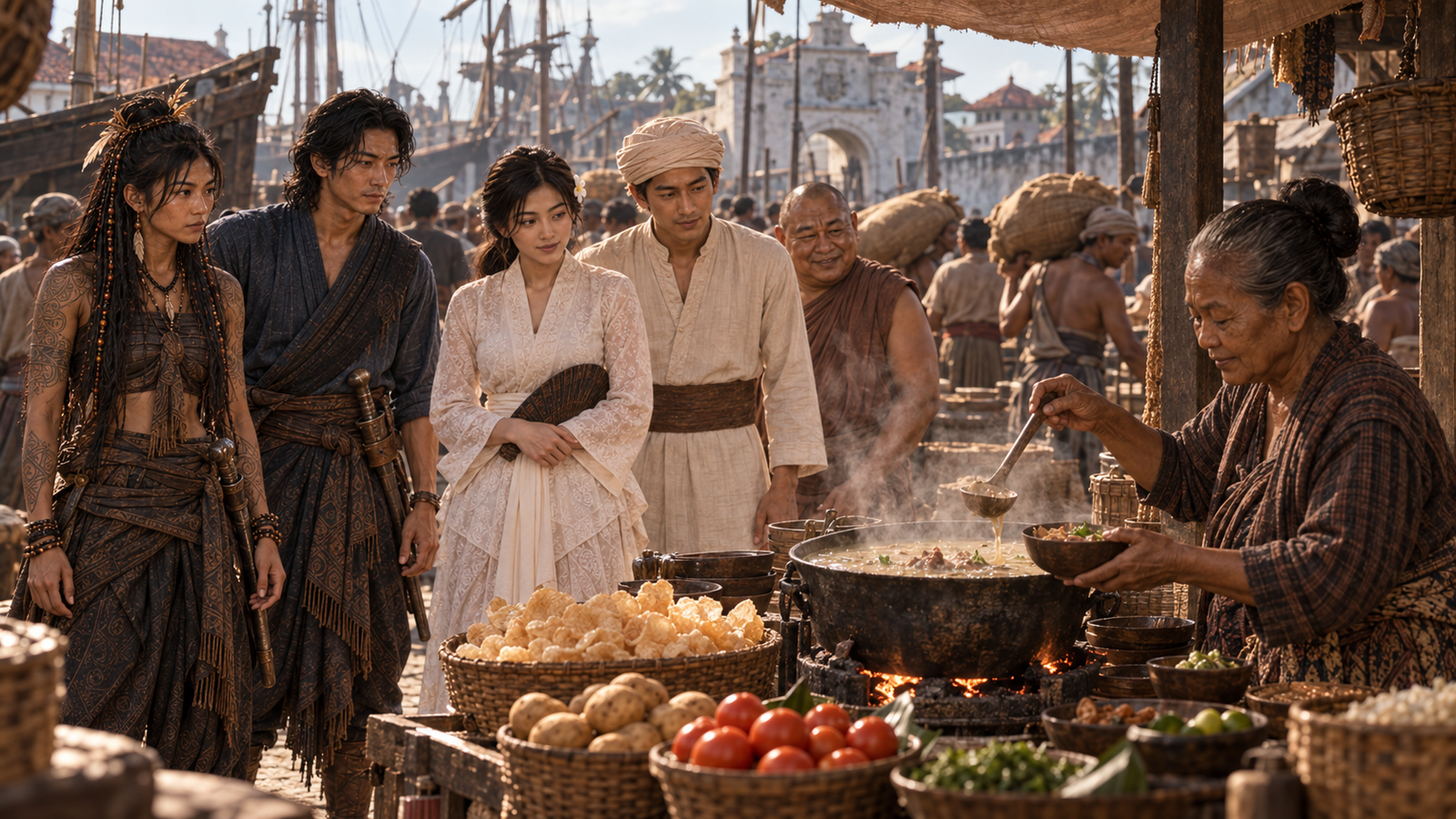
Near the entrance of the harbor market. Despite the early hour, a large pot was already bubbling over a small clay stove, and the rich, white scent of the broth rode the harbor breeze straight to the nose. Coconut milk and beef stock, mingled—the smell of coconut-milk beef soup. The woman tending the pot was an older Javanese cook. She had prepared the cooked beef and aromatic seasonings, fried kerupuk7 crackers and piled them in a basket, and was ready for the dock workers from early dawn.
“Here,” Surya said with certainty, and sat down.
Dewi sat and smiled. A smile with exhaustion still lingering.
“Traveling with Bhante Surya is going to be interesting,” Dewi said.
“Probably,” Intan said.
“And frightening. The places we’ll have to go—today’s wasn’t easy,” Dewi said.
“But we have to go,” Arya said.
“Yes. We have to go,” Dewi said, looking at Arya. Their eyes met.
Arya did not look away. Dewi did not look away either—it was only a moment. But the moment was there.
The broth came in bowls. Pieces of beef floated in the creamy white soup, topped with chopped scallion and fried shallots. Lay a piece of kerupuk on the surface and it would be crisp at first, then slowly soften as it drank the broth. Surya took his first spoonful and closed his eyes.
“The broth is rich. She hasn’t skimped on the coconut milk—to get this thickness, you have to put the pot on before dawn. How long have you had this pot?” Surya asked the old woman.
“Forty years,” the woman said with a smile.
“I knew it. A forty-year pot is different—you can see it in the color of the broth,” Surya said, nodding and taking a second spoonful.
“Is everyone all right?” Surya asked, looking into his bowl.
“Fine,” Intan said, picking around a bone.
“Hasan?” Surya asked.
“My knees are a bit cold. Kneeling on stone that long,” Hasan said.
“Warm broth is the best cure. Gets the strength back in the legs,” Surya said.
“Is that why you brought us here?” Hasan said with a smile.
“Partly,” Surya said.
A silence settled. What they had encountered in the warehouse still lingered in their bodies—the scent of black mist, the way the warehouse had shuddered when the seal was pulled from its roots, the weeping at the end. The broth’s warm aroma was slowly drawing those things away.
“In the spirit world, I saw something…” Dewi said, looking into her bowl, her voice quiet and clear.
Everyone looked at her.
“I believe this seal was the first. The first one ever planted—starting here in Batavia and branching outward, connected to others made the same way in other places. The markings were identical. In Dieng8, in Merapi9, in Bali, in Kalimantan, in Toba10Catatan ↗, in Sulawesi, in Maluku11, in Papua.” Dewi counted them off on her fingers.
No one spoke. A ship passed on the Sunda Kelapa harbor, and a sailor’s shout carried across the water. The morning was alive.
“The same person made all of them?” Arya said.
“The same person’s energy. Someone very powerful—starting here and spreading across the length of these islands. And it was done a long time ago,” Dewi said.
Surya took a sip of broth and looked toward the harbor. Beyond the VOC ship masts, the morning sky was growing brighter.
“Then we have a great many places to go,” Surya said.
A beat of silence.
“Kalimantan is on the list,” Intan said. She was looking down into her bowl. She had lifted a spoonful of broth but had not drunk it.
“Yes,” Dewi said.
“The Kapuas River area?” Intan asked. Her voice was slightly different.
“I can’t say precisely. But the same island,” Dewi said.
Intan looked at the Dayak tattoos on her arms—the dark curves flowing across her skin. She thought of the Kapuas River in Kalimantan, and of Manang Iban, her teacher. She understood now why her teacher had sent her to this alley.
“Where is Toba?” Surya asked Hasan, as if he did not know.
“Northern Sumatra. Batak land—my teacher told me about it. They say it has the largest volcanic lake in the world,” Hasan said.
“Would we reach the lake by sea?” Surya asked.
“Not all the way. We would still need a route inland,” Hasan said.
Surya nodded and drank his broth. The route would need thought.
Hasan turned the tasbih. He was thinking of his father—the father who had not come home from the sea off Banten. The thought that something like this seal might lie somewhere in those waters pressed against his chest.
“What about the Banten sea?” Hasan looked at Dewi.
“It wasn’t on the list I saw—but I may not have sensed everything. There could be more, made the same way,” Dewi said after a moment.
Hasan gripped the tasbih. He looked into the broth. He seemed about to say something—but didn’t.
“What happens when all the seals are pulled?” Arya said.
Everyone looked at him. It was rare for Arya to speak first.
“The spirit of this land will flow again. What’s been blocked will be released—exactly how things will change, I don’t know either. No one has ever pulled them all before,” Surya said, and took a sip of broth.
Arya nodded and lifted his spoon.
“We’d be the first,” Intan said.
“That’s right. The first,” Surya said.
“This broth—another bowl and I feel like I could go anywhere,” Surya said.
“Me too,” Intan said, looking at Surya. At that, Surya smiled wide.
“Two bowls each. Two more, please,” Surya said, turning to the old woman.
The five sat before their bowls of soto beside the Sunda Kelapa harbor. The harbor morning lay wide open around them. Ships moved, porters ran, languages tangled. The harbor had no way of knowing—what these five had done in a warehouse at the end of the canal before dawn. That the first seal ever driven into these islands had been pulled.
The air of Batavia had not changed. The same salt, the same spice, the same morning. Dewi noticed it as she spooned her broth. Something was strange. The seal had been removed—yet the air of this city was no different. Dewi did not yet know what that meant.
Surya took his second bowl—and his eyes flicked, just once, toward Kasteel Batavia. An instant. Then he drank the broth as if nothing had happened. No one noticed.
Notes
4. Coconut-milk beef soup
Coconut-milk beef soup: a fictional culinary reconstruction for the scene in 1683. Soto Betawi is associated with Jakarta in a later period; the scene does not claim that its modern name or recipe already existed then. Potatoes and tomatoes are omitted.
↩ Back to text5. Drawbridge (ophaalbrug)
Drawbridge (ophaalbrug): a Dutch-style drawbridge spanning the Kali Besar canal, with a center section that could be raised to let tall-masted ships pass beneath. Built around 1628, it was among the oldest bridges in Batavia. A remnant of the structure survives in present-day Jakarta under the name Kota Intan Bridge.
↩ Back to text6. Sampan
Sampan: a small, flat-bottomed wooden boat propelled by oar, used throughout Southeast Asian waters. In the harbor of 1683 Batavia, the larger VOC vessels could not reach the shallow wharves directly; sampans handled the loading and unloading of cargo between ship and shore.
↩ Back to text7. Kerupuk
Kerupuk: a traditional Southeast Asian cracker made from ground shrimp or fish mixed with starch and deep-fried until light and crisp. A near-universal accompaniment to rice and soup throughout these islands.
↩ Back to text8. Dieng
Dieng: a highland plateau in central Java, roughly 2,000 meters above sea level. Seventh- and eighth-century Hindu temple complexes still stand here, and it is regarded as one of the most spiritually potent sites in all these islands.
↩ Back to text9. Merapi (Gunung Merapi)
Merapi (Gunung Merapi): the most active volcano in these islands, located just north of the Mataram Sultanate's heartland. It holds deep spiritual significance for the Javanese, and old traditions speak of a covenant between the Mataram court and the spirits of Merapi.
↩ Back to text10. Toba (Danau Toba)
Toba (Danau Toba): the world's largest volcanic caldera lake, in northern Sumatra. Homeland of the Batak people, whose spiritual traditions center on Samosir Island at the lake's heart.
Read the illustrated Catatan Nusantara →
↩ Back to text11. Maluku
Maluku: the island chain in eastern Nusantara known in Europe as the Spice Islands—the only source of cloves and nutmeg in the world at the time. The VOC's wars to monopolize the spice trade were fiercest here; the 1621 Banda massacre, in which more than 14,000 of the islands' 15,000 inhabitants were killed, took place in these waters.
↩ Back to text