
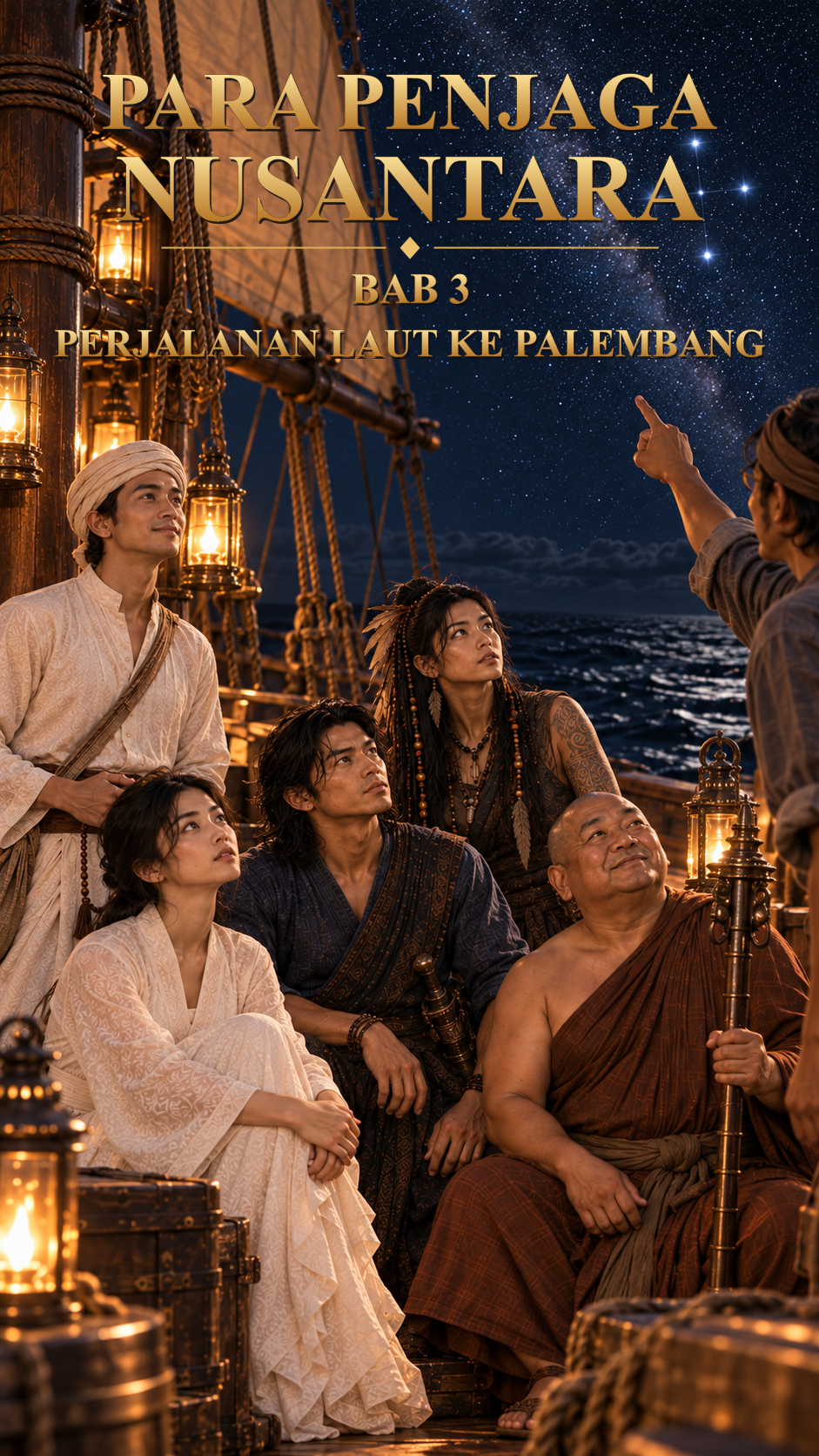
CHAPTER 3 · EPISODE 1/3
A Sea Without Direction
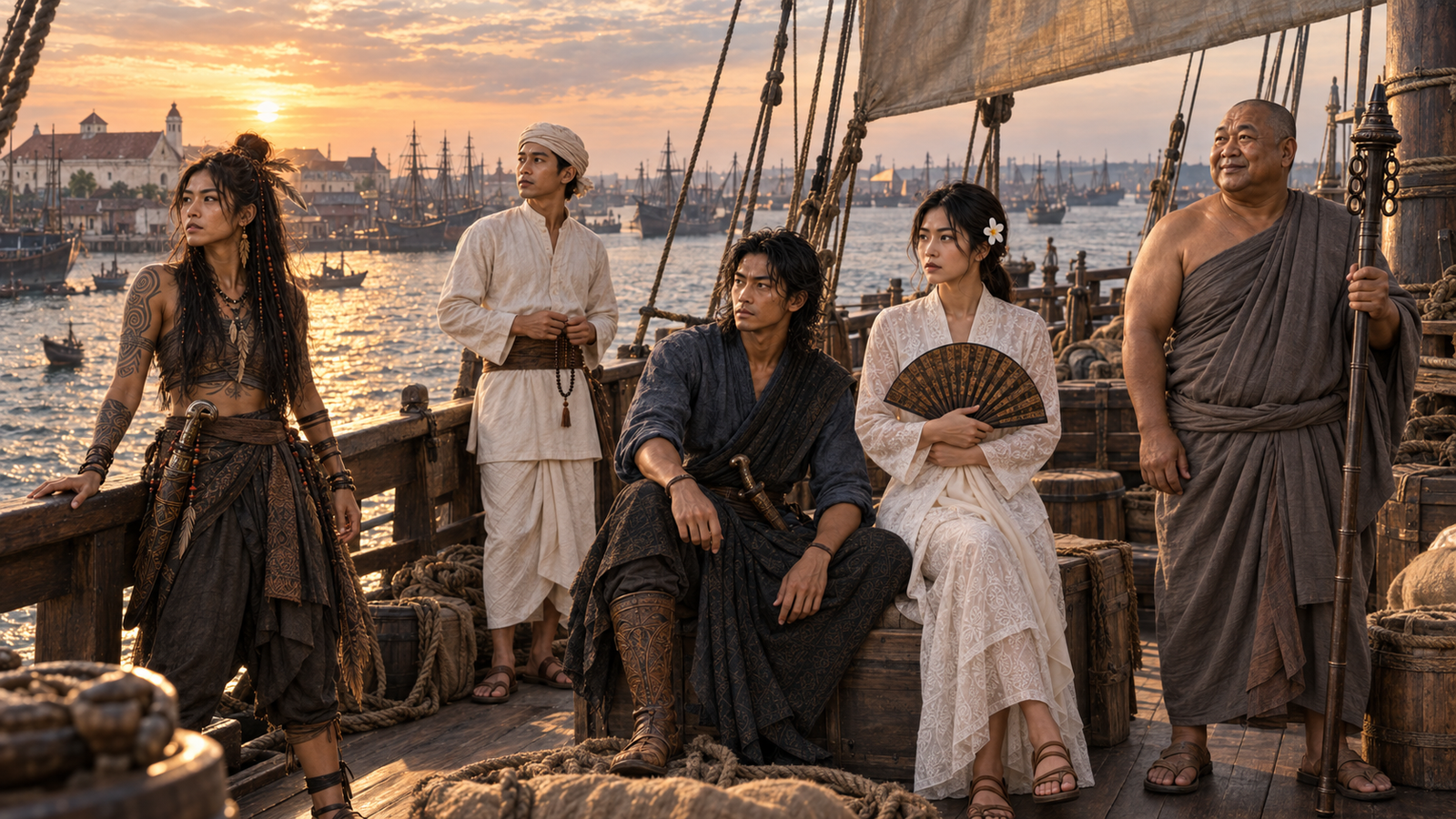
The ship departed from the port of Sunda Kelapa as the sun began its descent.
It was a merchant vessel bound for Palembang1. From Batavia, through the Selat Bangka2 to the mouth of the Musi River—several days, depending on winds, currents and stops. The captain was Javanese, and four of his six crew hailed from Madura3Catatan ↗—these crewmen were experienced in reading the currents of the Java Sea4. When the five of them boarded the vessel carrying spices and cloth, the captain asked no questions. Everyone who stepped onto a ship at Batavia’s harbor had their own reasons, and inquiring about those reasons was not the captain’s business.
As the ship cleared the harbor, the reek of Pasar Ikan’s fish market and the scent of coconut charcoal drifted together across the gunwale. Intan’s nostrils flared—the smell of the sea was still unfamiliar. On the Kapuas River5 back in Kalimantan, she could read the current with her eyes closed, but the sea was too vast, too without direction.
“The sea smells different from a river—on a river, you can tell where you are from the scent alone. The sea doesn’t have that.” Intan stood at the bow as she spoke.
“You get used to it—I was dizzy my first time too. Now I sleep better on a ship than anywhere else. The sea rocks you to sleep.” Surya said this while coaxing a piece of dried fish from one of the sailors.
“Do you take ships often, Bhante?” Hasan asked.
“No—Mount Semeru is inland, there’s no sea. The first time I boarded a ship, I couldn’t believe something this wide existed.” Surya chewed his fish as he spoke.
“Rivers are better—you can see land on the other side. That’s how you know direction.” Intan gazed at the horizon.
“On the sea, you use the stars—those Madurese sailors steer by the constellations. To them, the stars are the map.” Surya looked up at the sky.
“How do you read the stars?” Hasan asked.
“I’ll ask them—just thought of it myself, actually.” Surya said.
Intan looked at Surya. She started to argue, then just turned back to the sea.
Hasan stood at the gunwale, watching the harbor shrink slowly behind them. He turned his tasbih as he stood, facing the direction of Banten.
“How long to Sumatra?” Intan asked Surya.
“Three days with good wind—five without.” Surya said.
“What do we do on a ship for three days?” Intan asked.
“Eat, sleep, watch the sea.” Surya said.
“That’s it?”
“Time passes faster than you’d think—ships are smaller than they look.” Surya said.
Arya sat leaning against the railing at the center of the ship. One hand rested on Nagaraja, the other on his knee, his gaze fixed on the water—the posture of a man still turning something over in his mind, something he had been thinking about for a long time.
“First time at sea?” Dewi asked, settling beside him.
“No. I’ve been as far as Banten.” Arya answered, brief as ever.
“This time, we go farther.” Dewi looked toward the horizon where Sumatra lay. She held the Kipas Sakti against her chest and began reading the sea through the niskala—the Java Sea was vast. Beneath its surface, things older than darkness seemed to lie submerged.
“Can you read it?” Arya asked.
“Not yet—too far. I’ll feel it when we’re closer.” Dewi said.
“Are there things like the Batavia warehouse in Sumatra too?” Arya asked.
“Stronger ones. Batavia’s seal is not the only one. Sumatra holds powers that are far older—powers that were already here in the age of Sriwijaya,” Dewi said.
“Is that more dangerous?”
“Old things are driven deeper—they can be more dangerous, or more fragile. Some have been waiting a long time to be opened.” Dewi said.
“Doesn’t it make you dizzy, at first? Reading all that?” Arya looked down at the waves and asked quietly.
“It does, at first—when you read through the niskala, the real world and the spirit world overlap. For a moment, you can’t tell which is which.” Dewi looked at Arya. No one had thought to ask her that before.
“Even now?”
“Not anymore—I’m used to it now. Thank you for asking.” Dewi said.
Arya looked at Dewi. Then, without a word, he turned back to the sea. By the time Dewi opened her eyes fully, he was already looking somewhere else.
Hasan was alone.
He leaned against the railing on the opposite side of the stern, watching Batavia’s harbor grow distant. The farther the ship pulled from port, the wider the Java Sea became, and the horizon where sky met water stretched longer and longer before his eyes. The tasbih in his hand turned slowly, steadily—not in recitation, just turning. It was Hasan’s habit when he was lost in thought.
The tasbih had been his father’s. Muhammad Yahya’s6.
A fisherman had found it on a small overturned boat in the Banten Strait and brought it to Hasan. Since the day he received it, he had never once set it down. Hasan did not hate his father. He did not resent him either. He simply missed him. And sometimes, the thought drifted through—that somewhere in that sea, something of his father might still remain. Every time Dewi spoke of things that could not leave, things trapped by the seals in the Batavia warehouse, the thought rose quietly inside him, but he had never once let it past his lips.
Surya walked over carrying two pieces of dried fish. He stood beside Hasan, who was gazing out at the sea, and held one out. Hasan turned and took it. The two of them stood side by side, watching the water in silence.
“Were you looking toward Banten?” Surya asked, chewing his fish.
“Yes.” Hasan said.
“I feel it too—the sea toward Banten is heavy. If you read it through the spirit side, the energy is blocked there.” Surya said.
Hasan looked at Surya.
“You don’t have to talk about it if you don’t want to—but carrying it alone is the heaviest thing of all.” Surya said.
“My father never came back from the sea off Banten. A friend of his had disappeared near a seal—he went out in a hurry. Didn’t even finish preparing.” Hasan turned the tasbih in his hand as he watched the water.
Surya looked at Hasan. He said nothing.
“What Dewi said at the warehouse keeps coming back to me—that there are things that couldn’t leave, things trapped by the seals. I keep thinking the same thing might be true of that sea.” Hasan said.
“It could be—that’s why we’re going, isn’t it? To pull the seals out. Once they’re pulled, the things that were trapped will be free to go. Everything in that sea too.” Surya finished his fish and brushed his hands clean.
Hasan looked at Surya for a long time. A middle-aged monk with a belly, wearing an expression that seemed to carry nothing—but it was not nothing. Hasan had known how to read people for a long time.
“Jazakallah khair, Bhante.” Hasan said. Then he turned the tasbih again.
“I should go ask if there’s more dried fish—the fish on this ship is surprisingly good. The sea breeze does the seasoning for you.” Surya stood up as he spoke.
Dewi stopped first.
It was the moment the ship passed Banten and turned northwest, following the western coast of Java. Dewi said nothing. She simply walked a few steps toward the railing and looked down at the sea. The hand holding the Kipas Sakti tensed almost imperceptibly, then released.
“Something there?” Surya asked, opening one eye.
“A seal—beneath the sea, over there.” Dewi’s voice was low and quiet.
Intan pushed herself up from the gunwale and looked toward Dewi. Arya’s hand came to rest on the hilt of his keris.
Hasan stood at the stern railing. He must have heard Dewi’s words. But there was no reaction. Only his fingers, moving over the tasbih beads—slowly, very slowly, one by one.
“Can we pass by?” Surya asked without rising.
“Yes.”
“Then we leave it. It’s underwater, and there are too many eyes on this ship to stop—we’ll come back for it on the return from Sumatra.” Surya said.
“Will it hold until then?” Intan asked.
“It’s not me who needs to hold—it’s whatever’s down there. It’s been buried a long time. It knows how to wait.” Dewi shook her head as she spoke.
The ship sailed on. Dewi drew her hand from the railing and turned away.
Hasan watched the sea until the end. No one approached him—until Intan walked over and stood beside him.
“Are you alright?” Intan asked.
“Yes.” Hasan said. Turning the tasbih.
“That thing under the sea—is it connected to your father?” Intan asked. Direct, but without malice in her voice.
“How did you know?” Hasan looked at Intan.
“She said it was near Banten. And you’ve been staring that way.” Intan said.
“It might be—I won’t know until we come back and look.” Hasan said.
“Then we go back. Don’t just pass it by.” Intan said.
“Thank you.” Hasan glanced at Intan, then looked forward again.

Night came.
When the sun set, the sea changed. The Java Sea, blue by day, turned black, and the stars emerged. The strait between the islands was narrow enough that the lights of land did not intrude, and stars filled the sky all the way past the horizon. They reflected on the water—it was as if the boundary between sky and sea had vanished.
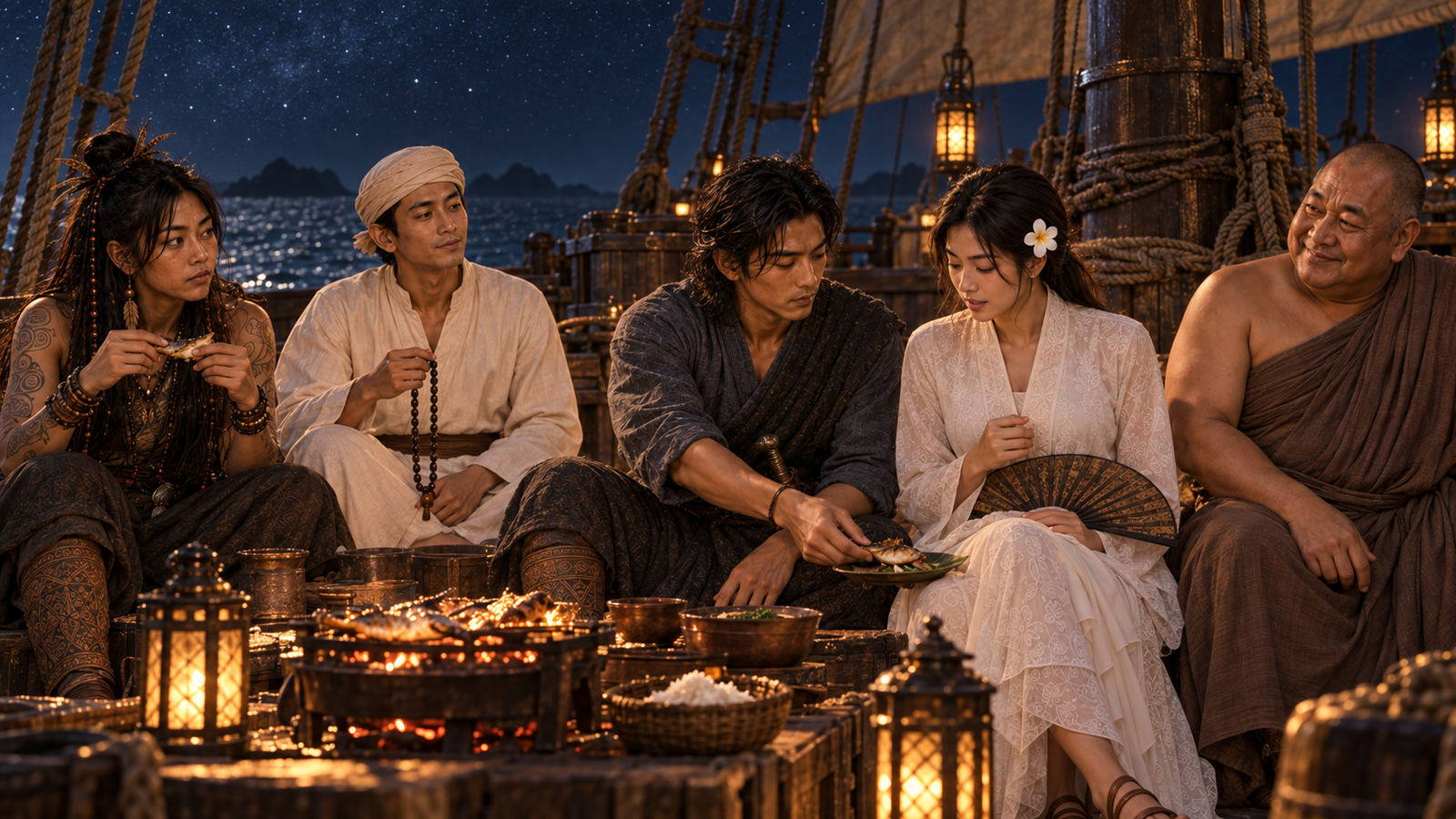
The sailors built a small fire on one side of the deck and cooked rice. When the smell of fish grilling over charcoal filled the deck, Surya was the first to come.
Hasan finished his Isya7 prayer and came to the fire. The five gathered around it—their second time sitting together for a meal since the morning’s nasi uduk.
“How do you find south by the stars?” Surya asked, sidling up to a Madurese sailor.
“We watch the stars in the southern sky,” the sailor said, pointing. “The sky helps us keep our bearings.”
“You navigate all the way to Palembang by that?” Surya said, looking up at the sky.
“At night, it’s more accurate than anything else.” The sailor said.
“Nuwun sewu—I’ve spent my whole life looking at maps, and you’re telling me the stars are more reliable.” Surya said.
Intan ate her fish bone and all—she was not one to waste time picking the flesh apart. Arya, without a word, separated the meat from his own fish and placed it in front of Dewi. He had noticed that she had been drained since entering and leaving the spirit world at the warehouse. Dewi looked at Arya. He was already looking ahead.
“Thank you.” Dewi said quietly. Arya gave the briefest of nods.
Surya caught the exchange from the corner of his eye and went back to his rice. There was a smile at the corner of his mouth, but he said nothing.
“Where next?” Intan spoke when the fire had quieted.
Everyone looked at Surya.
“We won’t know until Dewi reads Palembang, but—the seal is most likely inside the city. In a place where the VOC has been established for a long time, same as Batavia. Palembang was the old capital of Sriwijaya8, and now it’s where the VOC holds its monopoly on pepper—they wouldn’t have left a place like that without planting a seal.” Surya chewed his rice, thought for a moment, then spoke.
“There may be more than Palembang—Toba9Catatan ↗ as well. Deep in the Batak lands, there’s a powerful energy, and I can feel that it’s been blocked. It’s in the north of Sumatra, the opposite direction from Palembang. We’ll need to enter Palembang first, then travel north from there.” Dewi said.
“How far?” Intan asked.
“Far.” Dewi answered simply.
“The lake is far to the north. From Palembang, we still have to decide on a route; even a sea journey leaves an overland approach to the lake. Through the interior, it would take weeks, perhaps months,” Surya added.
“That far?” Intan fell quiet for a moment. She was calculating the distance and what they would need.
“Supplies?” Intan asked.
“We’ll stock up in Palembang—it’s been a trading post since the Sriwijaya era. There’s nothing we won’t be able to find.” Surya said.
“Shoes?” Intan asked.
“Shoes too—crossing mountains, it’s the feet that go first.” Surya said.
“If you’re headed for Palembang—we’ll be making a brief stop at the mouth of Bangka Island tomorrow. Need to take on water and supplies. We’ll pull in before dawn and leave before sunrise.” One of the Madurese sailors spoke quietly.
“Bangka Island?” Surya turned to the sailor.
“The fishing village there has been—strange, lately. That’s the word going around.” The sailor’s face stiffened for a moment.
“Strange how?” Intan looked at the sailor. Her eyes narrowed, sharp as a warrior’s.
“The villagers have been losing livestock—they wake up and their chickens, their goats, are dead. Cut them open, and the innards are missing. It’s been going on for days. One man’s collapsed, too.” The sailor shifted his gaze across the fire as he spoke.
“There’s something the Bangka people don’t say lightly—mencadin10Catatan ↗. When someone who did terrible things in life dies and the earth refuses to take them, it comes out.” The sailor exhaled and added this in a lower voice.
“What does a mencadin do to people?” Intan asked.
“Come too close and you go blind—that’s why the Bangka people never go out alone before dawn.” The sailor said.
“Is there a smell?” Intan asked Dewi.
“Thick but sweet—like flowers rotting. You’ll know it the moment you smell it.” Dewi said.
Intan nodded. She had smelled something similar in the forests of Kalimantan. Her body had known, before her mind, not to go closer.
“How large is the form?” Surya asked Dewi.
“The longer it lingers, the larger it grows—twenty years, and it could be quite large. I’ll read it when we arrive.” Dewi said.
“What changes when it grows?” Intan asked.
“It gets hungrier.” Dewi said.
Silence fell across the deck. The sea wind drummed against the sails.
“Does your keris read the spirit world, Arya?” Surya asked.
“It reacts. I don’t always understand what it is telling me,” Arya said.
“It might, on Bangka—old keris blades wake up in places like that.” Surya said.
“Wake up?” Arya looked at Surya.
“Heat, vibration, light—every keris reacts differently. Do you know where Nagaraja is from?” Surya asked.
“The Kartasura royal court.” Arya said.
“A court keris—it’ll react. Just keep hold of it.” Surya said, as if it were the simplest thing in the world.
“Were the dead in that village buried properly?” Hasan asked the sailor.
“From what I heard—buried without even a proper shroud. An old cemetery, about twenty years now.” The sailor said.
“A spirit that has not found rest may lose its way,” Hasan said quietly, turning his tasbih. “That is what we have seen here.”
“That happens in your faith too?” Intan looked at Hasan.
“Many traditions acknowledge wandering spirits—the reasons differ, but the inability to find direction is the same.” Hasan said.
“I’ll read it when we land—if it is a mencadin, the safest approach is for Hasan to call them through prayer, and then I open the way.” Dewi said.
“Call them?” Intan asked.
“It means showing them where to go—the prayer creates direction, and Dewi opens the door.” Hasan turned the tasbih quietly as he spoke.
“Where did you learn that?” Intan glanced at Hasan. She had never heard this explained before, and it surprised her that Hasan already knew it.
“From my father.” Hasan said.
“Do you read the direction first?” Intan asked.
“It’s the same thing—you read the direction, and then you make it.” Hasan said.
“My father used to say this—prayer is not sound. It is direction.” Hasan added quietly, turning the tasbih.
“Direction.” Intan rolled the word inside her mouth once more. Her hand rested on the hilt of her mandau.
The fire burned low. Starlight spilled across the water. No one spoke for a while—until Dewi looked at Surya.
“Aren’t you afraid, Bhante? Of all this.”
“Of course—but being afraid and going are two different things.” Surya said it as though it were nothing. He turned his head toward Intan.
“Aren’t you afraid when you hunt wild animals in Kalimantan?” Surya asked.
“I am.”
“But you still go.”
“Because I have to.”
“That’s it.” Surya said.
Surya’s expression changed for a moment—not his usual cheerfulness, but something deeper passing across his face, as though he were remembering something from far away. But it vanished in a blink, and he smiled as if nothing had happened.
“What about you, Arya?” Dewi asked.
“I’m afraid.” Arya said, short and certain.
“But you came.” Surya looked at Arya.
“I’m here.” Arya said.
Surya smiled. It took Intan a moment to realize that it was the same answer.
“Why did you come, Intan?” Arya asked. The question, coming from Arya, was unexpected—Intan looked at him.
“There could be seals in Kalimantan too—if you have a home, you have a reason to go.” Intan said.
“Do you have family?” Arya asked.
“I do. Why?”
“No reason.” Arya said.
“What about you?” Intan asked.
“No.” Arya said.
Intan did not press further. The sea wind swept across the deck.
“If there’s no one to worry about, you can fight better—sometimes I think about Kalimantan and my hands slow down.” Intan said, openly.
“For me, it’s the opposite—no one to worry about means I get reckless. Less careful.” Arya said.
Intan looked at Arya for a long time. She thought she understood what he meant.
“The opposite might be a good thing.” Intan said.
“Maybe.” Arya said.
Surya had been listening. He said nothing, drinking his coconut water. Hasan turned his tasbih and looked up at the sky.
Notes
1. Palembang
Palembang: a port city on the Musi River in southern Sumatra and an important centre of Sriwijaya. In the seventeenth century its rulers faced VOC trade interests and military pressure. The attack of 1659 and treaty of 1662 did not simply replace the sultanate with direct VOC government.
↩ Back to text2. Selat Bangka
Selat Bangka — the narrow strait between the eastern coast of mainland Sumatra and the western coast of Bangka Island. Since the Sriwijaya era, it served as the primary sea route to Palembang. In 1683, merchant ships from Batavia would cross the Java Sea, enter the strait from the south, and sail north to reach the mouth of the Musi River.
↩ Back to text3. Madura
Madura: an island northeast of Java with longstanding coastal and seafaring traditions. The crew’s composition and expertise in this scene are fictional choices, not a documented crew list from 1683.
Read the illustrated Catatan Nusantara →
↩ Back to text4. Java Sea (Laut Jawa)
Java Sea (Laut Jawa) — the shallow sea between Java and Kalimantan, and the central waterway of inter-island trade. Sailing direction and speed shifted dramatically with the monsoon seasons.
↩ Back to text5. Upper Kapuas River
Upper Kapuas River: the upper reaches of the Kapuas in West Kalimantan. In this novel, Intan comes from an Iban community there. This is distinct from the Mahakam River in East Kalimantan.
↩ Back to text6. Muhammad Yahya
Muhammad Yahya — Hasan's father. An Islamic scholar and spiritual practitioner from Banten, he went out unprepared to rescue his fisherman friend Ramin, who had vanished near a VOC seal, and was himself trapped and lost inside it. The tasbih was the only possession recovered from his overturned boat.
↩ Back to text7. Isya
Isya — the last of the five obligatory daily prayers (salat) in Islam. It is performed at night, after the Maghrib (sunset) prayer.
↩ Back to text8. Sriwijaya
Sriwijaya: a Buddhist maritime polity centred on Palembang, influential from the seventh to the thirteenth century. Its power changed over time; it did not necessarily control every vessel or port. The monk Yijing visited in 671 and recorded its importance as a centre of Buddhist learning.
↩ Back to text9. Lake Toba (Danau Toba)
Lake Toba (Danau Toba) — the world's largest volcanic caldera lake, located in northern Sumatra. Formed by a supervolcanic eruption approximately 74,000 years ago, it is the ancestral homeland of the Batak people. Samosir Island, at the center of the lake, is regarded as a sacred spiritual site.
Read the illustrated Catatan Nusantara →
↩ Back to text10. Mencadin
Mencadin — a spirit from the folklore of Bangka Island. It is believed that when a person who committed great evil in life dies and the earth refuses to accept the body, the spirit wanders for forty days. Similar in appearance to the pocong, the mencadin emits a foul, sweet stench and is said to rob people of their sight or consciousness if they draw too close. The belief persists across Bangka Island to this day.
Read the illustrated Catatan Nusantara →
↩ Back to text