
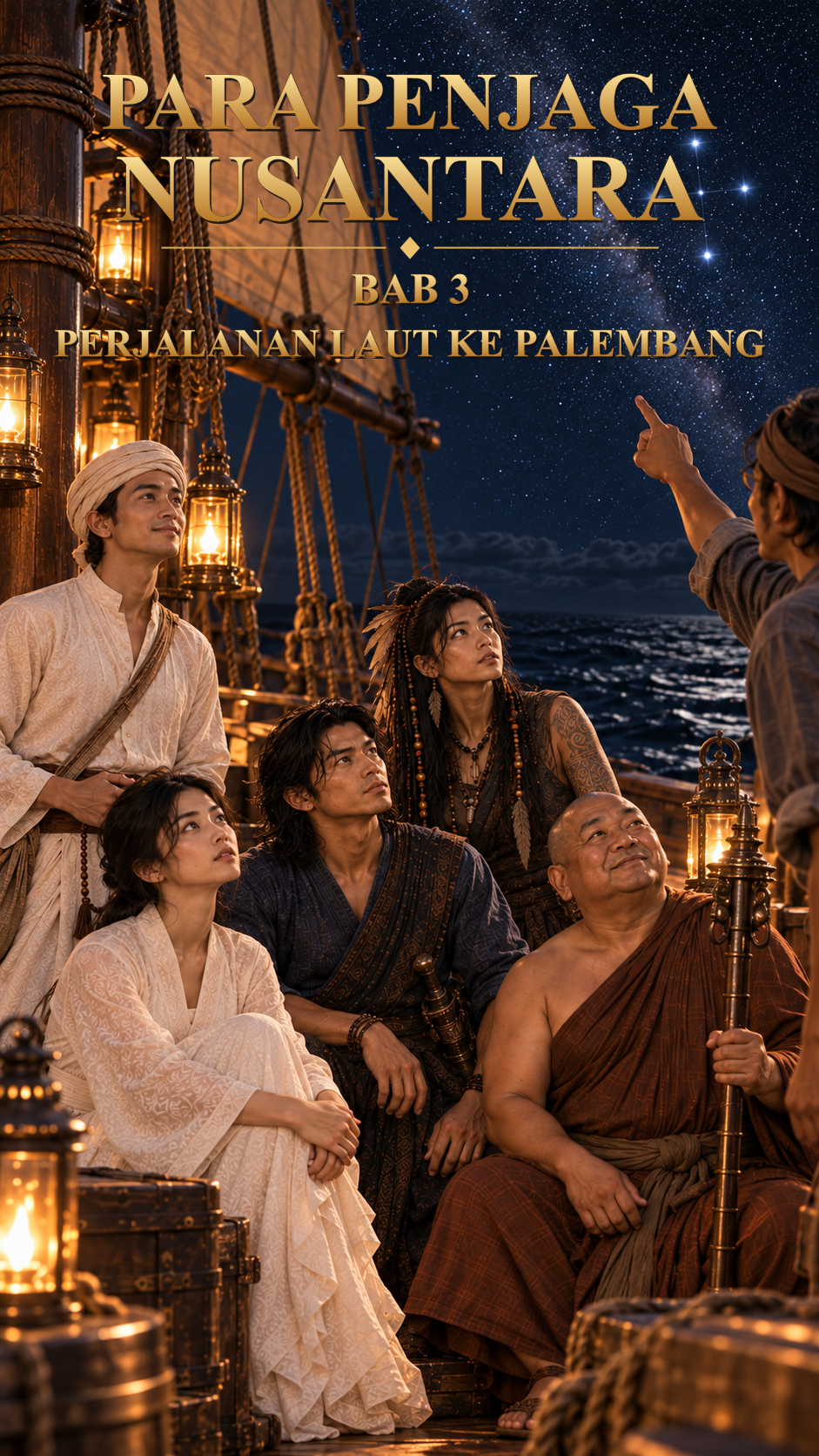
CHAPTER 3 · EPISODE 2/3
Mencadin on Bangka Island
Before the first light of dawn, the ship began to slow.
They had reached the mouth of Bangka Island. The sailors moved quietly, and the sound of the anchor dropping resonated through the deck. The silhouette of land lay low and dark in the darkness—the shapes of palm trees cut black against the starlight, and somewhere in the fishing village, two or three small lights flickered. The waves were calm, but the smell was different. Over the salt of the sea, something sweet and thick was drifting from the shore.
“Animal innards—that’s what I’m smelling. And there’s something still alive, too, something terrified. The fear is mixed in.” Intan stood at the gunwale, nostrils flaring, and spoke quietly. Her eyes narrowed to slits.
Hasan was offering his Fajr11 prayer on one side of the deck. When that quiet recitation carried on the pre-dawn sea wind, the Kipas Sakti trembled once against Dewi’s chest—sharp and strong.
Dewi half-closed her eyes. She read through the niskala. Something was roaming the shore—similar to the energy of the pocong at the warehouse, but different. This had not come from a seal. It had been here from the beginning, something native to this land. Older, rawer. It was wandering—hungrily.
“We need to go ashore—there are mencadin near the village. Two of them.” Dewi said.
“We’ll stay on the ship.” The sailors exchanged glances, their faces rigid.
“Of course—lower the small boat for us.” Surya rose to his feet. The vajra was already in his hand.
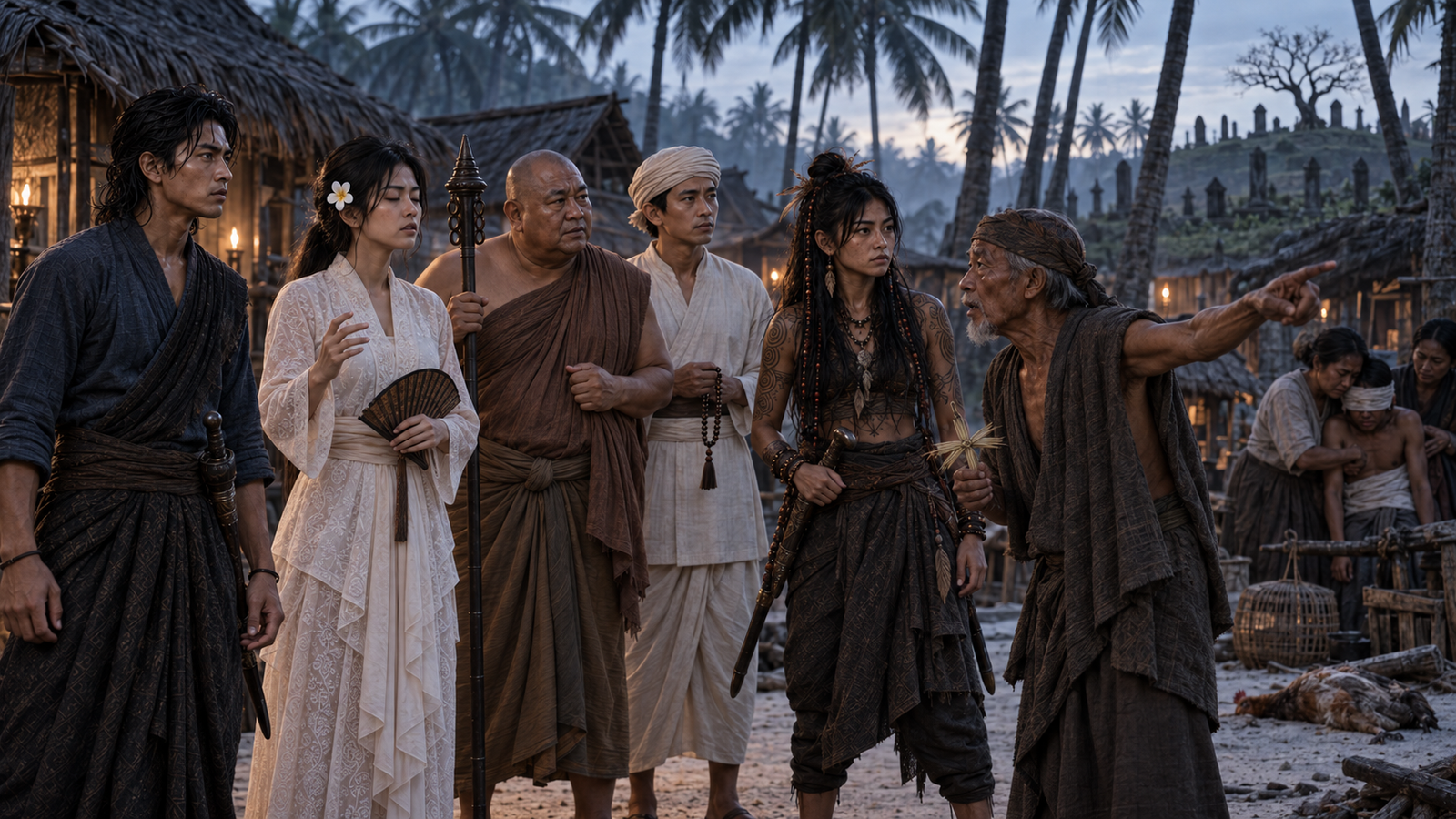
The fishing village was small. Fifteen or so houses woven from palm and nipa leaves, packed close together on a beach of sand. Fine white sand, the kind Bangka Island was known for—sand that would sting the eyes with its brightness by day, now lying pale and ghostly under the moonlight. The moment the five stepped from the small boat onto the shore, the smell came first. Sweet and thick, it coated the sand like a film. Rotting flowers and decaying animal innards, layered together—not the kind that struck the nose, but the kind that seeped in.
The villagers did not come out of their homes. Eyes peered through gaps in shuttered windows. Only one old man stood at his door, holding something woven from palm leaves—a charm, or something like one.
“How long?” Intan asked in Malay.
“Four days. First it was chickens. The next day, two goats. Last night—a young man from the village went out before dawn and came back collapsed. He’s gone blind.” The old man looked between Intan’s Dayak tattoos and the mandau at her side as he spoke.
“Is he still alive?” Hasan asked.
“Alive, but not conscious.”
“Do you know where it started?” Dewi asked.
“There’s an old cemetery over that way. Twenty years old, maybe—some people buried there without proper shrouds. A few bad ones among them.” The old man pointed toward a cluster of palm trees at the northern edge of the village.
Dewi looked toward the palm grove. She half-closed her eyes. Two presences were roaming there—the sweet, thick scent spreading outward like a web. The two were different. One was slow, the kind that had gone hungry for a long time. The other was fast—still searching for direction.
“Two of them—improperly buried, wandering. They’re hungry.” Dewi said.
“Do we soothe them, or drive them out?” Surya asked.
“Hasan needs to pray first. These aren’t sealed the way the things in the warehouse were—call them, and I’ll open the way.” Dewi read for a moment longer, then spoke.
“Understood.” Hasan wrapped the tasbih around his hand and stepped forward.
“Arya, take the north—Intan, Hasan’s left. When the forms appear, they’ll split. One each. I’ll hold the center.” Surya assigned positions as crisply as if arranging a formation on a battlefield.
“Can a blade touch them?” Intan asked Surya.
“Physically, no. But you can block the direction they’re trying to go—if there’s a blade in the way, the form turns. That’s what your mandau is for.” Surya said.
“Understood.” Intan drew her mandau.
“Dewi, signal us when the forms separate.” Surya said.
“I will. When they split, I’ll call it.” Dewi said.
“Hasan, maintain the prayer until I signal—if you stop, the forms could speed up again.” Surya said.
“Understood.” Hasan wrapped the tasbih around both hands.
Surya adjusted the vajra in his right hand and settled into the Bhumisparsha Mudra12Catatan ↗—the soles of his feet pressing flat against the fine sand. He was far from Semeru, but the earth of this island had energy too. Slow and low, but there.
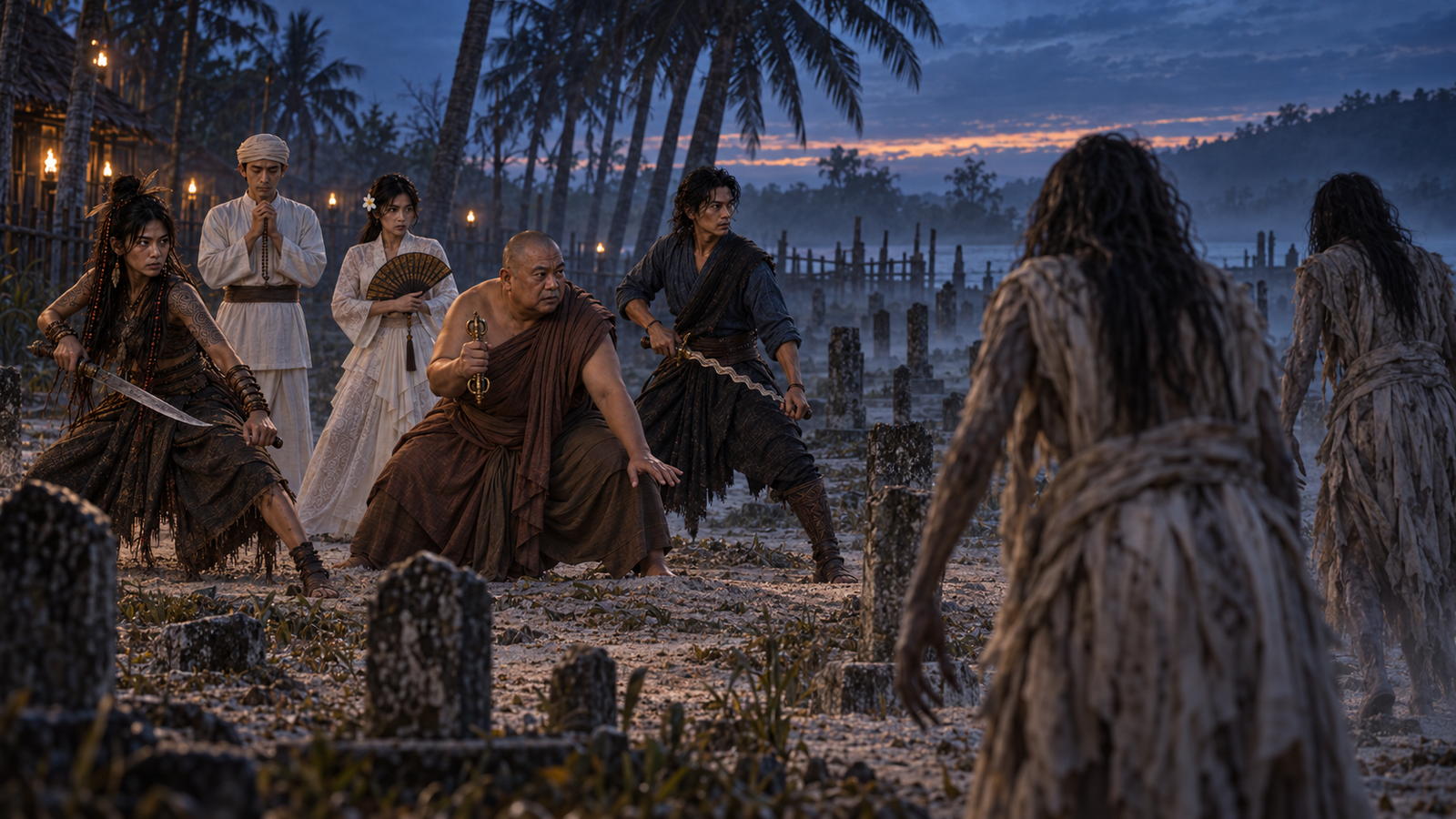
Two forms appeared at the edge of the palm grove.
“They’re out.” Dewi said, low.
They resembled the pocong but were different—there were no shrouds. Tattered, earth-stained strips of cloth clung to various parts of their forms, and the shapes themselves were more blurred. But that blurriness made them worse—without clear outlines, it was impossible to tell where the form began and where it ended. The two shapes glided across the sand, soundless. The sweet, thick scent rushed ahead of them.
“Is this the mencadin?” Intan asked, voice low. Eyes narrowed, mandau raised.
“Yes—both of them.” Dewi said.
“The smell is right.” Intan said. The sweet thickness had already spread across the sand.
The two forms diverged. One turned toward Hasan. The other began circling toward the ship.
“The second one is heading for the ship.” Dewi said.
“I’ll stop it.” Arya stepped between the second form and the ship, cutting off its path. When his hand touched Nagaraja’s hilt, the grip flared warm against his palm. He moved laterally, keeping a fixed distance from the form—drawing its attention away from the ship and toward himself.
The form shifted direction toward Arya. The sweet, thick scent thickened suddenly.
“Don’t step back.” Dewi called to Arya.
Intan stood between the first form and Hasan, cutting off their line. Mandau raised, she was ready to push the form back if it came closer. She did not know whether a blade could touch a spirit. She stood there anyway. The body knew its place.
Then the second form took one step closer to Arya.
Arya drew Nagaraja.
The instant the blade cleared the scabbard, a faint light ran along the keris—a silvery glow tracing the blade’s distinctive wavy edge. It lasted no more than a heartbeat, but the form stopped.
“That’s it, Arya—Nagaraja just reacted. Keep the light going.” Surya spoke as if it were the most ordinary thing.
“How?” Arya’s voice was short, steady—but with a thread of surprise woven through it.
“Just hold on to it—the blade knows what to do.” Surya said.
The second form began retreating from Nagaraja’s light. Arya followed, keeping the glow between himself and the spirit—each time he moved the blade, the form pulled back.
“When the form finds its bearing, call me.” Dewi said to Arya.
“How do I know when it finds its bearing?” Arya asked without taking his eyes off the form.
“When it stops, it’s found it.” Dewi said.
Arya gave one short nod.
Hasan closed both eyes and wrapped the tasbih in both hands.
A low, deep Arabic recitation spread across the pre-dawn beach on the wind. It was different from what he had used at the warehouse—this was an older thread. It had come from his father’s scroll. The only time Hasan had ever read it aloud was once, at sixteen, the dawn his father disappeared. This was the first time since then that it had passed his lips—and it was not frightening. This sound was what his father had left him.
The recitation filled the beach, low but clear. Lower than the waves, level with the wind. It seemed to sink into the sand itself.
“It’s working—keep going.” Dewi said, clipped.
The first form stopped. It wavered.
Then the sand beneath Intan’s feet shifted. The form was rising from below. A rush of scent hit her at the ankles.
“Intan!” Hasan called without opening his eyes. The recitation broke for a moment, then resumed.
Intan leapt backward. Dark energy rose from the ground where she had stood—and froze the instant Hasan’s voice caught again.
“Don’t move—not the ground. Watch ahead.” Dewi called to Intan.
Intan steadied her breathing and raised the mandau again. Both hands were still.
“You alright?” Arya glanced toward Intan without taking his eyes off his own form.
“Fine.” Intan said.
Hasan’s recitation filled the pre-dawn beach once more. Deeper this time, in an older register.
“Now.” Dewi raised the Kipas Sakti. Its light began to intensify—she was opening the way. Hasan’s prayer called them, and Dewi’s rite gave them direction.
The first form began to descend, slowly. The earth-stained cloth fragments loosened and dissolved into the sand. The second form paused, then turned toward Hasan—as though it had heard something it had been waiting for, for a very long time. And then it was gone.

The sand lay quiet.
“It’s done.” Dewi said. The light of the Kipas Sakti went out.
The sweet, thick scent lifted. The smell of the pre-dawn sea returned—clean and salt.
The old man exhaled. The villagers who had been peering through window gaps began to crack their doors open. A woman came out carrying two coconuts, and behind her, children followed—children who had not been outside in four days.
“I’m starving.” Surya lowered his hands from the Bhumisparsha Mudra and stretched.
“Right now?” Intan looked at him.
“Using that kind of energy empties you out—are there any coconuts?” Surya turned toward the old man.
“The woman next door already went to get some.” The old man looked at Surya for a long moment, and then, from the place where fear had lifted, something like a laugh emerged.
“We haven’t slept in days. Thank you.” The village woman handed the coconuts to Surya.
“You can’t leave things like this too long—the improperly buried grow dangerous when they go hungry.” Surya said, taking the coconuts.
“Can you take another look at the cemetery? Make sure they’re properly buried?” The old man asked Surya.
“It’s too dark now—when the sun comes up, the villagers should check it themselves. If there are no shrouds, wrap them again and say the prayers. Any way you know is fine—do it the Bangka way.” Surya said.
“Thank you.” The old man said.
“The young man who went blind?” Hasan asked the old man.
“He’ll be alright now—the way has been opened, so when the sun rises, his sight will return.” Dewi answered in Hasan’s place.
“Where are you from?” The old man asked.
“Just passing through—we’re on our way to Palembang.” Surya said.
Arya slid Nagaraja back into its scabbard. The light went out the instant the blade entered. He looked down at his own hand—warmth lingered in his palm.
“Are you beginning to understand what Nagaraja is telling you?” Dewi asked Arya quietly.
“A little,” Arya said.
“Then you’re learning to read its responses. That’s a good thing.” Dewi looked at Arya as she spoke.
“Thank you.” Arya said. So low it was barely audible.
Dewi paused. It was the first time Arya had offered thanks of his own accord. She started to say something—then simply smiled, brief and quiet.
Notes
11. Fajr
Fajr — the first of the five obligatory daily prayers in Islam. It is performed just before sunrise and marks the dedication of the new day to God.
↩ Back to text12. Bhumisparsha Mudra
Bhumisparsha Mudra — a Buddhist ritual hand gesture meaning "touching the earth to vanquish evil." The practitioner extends the right hand downward until the fingertips contact the ground. According to tradition, Siddhartha Gautama assumed this posture beneath the Bodhi tree just before attaining enlightenment, calling the earth itself as witness to defeat the armies of Mara. It is a gesture of grounding—setting the body against the land to stand against impure forces.
Read the illustrated Catatan Nusantara →
↩ Back to text