
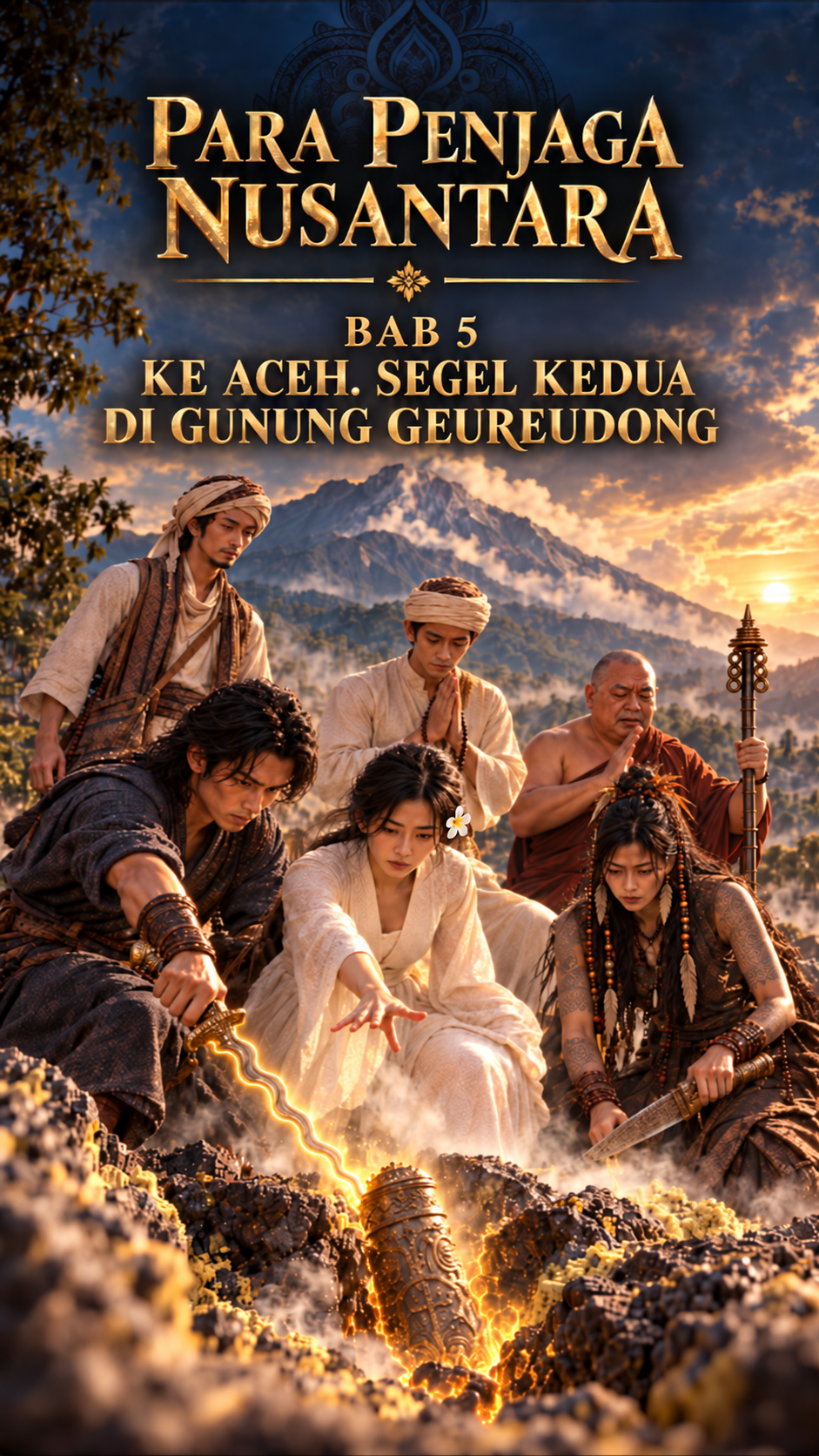
CHAPTER 5 · EPISODE 3/3
Mount Geureudong
They stayed in a Gayo village that next night. As the highlands drew closer, the air changed—cooler, heavier with moisture. The smell of vegetation deepened. The Gayo people did not regard the five strangers with suspicion. Faris spoke Acehnese mixed with Gayo, and it seemed everyone here knew him.
The host brought steamed rice and a fish broth with turmeric—similar in some way to the arsik from Toba but not quite. Here there were coriander and cumin folded in, and a thread of something from further west came through in the smell.
Surya took a sip of the broth and closed his eyes.
“The same turmeric—yet Javanese turmeric is one thing, Sumatran turmeric another, and Gayo turmeric is different still.”
A Gayo woman watched Surya’s face and said something. Faris translated, smiling.
“She says—a person who eats well lives well.”
“This Gayo woman understands the truths of life,” Surya said, pressing his palms together.
The night deepened.
The Gayo village hearth was smaller than the one in the Karo village—but more tightly constructed, stones stacked in a ring with fire contained inside. The village elder offered a prayer beside it. The hour of maghrib19 had already passed, but the elder prayed again briefly where he sat. Hasan listened from beside him. The pronunciation was not Acehnese—Gayo inflection ran through it. The same Quran, flowing from a different mouth in a different current.
“The same book—yet it sounds like a different texture,” Hasan said quietly.
“That is Islam in these islands,” Faris said from beside him. “It comes in through Aceh, passes to Gayo, and from Gayo moves deeper inward—each step it sounds a little different, but the meaning is the same.”
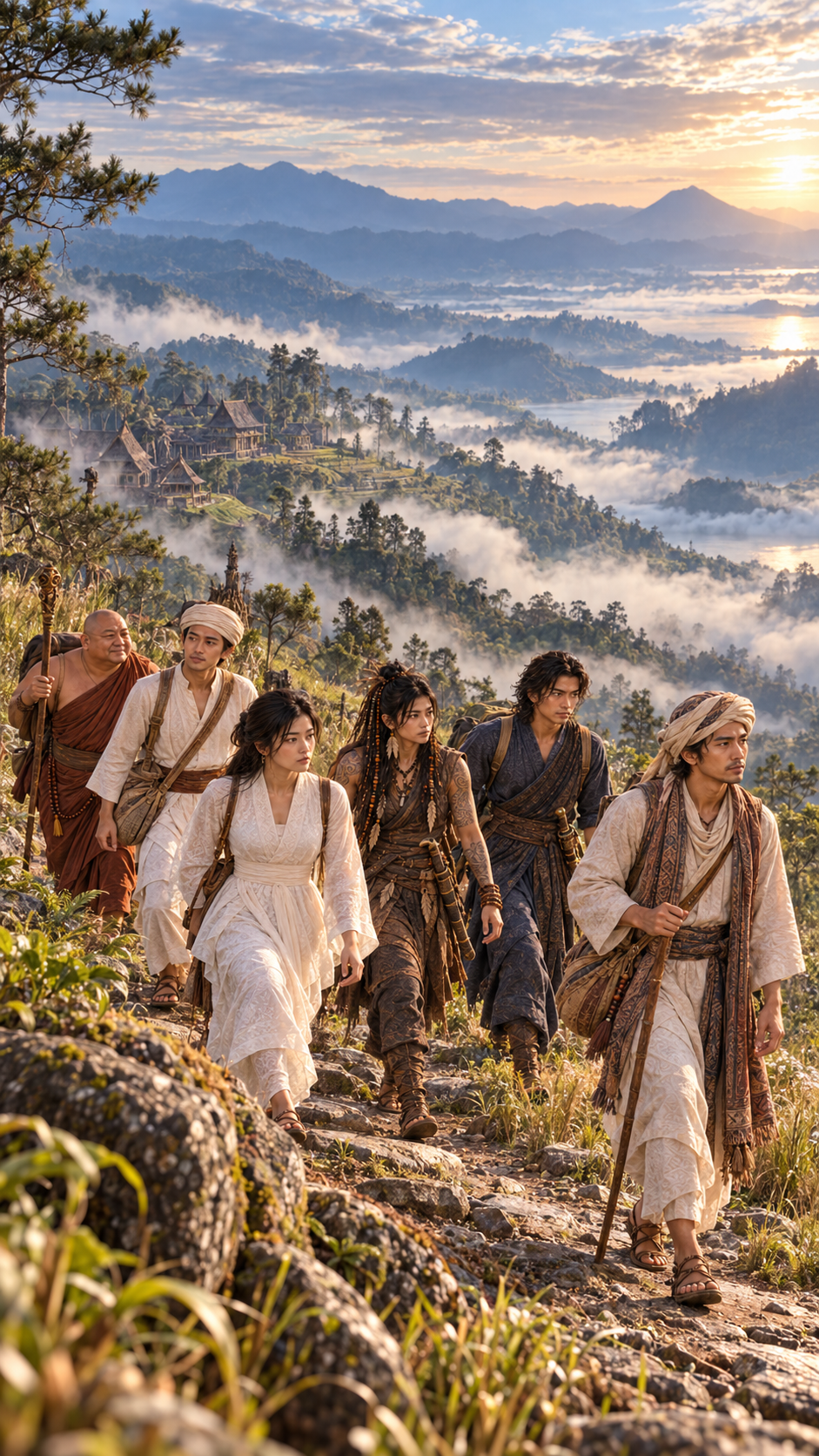
The following day took them deeper into the mountain. The path narrowed. Mist came down more often. The smell of vegetation grew denser with every hour. The true interior of the Gayo Highlands. Graves appeared occasionally beside the path—flat stones with smaller stones laid on top, nothing more. Faris said they were old Gayo graves, people buried in this mountain before Islam had arrived.
Dewi paused before one and opened the Kipas Sakti briefly, then closed it.
“Quiet. Everyone resting here—they all went in peace. The seal has not reached this far.”
“The mountain is deep enough,” Surya said. “The seal’s reach didn’t make it here.”
On the fourth morning, Mount Geureudong appeared on the horizon. Even from a distance its shape was wrong—the summit flatter than the mountains around it, clouds pressed thick across the top.
Faris pointed. “There. One more day’s walk to the foot of the volcano.”
Dewi opened the Kipas Sakti a fraction to read the niskala, then closed it. “I feel it. The seal is there. There’s something unusual—the sacred Islamic presence unique to Aceh, and the seal mixed together. A strange combination.”
“Sulfur,” Intan said, her nose moving. “The volcanic smell reaches all the way here. There’s something else underneath it.”
“The connection between this seal and Islamic scripture—you mentioned it on the way,” Hasan said, turning his tasbih. “How does that work?”
Faris considered the question. “You should hear that from my teacher directly. It is not something I can explain. He has accumulated over twenty years of this. He will show you.”
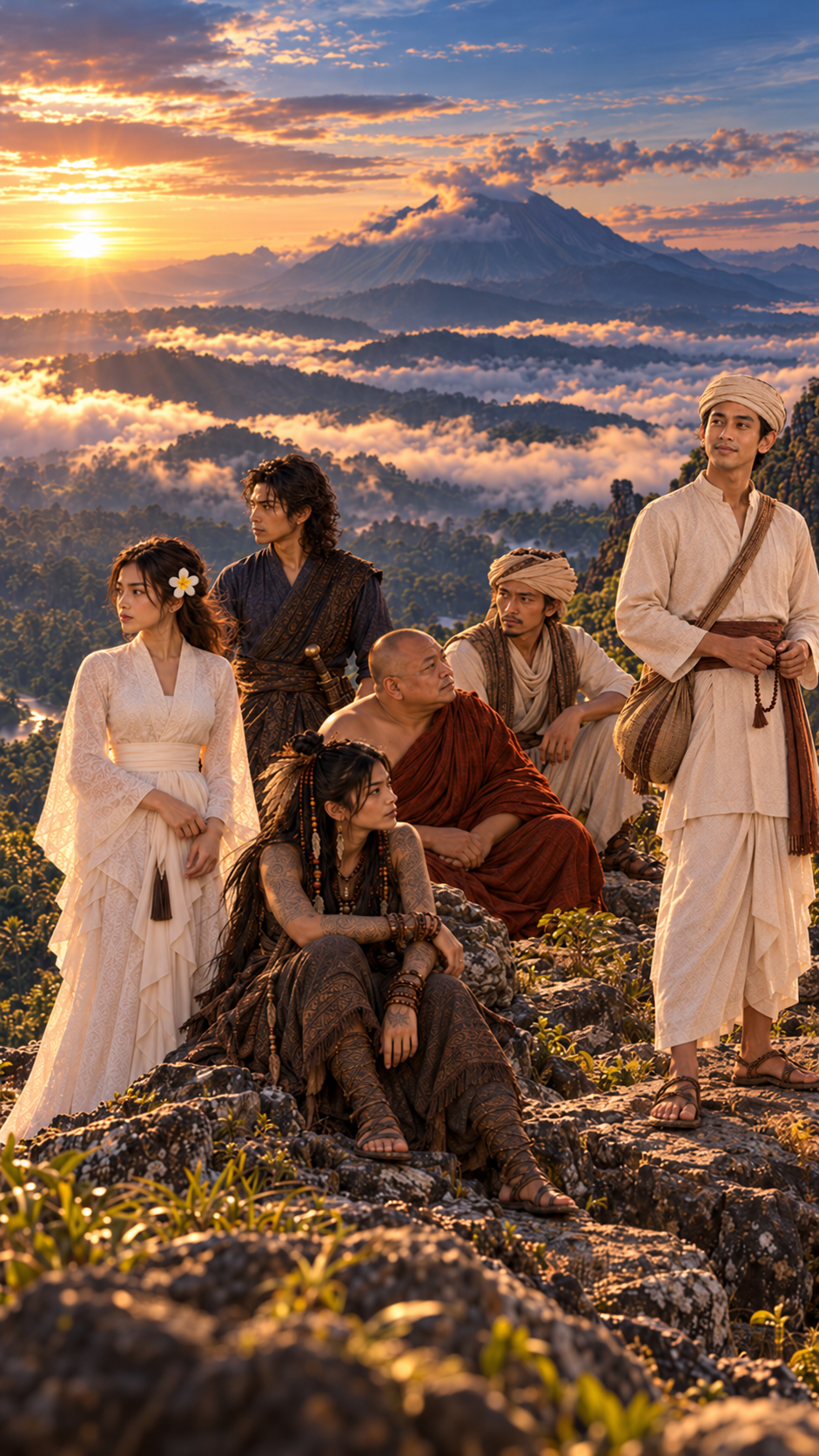
They reached the foot of Mount Geureudong in the afternoon, the sun already past the midpoint of the sky. The smell of the volcano was strong—sulfur woven into the air, and from the earth a faint warmth rising underfoot.
Following the rocky slope upward, they came to a small spring where water pressed up from the earth—and beside it, a simple wooden structure. A zawiyah.20 A roof against rain and a wooden floor to sit on. Nothing more.
On the floor of the zawiyah sat an old man—white jubah, white turban, a scroll unrolled across his knees, eyes cast down on the text. But he raised his eyes and lifted his face before the sound of their footsteps could have reached him. He had been waiting. That was what his eyes said.
“You have come,” the old man said.
His voice blended Acehnese and Malay. He rolled the scroll slowly and rose from his seat. His body was not light—but he did not hurry.
Faris stepped forward, pressing his hands together, bowing deeply. “Teacher—I have brought them all.”
The old man placed his hand briefly on Faris’s shoulder and nodded—then turned his gaze on the five, one at a time, neither slow nor quick, as though reading something in each of them.
“Sheikh Abdul Rauf al-Singkili—it is an honor to meet you,” Surya said, bowing.
The old man looked at Surya and paused. “You have come from Mount Semeru. The way you draw on the earth’s energy—it is visible.”
Surya’s eyes widened slightly. He had said nothing yet. The old man had simply seen.
The old man’s gaze moved to Hasan. Hasan pressed his hand to his chest. “Assalamu’alaikum, Sheikh.”
The old man looked at Hasan for longer than he had looked at Surya. A different quality of gaze—the recognition of something specific.
“Wa’alaikumsalam—you are from Banten. What kind of man was your father?”
“His name was Muhammad Yahya. A Muslim scholar. He went to find a friend at the sea seal off Banten—and did not return.”
The old man blinked once more and said, “I see.” Two syllables—but something was packed inside them. Acknowledgment. Sorrow. Understanding.
“Come—tea first,” the old man said, and walked inside.
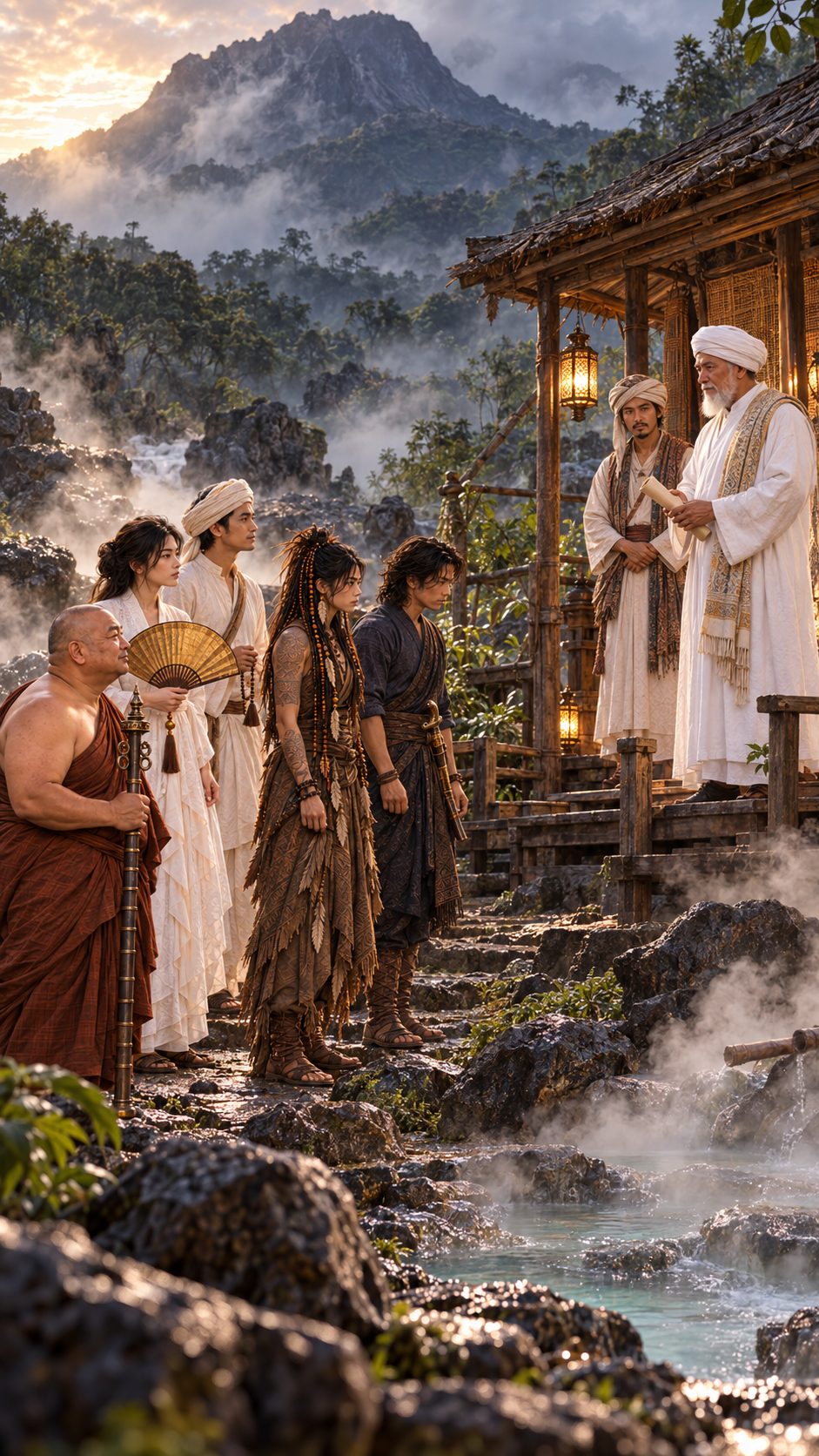
The tea had been brewed in the Acehnese way—ginger, cinnamon, and cloves simmered for a long time, the fragrance forceful, the warmth staying in the palm long after you first held the cup.
Six of them settled on the wooden floor of the zawiyah. Faris passed the small cups around in turn.
Surya closed his eyes over the first sip. “This is Acehnese tea? The spice is so much stronger than what I had in Palembang.”
Abdul Rauf looked at him. “Ginger, cinnamon, cloves—spices from Asia and these islands. Cloves come from Maluku. Aceh’s trade reaches Arabia and India; ingredients and ways of preparing them meet here, carried by ships.”
Abdul Rauf placed the scroll on his knees and began.
“The first time I knew a seal existed at the foot of this volcano—that was twenty-two years ago.” Unhurried. The pace of someone who had spent a lifetime teaching.
“At first I did not know it was a seal. I simply felt that the sacred Islamic presence in this land was weakening in a strange way, and I began to study why. Here, near the volcano, Quranic verses seemed to fall into the air and sink. Prayers that should have spread outward were being drawn into the earth instead.”
Hasan set his tasbih down on his knee and looked at the old man. “The seal was absorbing the prayers.”
“Yes,” the old man said, nodding. “At first I tried praying harder—if the seal was absorbing what I offered, I would offer more, and suppress it that way. But I could not remove it completely. Because the seal’s root was not in this land. Only later—with time—did I understand that the root runs through underground volcanic channels, far from here: Lake Toba.”
Dewi set the Kipas Sakti on her knees. “How did you come to understand that this seal is connected to Islamic scripture?”
The old man looked at her. “You see both worlds.” Dewi nodded. The old man continued. “To explain that, I must first tell you about one person.”
Abdul Rauf drew two scrolls from beside his knee. One was old and thick. The other was smaller and newer. He unrolled the old one. Arabic script covered the interior, dense and close—but between the Arabic, other letters had been drawn that were not Arabic. Hasan looked at them briefly and did not recognize them.
“The name of the person who planted this seal in this land,” Abdul Rauf said, “is Pieter van der Berg.21“
Silence settled briefly over the six of them. Intan rolled the name once behind her teeth. Arya looked at the old man, his hand resting on Nagaraja. On Dewi’s knees, the Kipas Sakti gave the faintest tremble.
“A Dutchman,” the old man continued. “Tall, fair-haired, a large scar on his left cheek—so recorded by those who saw him. Not a VOC man. Something else. If the VOC takes spices and pepper—this person moved in their shadow and took something else: the vital spirit of this land.”
Surya’s hand moved once on the ring of his tongkat candi. “One person planted seals across all these islands?”
“I cannot say with certainty. But it began in 1621—immediately after the Banda22 massacre. The spiritual energy of these islands shifted profoundly in the wake of that event, and in the four to ten years that followed, I believe he traveled the length of these islands planting seals.”
“Too wide for a single person’s footsteps,” Dewi said quietly.
“He used the VOC fleet. Wherever VOC ships went, he went too. If the VOC built a road of spice—this man laid another road on top of it, a road of seals. Because the two roads traveled together, neither one was visible.”
Hasan’s hand went still on his tasbih. “My father’s scroll described part of this pattern. Banten’s sea and Toba. That both of those were the work of one person—I am hearing this for the first time.”
Abdul Rauf pressed a finger to a section of the old scroll.
“This man’s sorcery is unlike any dukun23 magic in these islands. A dukun works with human souls, or with the grief of the dead. But this man’s sorcery uses text. More precisely—he takes the meaning held inside certain sacred letters and twists it into force.”
Hasan leaned closer and looked at the letters. Among the Arabic were Latin characters—and other script he had never seen before.
“What writing is this?” Hasan asked.
“Old European script. I have not been able to identify exactly which people it belongs to. But what I have determined is this—the letters used in the seal are letters that point toward things which the Quran calls sacred. And this man took those sacred things and used them as the material of the seal. That is why the seal responds to Quranic verses. They spring from the same root—the same sacred source, divided.”
Hasan turned the words over slowly inside himself. Sacred things divided from the same root. A familiar weight rose in his chest.
“Where is this person now?” Arya spoke for the first time. Short words, hard-edged.
“I believe he died more than a generation ago. I know little of the details—only that after finishing his work in these islands, he returned to Europe. He died there, it seems. But the seals—the seals live on without him. That is what makes this sorcery terrible. The one who made them can die, and the seals continue their work.”
Arya’s fingers found the hilt of Nagaraja, then left it. The enemy behind these seals was not simply the VOC he knew. Not something you could end with a blade. He took a moment to absorb that.
“Are there others like Pieter?” Intan asked. “If he’s dead, someone must be continuing this work.”
Abdul Rauf looked directly at Intan—the first time he had done so.
“There will be. The seal’s energy is still drawing vital essence and sending it somewhere. Someone is at that somewhere. But who that person is—that is beyond what I know. This is a road you must find your way along.”
Surya nodded slowly. “One person put down branches—and the branches are still living.”
“Yes.” Abdul Rauf unrolled the newer scroll. “This is twenty-two years of my analysis of this man’s sorcery—how the seal is structured, which verses act on which part of it, where the weak points lie. Everything confirmed line by line over the years I spent weakening the Geureudong seal.”
He pushed the scroll toward Hasan.
“This is for you, Hasan,” Abdul Rauf said. “I believe your father, Yahya—he was looking at the seal from the same angle. We never met. But we were reading the same books. That is how scholarship connects people.”
Hasan touched the scroll but did not unroll it. His hand trembled briefly. He waited for the trembling to pass before drawing the scroll to his chest.
“Thank you, Sheikh.”
“All I did was write it down. You are the one who will use it.” Abdul Rauf paused. “One thing to remember: this man’s sorcery is powerful because he understands the meaning of sacred script—not just the letters. To overcome him, you need someone who understands the meaning more deeply still. Memorizing the letters is not enough. You must understand what they mean. That is your work, Hasan.”
Hasan held the scroll briefly against his chest.

Surya took another sip of tea. “Then we break this seal—tomorrow?”
“Tomorrow morning. Rest tonight—and tomorrow morning we attempt the removal. The seal is already greatly weakened. With your help, it should be done.”
That evening, Faris cooked. He made Kuah Pliek U24Catatan ↗—an Acehnese dish, a thick and deep vegetable curry made from fermented coconut. The smell was powerful.
Surya went to stand near the pot and inhaled, his eyes widening. “Fermented. Similar to the andaliman smell from Toba—but much, much deeper. What is this?”
“Pliek u—coconut that has been fermented for a long time,” Faris said, stirring. “The fermented ingredient can be stored and carried elsewhere. Here we use it to flavor the vegetable broth.”
Surya took a spoonful. The fermented coconut came first—deep and faintly sour—then turmeric and coriander rising behind it, and at last the soft giving texture of the vegetables dissolving gently on the tongue. He opened his eyes. “Where did someone teach this? Where does a flavor like this come from?”
Abdul Rauf smiled from beside him. “Aceh has its own ways with coconut and spices. This is a dish of this land.”
Hasan ladled Kuah Pliek U over his rice and looked at Abdul Rauf. “Coming here in person—you can feel how much this land has taken in and blended together. In the food too.”
Abdul Rauf filled his own bowl. “Aceh sits between Arabia, India, and these islands. Everything that comes through here is filtered once, blended, and then sent into the archipelago. Islamic scholarship and spice alike.”
After the meal, Faris fed the fire higher. The night at the foot of Mount Geureudong was cool. Flames moved, and six shadows stretched long across the rocks.
Hasan unrolled the scroll he had received and moved close to the light. He read from the point Abdul Rauf had marked and worked his way through. He felt the seal’s structure loosening, one line at a time—the script unfamiliar, but the Arabic commentary Abdul Rauf had written beside it gave him footing, and meaning came.
Surya came to sit beside Hasan and glanced at the scroll. “Those letters—I feel as though I have seen them somewhere.”
“You have seen them, Bhante?”
“Once or twice, in manuscripts my own teacher kept. I don’t know if they’re exactly the same—but the shape is similar. He never explained them to me in detail.”
Hasan looked at Surya for a moment, then returned to the scroll. He asked nothing further. But the letters on the page became something else now—marked twice in his memory. If this script also appeared in manuscripts kept by Surya’s own teacher, then this script reached further than he had imagined. Hasan held that inside himself for now.
Abdul Rauf had listened. He glanced at Surya briefly but did not ask. Instead, he spoke to Hasan.
“Do not try to memorize it all tonight. Read it slowly. Becoming familiar with it comes first. Know enough for tomorrow’s rite—nothing more than that.”
Hasan nodded and rolled the scroll closed slowly. He placed one hand briefly over his chest.
Early the next morning, six of them stood before the crack in the rock at the foot of Mount Geureudong.
The crack was not large—a gap running across the face of the rock, wide enough for one arm—but from it rose the smell of sulfur, and with the sulfur, the seal’s presence.
Dewi opened the Kipas Sakti and read the niskala. “It’s here. Much weaker than Toba’s. But it is old—the roots reach all the way down into the volcanic bedrock.”
Abdul Rauf closed his eyes and brought his hands together. Arabic prayer began to flow.
Surya listened. The same language as Hasan’s prayers—but the weight inside it was different. Twenty-two years of standing before this seal had soaked into every phrase. The prayer met the air—and the sulfur rising from the crack paused. The first moment the seal had moved.
Hasan stood beside Abdul Rauf, tasbih in hand, and added his prayer to the current. Carefully at first—listening to how Abdul Rauf prayed, trying to align his own prayer with that flow. Then something changed. The prayer went deeper than it did alone.
Two streams meeting make a stronger current. Hasan’s prayer flowed into Abdul Rauf’s. The letters he had read the night before arranged themselves once more inside him—and where the seal was weak, the knowledge rose alongside the prayer.
Surya gripped the vajra in both hands and enclosed the others from the outside. Forty years gathered at Mount Semeru moved through the vajra. His feet touched the volcanic earth, and the energy rising from beneath him traveled up his spine to the top of his skull. They were far from his mountain—but the earth itself was alive here, and the energy was not weak.
Arya drew Nagaraja and turned its light toward the crack in the rock—Nagaraja’s light entered the fissure. The hand gripping the hilt tightened. Arya’s face did not move.
Intan dipped her mandau in the spring water and held watch around them. The blade vibrated—barely, but it did.
Dewi entered the niskala. There was the seal—thinned by twenty-two years of Abdul Rauf’s prayers. Hard still, but cracked through, like stone weathered too long. Dewi put her hands on those cracks.
From outside, Abdul Rauf’s prayer pressed in stronger. Hasan’s voice echoed inside it. Surya’s vajra held the perimeter. Arya’s Nagaraja lit the fissure from within. Intan’s mandau kept time with its trembling.
Dewi pulled at the cracks.
The seal came apart.

No sound—but the air changed. Something that had been pressed down beneath the sulfur rose now, and it was the sacred presence of this land—the spiritual force of Aceh’s earth. Everything the seal had drawn in was rising, and as it came up the air went briefly cold, then warm. Dewi watched it spread—a layer at a time, across the zawiyah, across the Gayo Highlands, outward toward the distant sea. Twenty-two years of suppressed prayers, each one finding its way in the direction it had been meant to go.
“It’s changed. The whole mountain just breathed,” Intan said, drawing her mandau from the spring.
Abdul Rauf finished his prayer and opened his eyes. His expression was that of a person who had set down a weight they had carried for decades. His shoulders had dropped, just slightly.
He looked briefly at the sky. A strip of cloud moved sideways off the summit of Geureudong, and for a moment sunlight fell on the place where it had been. At the corner of the old man’s eyes, something caught the light briefly—and was gone.
Dewi came back from the niskala. “The Toba seal—it moved. When the connection with this one was severed, something cracked in it.”
“I will come with you to Toba,” Abdul Rauf said. A pause, then: “I need to see the seal there myself—and the script written into it.”
Faris looked at his teacher’s profile. This would be the first time. He started to say something—then stopped. The zawiyah would be his to keep, from tonight.
Hasan carried the scroll against his chest and walked back to the zawiyah. Abdul Rauf followed behind him, unhurried. Faris added fresh wood to the fire. Intan stood beside it and watched the light for a moment. Dewi slowly closed the Kipas Sakti and looked once more toward the mountain. Arya sheathed Nagaraja and stood for a moment at Dewi’s side. No one had announced it—but the five, and one more, were now six, and this felt natural to everyone.
Surya sat on the wooden floor and laughed—just briefly.
“Are we leaving tomorrow morning?” He paused. “One more bowl of Kuah Pliek U this evening, then? We won’t be able to have it again once we go.”
Faris smiled and went to the hearth. Abdul Rauf arranged his scrolls and let a faint smile appear—the first one any of them had seen from him.
Mount Geureudong sent its white steam through the fumaroles that night, as it always had. But from the crack in the rock—no sulfur rose.
Notes
19. Maghrib
Maghrib: the fourth of the five obligatory daily prayers, performed at sunset. A brief supplication after prayer is distinct from the obligatory prayer itself. A prayer missed through sleep or forgetfulness is made up when remembered.
↩ Back to text20. Zawiyah
Zawiyah: a place for worship, study and teaching in Sufi traditions. The retreat near Geureudong and Abdurrauf’s work on the seal belong to this novel’s fictional storyline, not his documented biography.
↩ Back to text21. Pieter van der Berg is a fictional Dutch practitioner of harmful magic in this novel. His journeys,
Pieter van der Berg is a fictional Dutch practitioner of harmful magic in this novel. His journeys, seal-making, appearance and relationship to colonial violence are story elements, not a documented historical biography.
↩ Back to text22. Banda Massacre (1621)
Banda Massacre (1621): VOC violence under Jan Pieterszoon Coen, including executions, displacement and enslavement, in pursuit of control over nutmeg. It devastated the Bandanese population. The connection between this historical trauma and Pieter van der Berg’s seals is fictional.
↩ Back to text23. Dukun is a broad term for traditional healing or ritual specialists whose roles vary by community. D
Dukun is a broad term for traditional healing or ritual specialists whose roles vary by community. Dukun santet refers to a person believed to use supernatural means to harm others. The account of souls, grievances and script-based magic in this scene belongs to the novel’s fantasy.
↩ Back to text24. Kuah pliek u
Kuah pliek u: an Acehnese vegetable curry made with fermented coconut flesh and seasonings such as turmeric, coriander and lemongrass. A specific origin from scarcity of coconut in the Gayo Highlands is not asserted.
↩ Back to text