
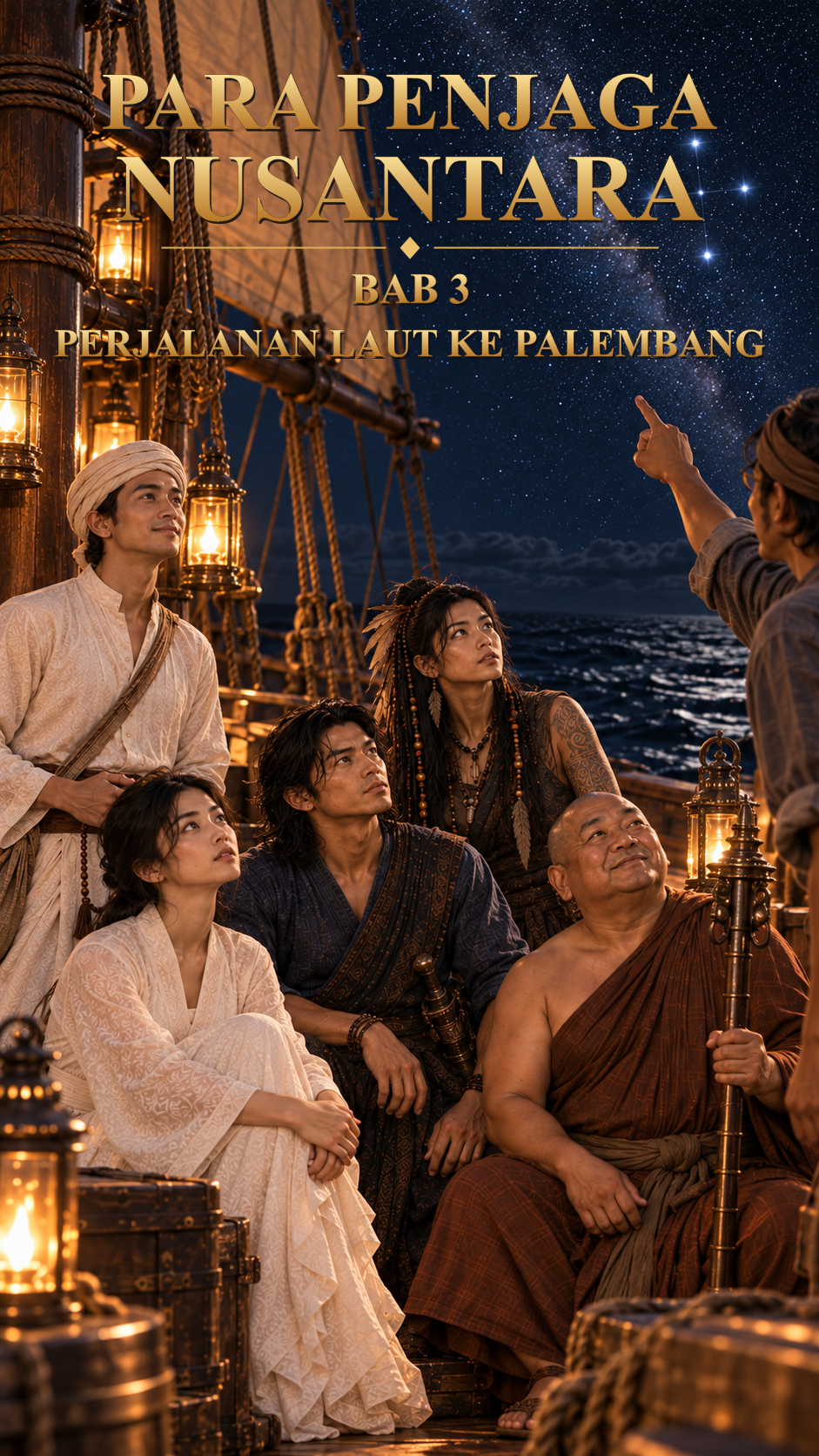
CHAPTER 3 · EPISODE 3/3
Toward Palembang
The five returned to the ship before sunrise.
“It’s done?” The Madurese sailor asked.
“Done—the old man gave us these.” Surya climbed aboard carrying two coconuts.
“Did Nagaraja give off light?” Intan asked Arya as she boarded.
“It did.” Arya said.
“What did it feel like?” Intan asked.
“My palm got hot. Briefly.” Arya said.
“Were you scared?”
“I was caught off guard.” Arya said, and the honesty in it was new.
Intan looked at Arya. It was the first time he had admitted being caught off guard.
“When the ground shifted under me, I was caught off guard too—it’s different from hunting beasts in Kalimantan. You can’t see it.” Intan said.
“How long have you been reading the spirit world, Dewi?” Intan asked.
“Since I was born.” Dewi said.
“Doesn’t it bother you?” Intan asked.
“It’s already mine.” Dewi said.
“Thank you, Intan—when the ground shifted under you and you jumped back, that was the right move. If you’d held your ground, it would have pulled you in.” After a pause, Dewi added this.
“How do you know that?” Intan asked.
“Because I’ve felt the pull.” Dewi said.
“Be careful.” Intan looked at Dewi once more.
“I will. You too, Intan.” Dewi said.
“Hasan, your prayer on that beach—I’d never heard anything like it. I don’t know what the sound was, but the sand stopped moving.” Intan shifted the subject.
“My father used to say that the earth remembers sound.” Hasan said.
“The earth?” Intan asked.
“The sand on Bangka knew that prayer—it’s an old sound.” Hasan said.
“Raising anchor.” The sailor said without further questions.
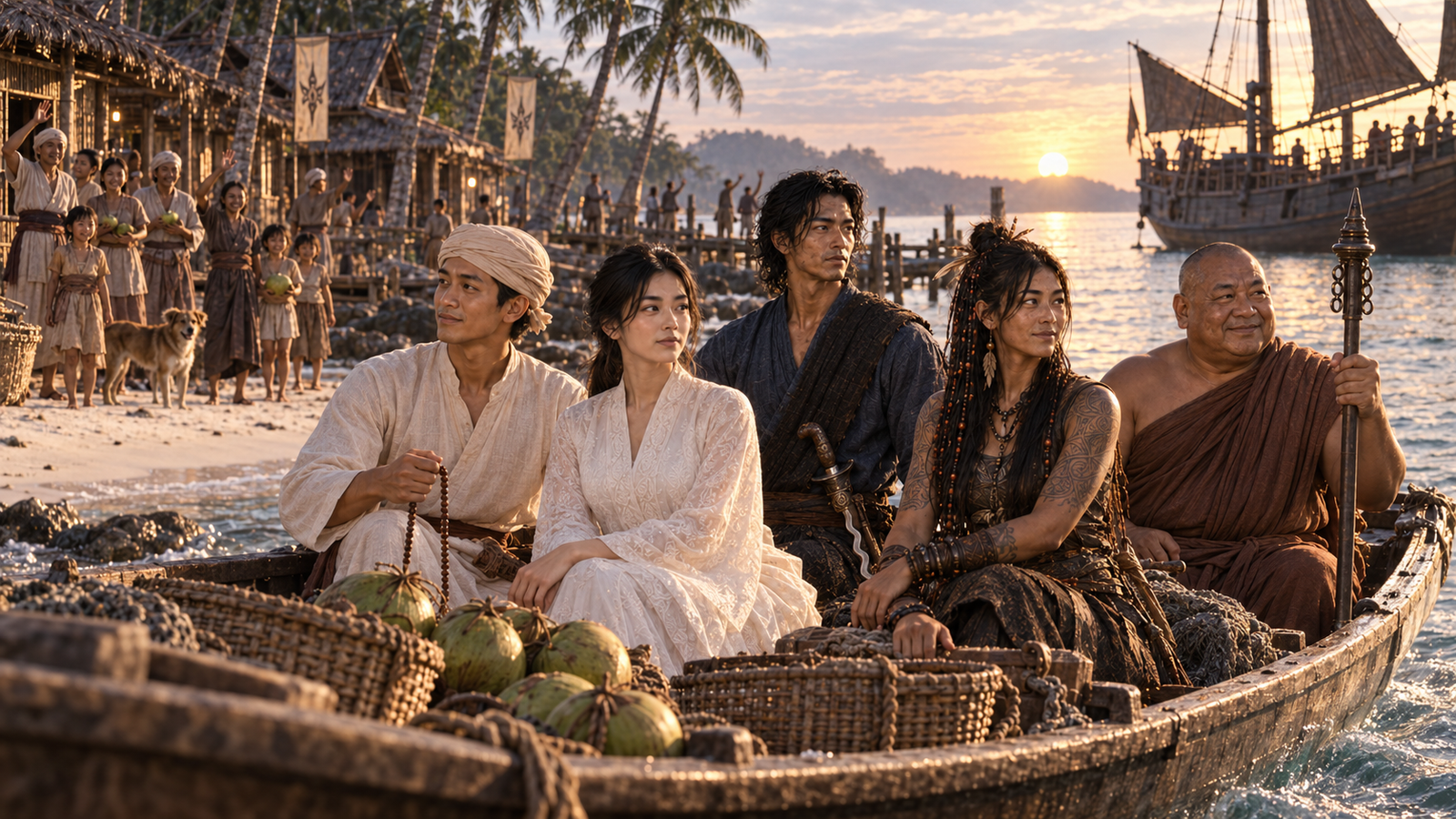
The ship began to move again. The mouth of Bangka Island fell behind them. The narrow channel of Selat Bangka opened ahead—Bangka Island to the east, the Sumatran mainland to the west, the two shores closing in on the strait. The sea between them caught the first light of morning and turned to gold.
Hasan finished his Fajr prayer on deck and looked east.
“Why was your prayer different on Bangka?” Surya came and sat beside Hasan.
“How could you tell?” Hasan looked at Surya.
“The thread was different from what you used at the warehouse.” Surya said, cracking open a coconut.
“The two forms—they recognized the direction the sound was coming from,” Surya said, offering Hasan a coconut.
“I don’t fully understand it yet,” Hasan said quietly as he took it.
“There are things you learn by doing, not by understanding first—forty years of practice on Mount Semeru taught me that.” Surya drank his coconut.
Hasan turned the tasbih. The beads in his hand were warm—they were always warm. The things his father’s hands had touched seemed to hold that warmth for a long time.
“Bhante.” Hasan said.
“Yes.”
“I watched the forms stop when they heard my recitation—it felt strange. I don’t know whether they were responding to my sound, or to my father’s.”
“Do you think those are different things?” Surya stopped drinking and looked at Hasan.
Hasan turned the tasbih in silence.
“I’ve had moments like that in my practice too—where I couldn’t tell whether it was me, or my teacher when I was a novice, working through me.” Surya said.
“But why should that matter—you inherited it, and that makes it yours.” Surya said.
Hasan turned the tasbih for a long time.
“Jazakallah khair, Bhante.” Hasan said. The same words as before, but the weight behind them was different.
“When we arrive in Palembang, what do we do first?” Surya asked.
“Read the place—find out what’s where.” Dewi answered.
“And then?”
“Find it and pull it out.”
“And then?”
“From Palembang, we head north to Toba.”
“But first, pempek13Catatan ↗—if you go to Palembang, it’s the one thing you must eat. Fish paste mixed with sago starch, shaped into cakes, and served with cuko, a vinegar-based sauce. And the best kind is the telok besak—a whole egg wrapped inside the cake. Break it open and the egg comes out whole.” Surya said.
“Have you been?” Hasan asked.
“Never.” Surya said.
“Then how do you know all this?”
“There was a monk from Palembang at the Semeru monastery, and he talked about pempek constantly—I asked him once what kind of food it was, and he explained for two hours straight. The ingredients in the cuko, the temperature for steaming the fish, the exact moment you fold the egg into the telok besak. When someone explains a single dish to you for two hours, you are obligated to eat it. Not eating it would be an insult to those two hours.” Surya said.
Intan snorted. Everyone saw it—it was the first time Intan had laughed. She seemed unaware of it herself, and quickly pressed her lips shut. Surya pretended not to notice and drank his coconut.
As they cleared the Selat Bangka, the sea opened wide. The eastern coast of Sumatra stretched out in a long line, and far ahead, the mouth of the Musi River came into view—its breadth was enormous. Where river met sea, the muddy water mingled with the blue, drawing a visible boundary between them. There was a smell of earth—carried from deep inside Sumatra.
“For centuries, Sriwijaya held great influence over trade in these waters. Chinese ships, Indian ships, Arab ships—Palembang stood within those sea routes,” Surya said, gazing at the coastline.
“Why?” Intan asked.
“When you have power, that’s what you do—if you hold the sea, you hold the world. Sriwijaya understood the sea better than any kingdom in the history of these islands. They didn’t just build ships. They built the waterways themselves.” Surya said.
“And now the VOC has taken that role.” Hasan said, looking toward the river mouth.
“Exactly—and that’s why the seals are on the same waterways. Where there’s power, there are seals.” Surya said.
“Why did Sriwijaya fall?” Intan asked.
“Internal fractures—and then Majapahit grew strong. The kingdom that holds the sea is the strongest, but the sea can never belong to one person. Someone always comes next.” Surya said.
“The VOC too?” Intan asked.
“The VOC too—though I couldn’t tell you when.” Surya said.
“Then the power of this land goes back to Sriwijaya’s time, and further,” Arya said.
Everyone looked at Arya. It was rare for him to speak first.
“Yes. A seal takes root in what is already there. The land’s strength is older than the thing feeding on it,” Surya said, looking at Arya.
“Then we must distinguish the seal from what it has bound,” Hasan said.
“Exactly. Dewi will have to read it before we can know what to do,” Surya said.
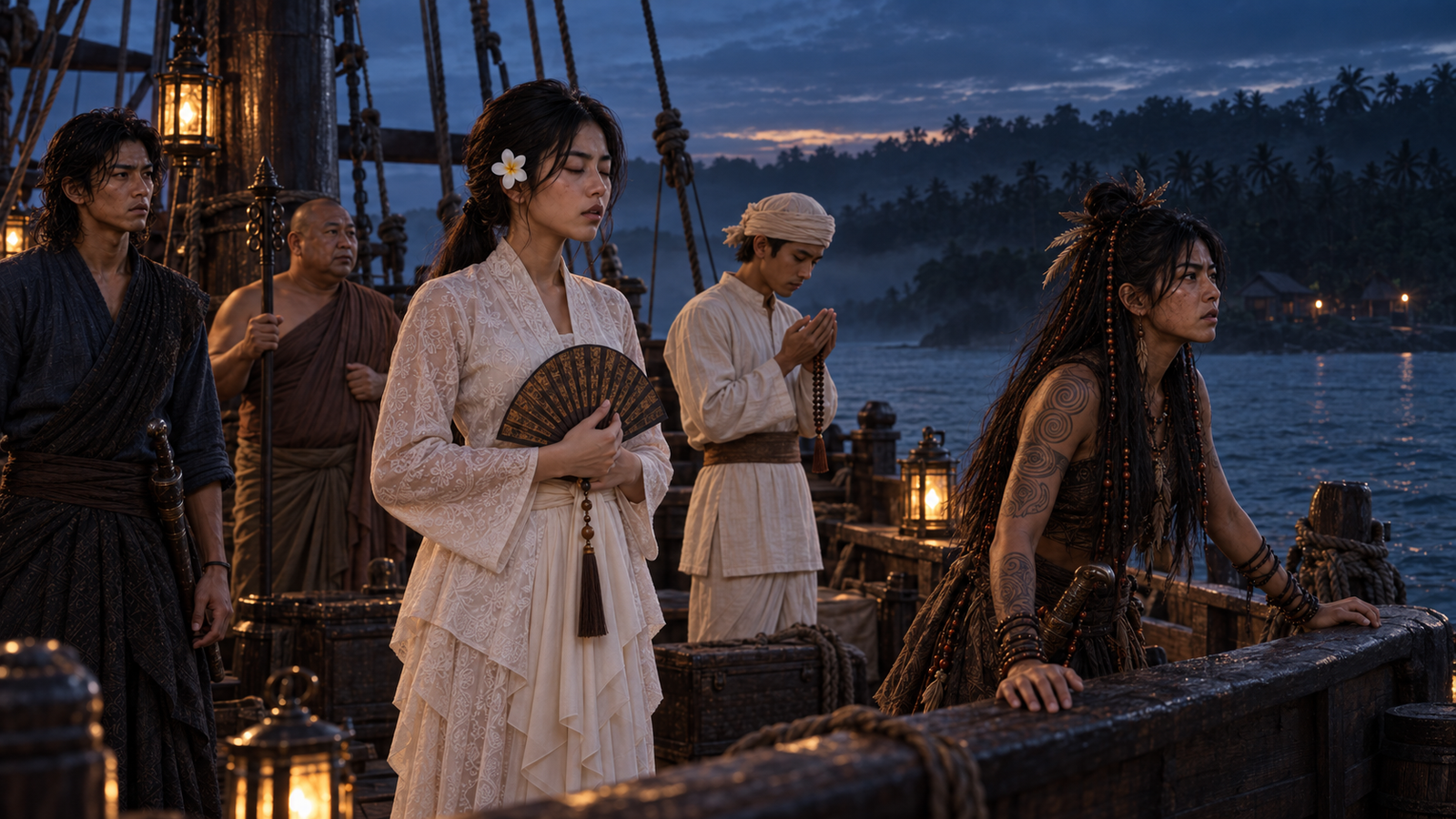
Dewi gazed toward Sumatra and read through the niskala. It was different from Java—more primal, more ancient. Centuries of Sriwijaya’s history had seeped into the land, and beneath that, things were blocked.
“Can you read it?” Arya asked, standing beside her.
“Yes—there are things in Sumatra stronger than what we found in Batavia. Especially toward Toba. Deep beneath the lake, something very old is buried. It feels different. The roots go deeper.” Dewi said.
Arya placed his hand on Nagaraja. The vibration was faint, but it was directed toward Sumatra.
“Is the vibration different now, from before Bangka?” Dewi looked at Arya.
“A little stronger.” Arya said.
“Nagaraja remembers places it has passed through—keris blades remember the ground they’ve walked. That’s what’s getting stronger.” Dewi said.
“Memory?”
“Yes—there are old things in Sumatra, so Nagaraja is reading them too.” Dewi said.
Arya placed his hand on Nagaraja again. The idea that it was reading something was unfamiliar—but the warmth he had felt on Bangka’s sand, when the blade had lit up against the spirit, still seemed to linger in his palm.
“Ready?” Arya asked, short.
“We have to be.” Dewi looked at Arya’s steady, clean-lined face as she spoke.
“Are you afraid?” Arya asked. His voice was short and firm—but the question was genuine.
“I am—but we still have to go.” Dewi answered honestly.
“Let’s go together.” Arya said. Then he turned back toward Sumatra.
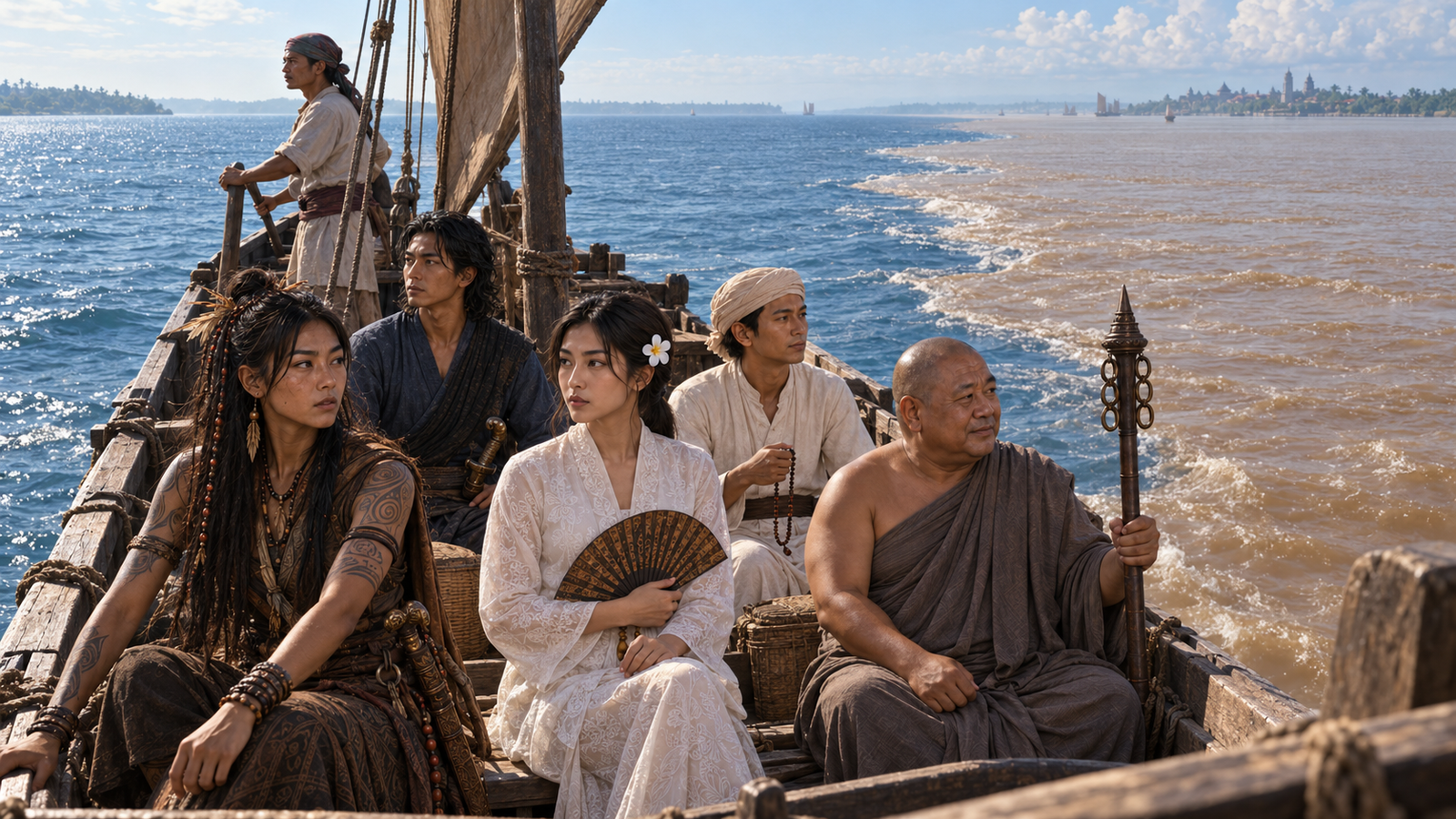
The waves rocked the ship, and the wind filled the sails. The ship pressed forward.
The silhouette of Sumatra sharpened by a fraction.
The five of them were heading that way.
Notes
13. Pempek
Pempek: a Palembang fishcake now commonly made with tapioca and served with cuko. Accounts of its origins differ. The name, the Telok Besak variety, and the sago-based preparation in this 1683 scene are fictional adaptations, not proof of an unchanged recipe from Sriwijaya’s time.
Read the illustrated Catatan Nusantara →
↩ Back to text