
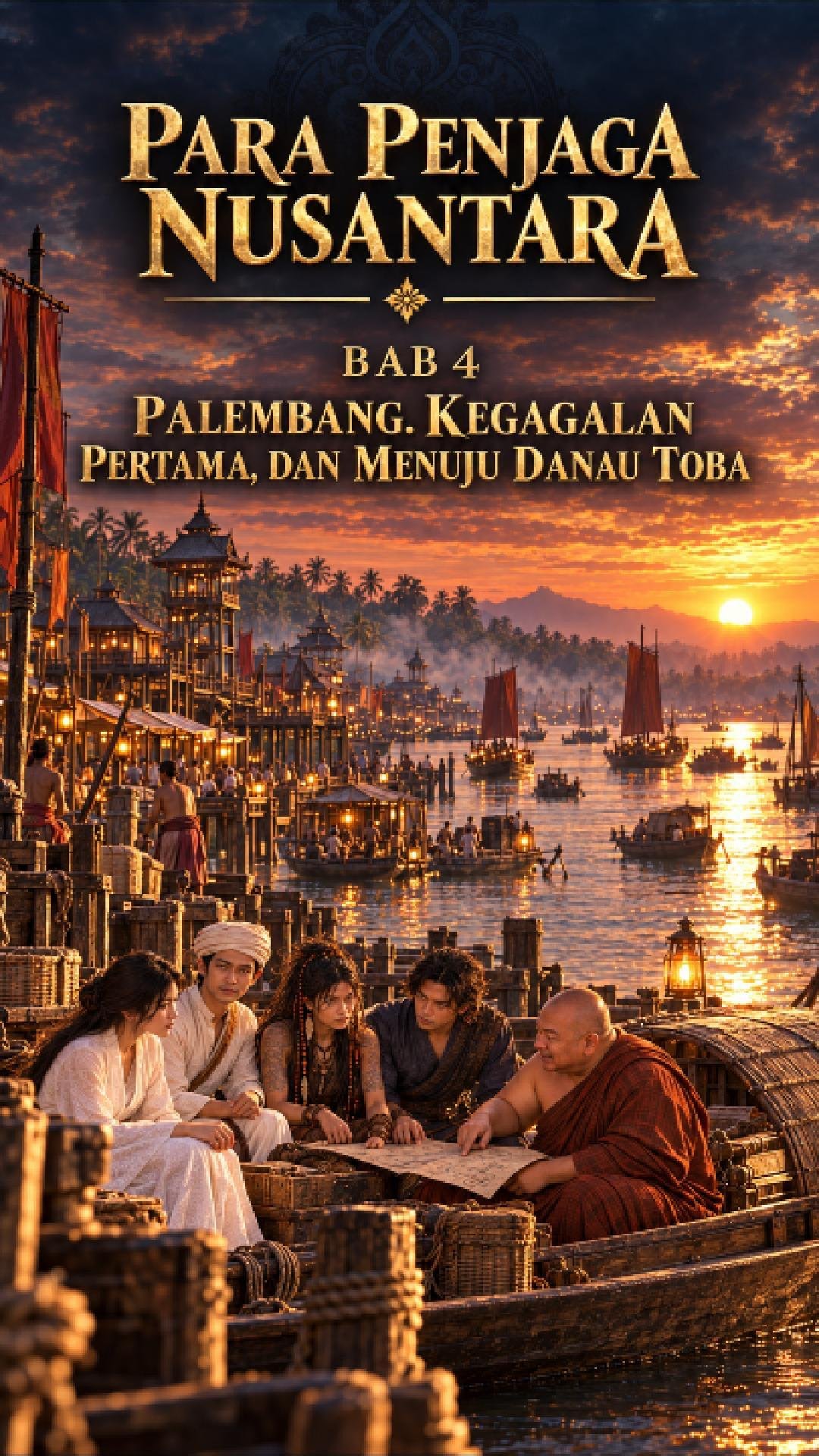
CHAPTER 4 · EPISODE 1/3
Palembang and the First Failure
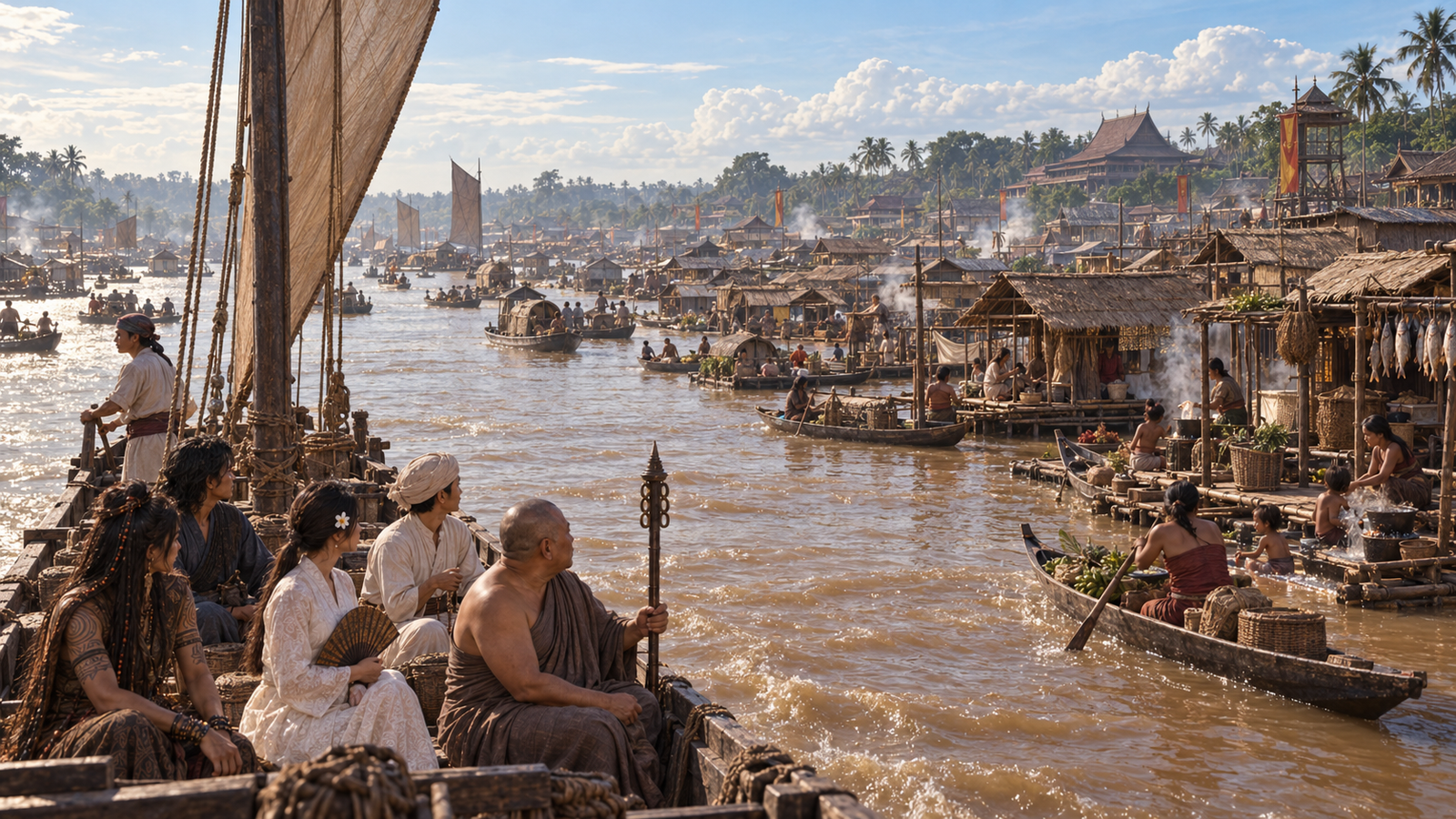
At the mouth of the Musi River1, sea and river seemed to claim each other. Brown water met blue water across the broad estuary. The merchant ship that had brought them from Batavia lay offshore; for the journey upriver they had transferred to a small local boat. At its tiller stood Thomas, a boatman familiar with the Palembang waterways.
The moment saltwater gave way to fresh—Intan, standing at the bow, drew a breath and felt something she had not felt once since leaving shore: orientation. The sea was vast but directionless; a river always knew where it had come from and where it was going. This one was nothing like the Kapuas in scale, but it was a river, and rivers were the closest thing Intan had to home.
“The smell is different,” she said from the bow. “The sea has one smell. The river has many.”
“This river carries all of Palembang down with it,” Thomas said, one hand on the tiller. “Fish caught upstream—that smell comes. Someone burns wood at the market—that smoke comes. Boats go up and down—the oil smell comes too. Any big river next to a big city is the same.”
The journey upriver took half a day. From the estuary to the city the water slowly narrowed, and the mangrove forest thick on both banks gave way bit by bit to settlements. Fishermen’s wooden boats drifted at intervals on the water; from somewhere along the banks came the sound of women doing laundry and children throwing themselves into the river. Mud smell, fish smell, smoke smell filled the air above the water—and Intan, whose nose had grown used to five days of ocean salt, closed her eyes and flared her nostrils as dozens of scents arrived at once.
“So many smells,” she said. “More than the sea. Much more.”
Palembang opened before them. Along the river, rumah rakit2Catatan ↗—the floating houses—stood crowded together: wooden homes built on bamboo rafts that swayed each time the water moved, and the life lived on that water—cooking, laundering, bathing children—came drifting to the boat’s edge in sound and smell. Grilled fish, burning coconut husks, the damp swollen scent of wood long soaked in water. Intan’s nose separated them, one by one.
Surya stood watching the smoke rise between the floating houses and flared his own nostrils. Dewi held the Kipas Sakti against her chest and read the river through the layers of niskala.
“Bhante.” Dewi spoke his name, and Surya turned—not because of the smoke but because of the weight he heard beneath her voice.
“The seal here is different from Batavia’s. It’s in the bed of the Musi, with its roots going far deeper. Much deeper.”
Surya looked down at the brown water moving slowly beneath them. He had felt it too—something below the surface.
“Underneath the river,” he said. “In Batavia we could walk in and pull it. How do we even approach something underwater?”
“We’ll have to find out. Whether I can enter the niskala from the surface, or whether I need to be in the water—I don’t know yet.” Dewi answered plainly.
“Let’s eat first.” He smiled even as Dewi’s eyes told him she wasn’t finished. “I can’t think on an empty stomach. A river that has fed generations of kingdoms must have food worth waiting for. Five days of dried fish on open water—what we need right now is a proper meal.”
The moment they stepped off the boat, Surya’s nose reacted. From somewhere inside the port alley came a smell—fish, but not the raw brine smell of Batavia’s Pasar Ikan. Sweeter. Fermented. Layered beneath it, the rich warmth of something frying in oil, and above that, the sharp-sour bite of vinegar. Surya turned his head and followed, walking, and the other four and Thomas fell in behind—watching his broad back.
“Bhante—where are we going?” Intan asked.
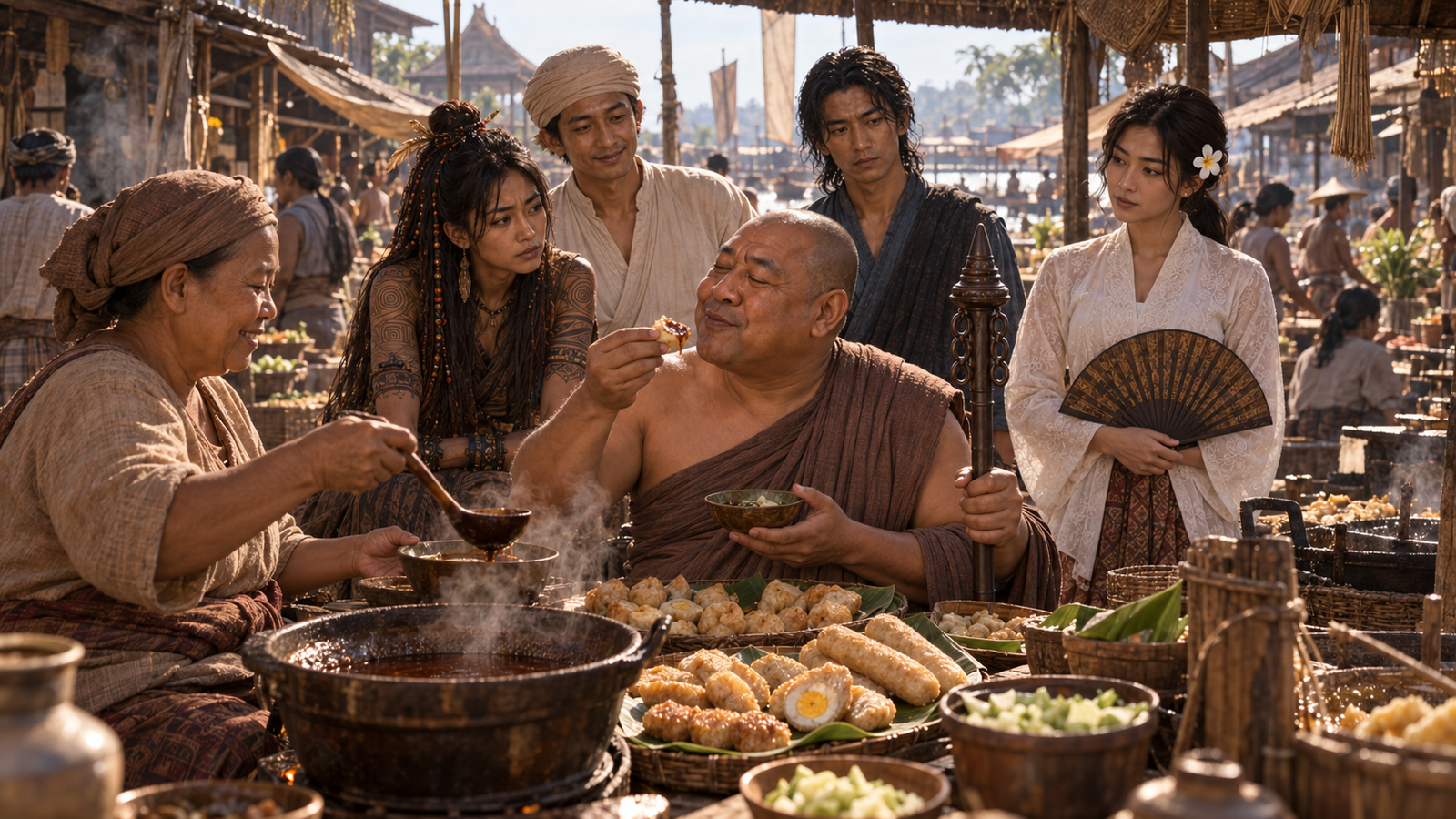
“Pempek3Catatan ↗,” he said, not breaking stride. “A monk from Palembang, who passed through our hermitage on Mount Semeru, once spent two full hours explaining pempek to me. The kelesan4—he said it goes back to Srivijaya, originally made from belida5 fish from the Musi, mixed with sago palm starch and steamed. The fish is mixed with sago starch; steaming and frying give it different textures. Telok besak6 has a whole egg inside. Adaan7 goes in with coconut milk and comes out fried and round. Lenjer8 is long and cylindrical—you cut it before eating.” He recited all of this while walking, unhurried. “A meal that required two hours of instruction must be eaten. To leave it uneaten would be an insult to those two hours.”
“In Islam, sharing food is the beginning of learning,” Hasan said, a smile in his voice. “That monk from Palembang—he taught through food.”
“Exactly!” Surya turned and grinned at Hasan. “You understood it perfectly.”
Inside the alley there was a stall. An old woman sat before a large pot, cutting fishcakes, while inside the pot kuah cuko9—a sauce of palm sugar, vinegar, garlic, and chilies—bubbled and sent up its sweet-sour-spicy cloud all at once. Beside the pot, long pieces and round pieces and egg-filled pieces were stacked on a wooden tray. Surya stopped at the stall and greeted the woman, who looked up at the round-bellied monk and made space for him without ceremony.
“Telok besak, two. Adaan, one. Lenjer, one. For five people.” He ordered without a moment’s hesitation.
“Bhante—you didn’t ask us?” Intan said.
“Someone trying pempek for the first time cannot choose.” He turned to Intan with an expression of absolute seriousness. “You have to trust the judgment of someone who received two hours of instruction.” It was difficult to believe a middle-aged monk with a round belly could look so grave about fishcake, and there was no room to argue—Hasan was turning his tasbih and laughing quietly, and Arya had placed his hand on Nagaraja and sat in silence.
The woman ladled kuah cuko over the telok besak and Surya cut one open. Inside was a whole egg, the yolk deepened to gold where the sauce had soaked in. He lifted a piece and put it in his mouth, and what followed was the face of a man who stops chewing and begins again, slowly receiving the flavor—something deeper than the brightness that had crossed his eyes over nasi uduk, the quiet wonder of a person finally tasting something he has waited decades for.
“Lha.” He said it very softly. Almost to himself. Then he reached for a second piece.
“The fish is tender but it holds together. The sauce is sweet and sour and spicy all at once, and yet it becomes one thing. Five days at sea—the reward for all of it is on this one plate.”
“If it’s good, you eat more.” Intan took a bite of hers, chewed—then paused. Then reached for a second piece. Surya slapped his knee and laughed.
“The egg holds the sauce inside it, so the flavor changes three times in a single bite. First the fishcake—savory. Then the egg—soft. Then the sauce rises at the end, hot.” Hasan said as he ate. Arya quietly cut a piece of his lenjer and set it on Dewi’s side of the plate. When Dewi looked at him, Arya was already looking forward.
“Thank you,” Dewi said quietly.
“Auntie,” Surya said to the woman between bites, “what fish is in this pempek?”
“Tenggiri and gabus, mixed. Belida would make it better, but belida is hard to find these days.”
“Why hard to find?”
“The VOC controls the boats on this river—the fishermen can’t fish freely anymore. Twenty-four years ago they burned this city.” She paused. “Burned the Kuto Gawang palace itself. They rebuilt it, but the Palembang10Catatan ↗ before that burning—it isn’t this.”
Her voice held anger, and underneath the anger, settled resignation.
“Banten11 is similar,” Hasan said quietly, turning his tasbih. “Since the VOC intervened on Sultan Haji’s side in the war with his father, its influence over trade has grown. People of this land are finding it harder to use what belongs to their land.”
The woman studied him—this young man in white, the same anger she recognized in his face—and slowly nodded. She pushed another plate of pempek across to them.
“Eat more. They can burn a city, but they can’t burn this.”
“Auntie,” Surya said, receiving the plate, “I need to pass this to that monk from Palembang someday. They can burn a city but they can’t burn this—that is Palembang.”
As the sun leaned west, the five sat on an empty boat moored along the riverbank and talked through the seal. The Musi had gone red in the evening light, and between the floating houses charcoal smoke rose with the smell of evening rice being cooked above it.
“We need to do this at night,” Intan said first. “Anything we do on this river in daylight, everyone will see—including the VOC. At night, a small boat to the middle of the river. That’s the right approach.”
“You think faster after pempek, Intan,” Surya said, nodding.
“Nothing to do with the food. I’m a Dayak warrior.”
“Don’t Dayak warriors eat?” Surya asked. Intan didn’t answer. Hasan laughed quietly beside her.
“Three on the boat,” Surya said. “Dewi enters the niskala. I hold the vajra alongside and push back. One person rows.”
“I’ll row. I know rivers,” Intan said.
“Then Hasan and I stay on the bank,” Arya added, brief. “Hasan’s prayers carry across water.”
“They will reach. In the Batavia warehouse they went all the way inside—water conducts sound well; they may carry even farther here.” Hasan said.
“How deep is it? The seal under the river?” Arya asked Dewi.
“Far deeper than Batavia’s. I’ll know more exactly once I’m inside. But I can go down. I only need to reach the riverbed.”
“If you can’t?” Intan asked.
“Then we come back. We don’t push it—Dewi comes first.” Surya looked at Intan. It had been an honest question.
“I won’t push it,” Dewi said.
That night. The Musi River.
There was no moon. Clouds covered the sky, and the Musi ran dark as black silk. Light leaked from the floating houses and shivered across the water, and from inside came the sound of a child crying, of adults talking low, and the smell of evening rice—the night of people who lived their lives on this river.
Hasan had finished his Isha prayer on the bank and risen. Intan pulled their borrowed boat to the water’s edge.
Three climbed aboard. Dewi first, then Surya, and last Intan—who, as she stepped in, met Arya’s eyes on the bank. Arya said nothing, but set his hand on Nagaraja. Intan gave one nod and took the oar. The boat moved between the floating houses, and from inside came the click of bowls and the low sound of laughter, and the smell of fish tail burning over charcoal drifting out across the water.
As they moved toward the center of the river, the weight of what Dewi was reading in the niskala grew heavier. Similar to what she had felt in the Batavia warehouse—but different. Lower. Deeper. If the Batavia seal had been buried one fathom under the earth, this one was ten, its roots going down past any point she could see.
“Here,” Dewi said, and Intan lifted the oar. The boat floated quietly in the middle of the river.
“Deeper than Batavia. Be careful, Dewi.” Surya held the vajra in both hands, a furrow across his brow, voice low.
Dewi gripped the Kipas Sakti and closed her eyes.

She entered the niskala. Darker than the Batavia warehouse. As she descended, the weight of water pressed against her even within the spirit realm—the deeper she went, the darker it became, and instead of the smell of water, the smell of iron drove into her.
The seal appeared.
The same iron stake as Batavia’s. The same markings. But the size was different—far larger. It had driven through the riverbed and sent roots into the earth below, and the end of it was beyond sight. When Dewi approached, the resistance came—far stronger than Batavia’s had been.
She pressed harder toward the seal and was pushed back again. She circled it once, twice, three times looking for a fracture—there was none. The Batavia seal had a fracture; this one had a will driven into it more completely, with nothing to find.
Dewi stopped.
And then the seal reacted. In Batavia it had only repelled her; this was different. The seal sensed Dewi and tried to take hold of her. A force arrived—pulling her consciousness down toward the riverbed, into the seal itself—and Dewi tried to pull back but could not break free.
On the surface, Surya felt it first. Dewi’s breathing had changed. Sitting there with her eyes closed, the color was draining from her face, and sweat had begun to bead at her brow.
“Dewi!” He called, and when she didn’t respond, the ease in his face disappeared—replaced by something else entirely, the face he wore when he raised the vajra. He turned it toward the water and drove force down toward the seal, but the distance was too great. He drove it again, and each time a brief light appeared above the dark water and was gone.
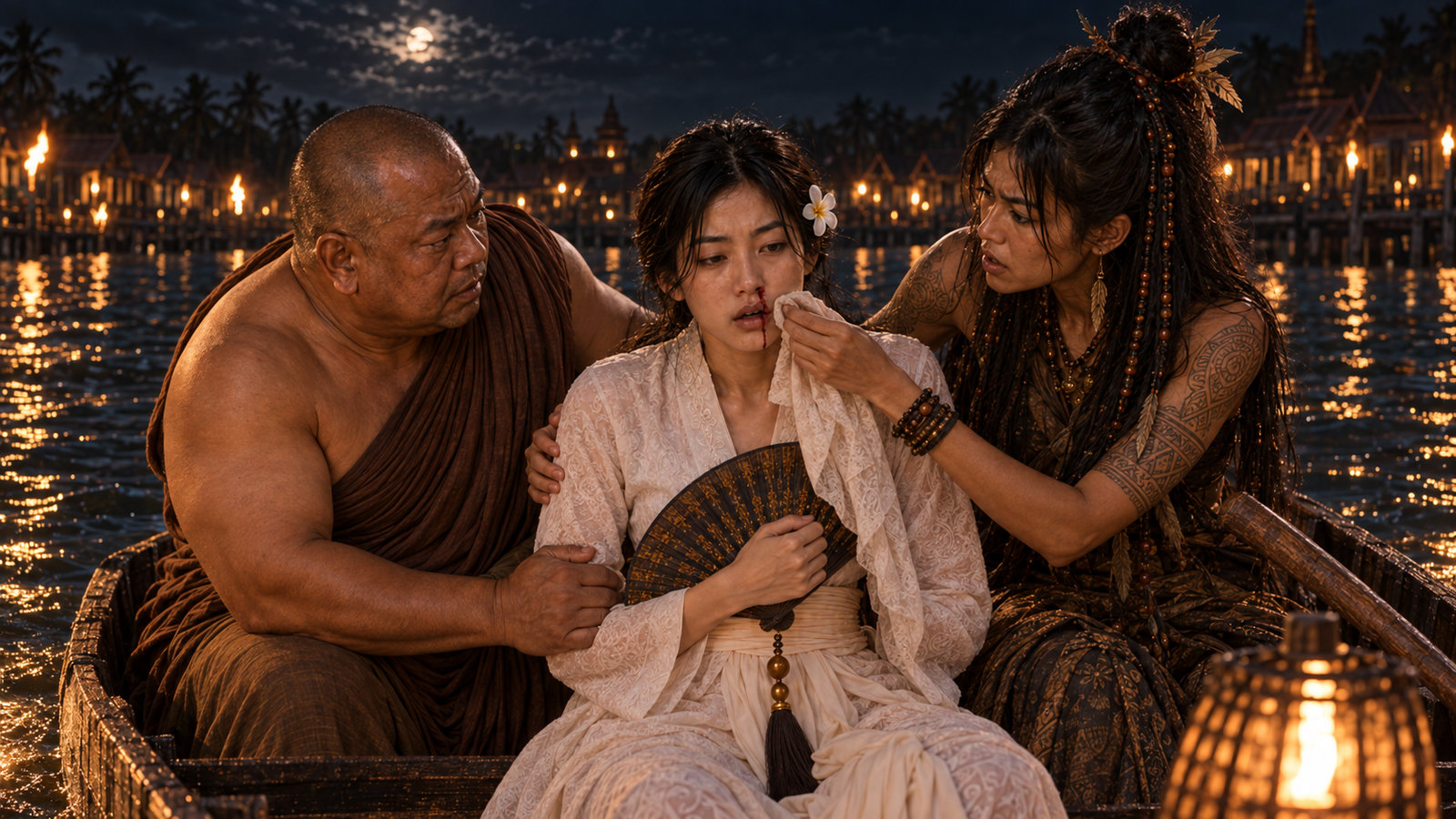
“Bhante—Dewi’s nose is bleeding!” Intan gripped the oar, staring. A thin thread of blood ran from Dewi’s nose.
On the bank, Hasan felt it. He saw the vajra light flicker over the water and vanish, and knew something had gone wrong. He dropped to his knees on the riverbank mud, took the tasbih in both hands, and began to recite—a deep prayer from the Banten Islamic tradition, one his father, Muhammad Yahya, had passed down to him.
Arya drew Nagaraja. A faint light came from the blade and drove toward the boat in the center of the river—stronger than it had ever vibrated before.
Inside the niskala, Dewi was resisting the pull. The seal’s force was drawing her consciousness toward the riverbed, the same force that had been drinking the tuah of this land for decades—and now it was directed entirely at her. Then, from outside, something reached her. Two lights. One was the warm light from Surya’s vajra. The other was the steady light from Arya’s Nagaraja. Neither could fully enter the niskala the seal had locked shut, but both reached its boundary.
And then Hasan’s prayer came through the water. Sound moved through the river and into the spirit realm, and the moment it arrived, the seal’s pull weakened—slightly. Just slightly. That was enough. Dewi threw herself backward and came out.
On the boat, Dewi opened her eyes. She was gasping as though she’d surfaced from a dive, and Surya immediately caught her by the back and steadied her breathing. Her body shook, and so did the hand gripping the Kipas Sakti. Intan reached with her sleeve and wiped the blood from Dewi’s face. Intan’s hand was trembling—a slight, barely perceptible trembling she wasn’t aware of herself.
“I couldn’t do it,” Dewi said, her voice unsteady. “I couldn’t pull it.”
“Intan—get us to the bank. We’ve pushed far enough for tonight.” Surya looked down at the water for a moment before speaking. The ease in his face was gone; something passed across it in its place—the expression of a man thinking very deeply.
The five gathered on the bank. Hasan reached them first and asked if everyone was all right. Dewi said yes, but her voice still trembled. Arya said nothing—he moved to Dewi’s side and took off his outer garment and draped it over her shoulders. The river wind was cold, and Dewi was shaking. Dewi looked up at him, but Arya was already looking at the river.
“Tonight the seal was too much,” Surya said to all of them. “We need a different approach. The seal’s force is too strong for Dewi to reach it alone from the niskala. It’s older than Batavia’s. The roots are deeper.”
“When I got close, the seal tried to take me—hard,” Dewi said, holding back the trembling in her body. “There was no fracture. The Batavia seal had one, but this had none, and it was stronger. But near the seal I felt something. This one and the Toba seal are connected. The same root. The reason the Palembang seal is this strong is because it draws from the Toba seal.”
“Then if we release Toba first, the Palembang seal weakens?” Hasan asked.
“I believe so.”
“Then let us change the order,” Surya said, nodding. “We go to Toba first. Palembang on the way back.”
Intan stared at the dark Musi and said nothing for a moment. She thought of what her teacher, Manang Iban, had told her in the Dayak forest: The first failure is a lesson. It becomes the preparation for the second attempt. She kept it to herself, but she didn’t believe they were wrong to go to Toba first.
“On the river, Hasan’s prayers reached me,” Dewi said. “They couldn’t enter the niskala all the way, but they weakened the seal’s pull for just a moment. Without that, I couldn’t have come out.”
“I thought of my father,” Hasan said, turning the tasbih quietly. “I thought—perhaps under this river there are souls like my father’s, trapped. That thought made me recite harder.”
“You did well,” Arya said—toward Hasan, briefly. It was rare for Arya to speak first to someone else. Hasan looked at him. Arya was already looking at the river.
“Now—let’s sleep,” Surya said, rising. “Spending the night staring at a river and regretting what we couldn’t do helps no one. Sleep, and the answer you find in the morning will always be better than the one you found without sleeping. Forty years of practice, and I can confirm that.”
“Will we be able to do this?” Dewi asked.
“Of course. We did it in Batavia, didn’t we? We’re changing the order—we’re not reversing course. And what Dewi did tonight wasn’t nothing. You went in and came back out. You learned what the seal looks like. You found that Palembang and Toba share the same root. That alone is enough for tonight.” He looked at Dewi as he said it.
Dewi held his gaze for a long moment. He was a middle-aged monk with a round belly—and behind that face was the weight of fifty years, and behind that weight was the knowledge of how to carry it lightly.
“Yes. We failed. But—you’re right, Bhante.” Dewi said.
“And tomorrow morning, before we leave for Toba, I need one more pempek,” Surya said, walking ahead toward their lodgings, already half talking to himself. “I forgot to ask that woman where to find belida pempek in this city. That was a real oversight.” Intan watched his back—then, without a word, followed.
Arya lingered at the river’s edge. He set his hand on Nagaraja, and it was vibrating—aimed downward, toward the river below. His grandfather Wijaya had once told him: Nagaraja opens more the closer it comes to where it must go. What it had done tonight from the bank—that faint light—was all it could manage. It had not entered the niskala. It had not reached the seal. Nagaraja was not yet complete.
Arya walked in the direction Surya had gone.
The five of them. Tomorrow, they would leave for Toba.
Notes
1. Musi River (Sungai Musi)
Musi River (Sungai Musi) — The great river of southern Sumatra, roughly 750 kilometers long. Since the age of the Srivijaya kingdom, it served as the principal waterway of maritime trade across the region; Palembang stands on its banks.
↩ Back to text2. Rumah rakit
Rumah rakit — The traditional floating houses of Palembang, built of wood on bamboo rafts that rise and fall with the river. Their origins trace to the sultanate era, when people from outside the city were forbidden to settle on land and built their homes on the water instead.
Catatan Nusantara: Rumah Rakit of Palembang →
↩ Back to text3. Pempek
Pempek: a Palembang fishcake now commonly made from fish and tapioca and served with cuko. Accounts of its origins differ. Sago-based fishcakes and the modern food names used in this 1683 scene are fictional adaptations, not a documented unchanged recipe from Sriwijaya’s time.
Catatan Nusantara: Pempek Palembang →
↩ Back to text4. Kelesan
Kelesan: a name connected in some accounts with the development of pempek. Claims about an exact recipe or an unbroken origin in Sriwijaya’s period remain uncertain. The sago-based preparation described in the novel is a culinary reconstruction.
↩ Back to text5. Belida (Chitala lopis)
Belida (Chitala lopis) — A freshwater fish found in the Musi River, prized above all others as the finest material for pempek. Its flesh is soft, fragrant, and carries a depth of flavor that tapioca alone cannot replicate. Now increasingly rare.
↩ Back to text6. Telok besak
Telok besak — "Big egg" in the local tongue: pempek with a whole egg stuffed inside the fishcake dough. During cooking the egg sinks, then rises when done; the sauce seeps into the egg over time, deepening the yolk to gold. The most beloved variety in Palembang. In later eras it came to be nicknamed kapal selam—submarine—for the way it moves in the pot.
↩ Back to text7. Adaan
Adaan — Round, ball-shaped pempek made with coconut milk added to the fish dough for a richer flavor, then fried immediately. Smaller and softer than lenjer.
↩ Back to text8. Lenjer
Lenjer — The most basic form of pempek: a long cylinder of fishcake dough, sliced before eating. Sometimes called the mother of all pempek varieties.
↩ Back to text9. Kuah cuko
Kuah cuko — The Palembang vinegar sauce that defines pempek. Made by reducing palm sugar, vinegar, garlic, and chili together until thick; the result is simultaneously sweet, sour, and hot—a single mouthful that contains multitudes.
↩ Back to text10. Palembang Sultanate
Palembang Sultanate: an Islamic power on the Musi. The VOC destruction of Kuto Gawang in 1659 was followed by a move of the court to Beringin Janggut. Historical accounts vary in the dates and emphasis they give to the sultanate’s formation.
Catatan Nusantara: The Sultanate of Palembang Darussalam →
↩ Back to text11. Banten Sultanate
Banten Sultanate: an Islamic sultanate in western Java. VOC support for Sultan Haji in the war of 1682–1683 increased Dutch influence. The important treaty governing political and trading relations was signed in 1684, after the novel’s opening.
↩ Back to text