
CHAPTER 4 · EPISODE 2/3
The Long Road to Lake Toba
The next morning, Thomas helped the five arrange a boat downriver from Palembang to the Musi estuary, where larger trading ships lay at anchor. He pointed to a vessel loaded with pepper sacks.
“That one goes to Jambi12Catatan ↗. From Jambi, follow the Batang Hari13Catatan ↗ inland toward Minangkabau14Catatan ↗, then continue through the mountains into Batak country. It is the route I know.” Dewi knew the seal was connected to Toba, but not yet where on the lake it lay. After being pursued in Batavia, the five also preferred an inland route to the busier northern ports.
“Thomas,” Surya said, bowing. “You’ve looked into all of this for us. This connection is no accident—when we meet again, I’ll buy you a meal.”
“Bhante—not a meal. Pempek.” Thomas laughed. “Belida pempek.”
“Pempek, and a better meal after.”
The five boarded the trade vessel. Pepper sacks were piled high as mountains on the deck, and the crew moved busily with preparations for departure. Thomas stood on the pier and waved. Surya waved back. The anchor came up and the sail spread wide, and the brown water of the Musi estuary slowly receded as the blue sea took its place.
As the ship cleared the estuary mouth, salt wind came. The same wind they had grown used to five days before, and Intan stood on the deck and breathed it in deep. There was one difference from the voyage in from Batavia—this time, the long shape of Bangka Island lay to the east, so it was not open ocean but the narrow water between two shores. The blue current of the Selat Bangka met the brown water pouring out of the Musi, and the colors shifted slowly where they joined.
Dewi stood at the rail with the Kipas Sakti against her chest and read the sea.
“The niskala is thin here. Now that the Palembang seal is farther away, the weight is lighter. But—going north, a different weight begins.” She spoke quietly.
“The seal?” Hasan asked.
“Still too far to tell.” Dewi answered.
“Nothing following us from the sea?” Surya moved closer to ask.
“Not now. What tried to sense us in Batavia seems focused on the Palembang seal—because that one is stronger.” Dewi said.
“Then the five days to Jambi are Dewi’s recovery stretch. The seal pulled hard on your body last night; that force is still in you.” Surya said.
“Understood.” Dewi answered, brief.
The ship traveled five days north along the coast. Sunlight warmed the deck by day, and at night the stars filled the Selat Bangka above. Intan’s nose at first read only the salt wind and the pepper sacks—but around the fourth day it began to pick up a different earth smell coming from somewhere far to the east.
“The soil smell has changed. It isn’t Palembang earth.” Intan said from the deck.
“Jambi is close. That’s the soil the Batang Hari River carries to sea.” A crewman overheard and answered with a smile.
On the fifth evening, the ship reached Jambi port. The mouth of the Batang Hari was wide like the Musi but the current ran faster, and the land visible between the riverbanks was much closer to mountains than the Musi’s plain. The port was crowded with floating houses; boats loaded with pepper sacks and sago starch came and went, and on the decks Minangkabau merchants argued loudly in their own language.
When the five stepped onto the pier, across the river, they saw it—a white-walled building. The VOC trading post. The Dutch flag hung at its peak, and two Mardijker soldiers stood at the gate. Hasan saw it and drew the brown cloth he carried over his white garment, dimming the white.
“Don’t go close. Those who were looking for us in Batavia may be here too,” he said quietly.
“Someone here stands out,” Intan said. Her gaze moved over Surya’s shaved head and monk’s robes.
“I’m also the one who can touch a seal fastest,” Surya said, unbothered. “Standing out matters less than that.”
“Then when we pass the VOC side, I’ll walk ahead,” Intan said. “A woman walking alone draws fewer eyes.”
Surya nodded. The five turned into a lane that kept the trading post out of sight. Behind the port, small prahu waited in a line for passengers heading upriver. Surya walked to the oldest-looking boatman.
“Going to the Minangkabau highlands?” the man asked.
“Yes,” Surya answered.
“Plan for two weeks, then. Where the river narrows, you’ll be going against the current with oars.”
“Two weeks again?” Intan muttered under her breath.
“Five days at sea, two weeks on the river, a little over twenty days on foot—that is the road to Toba. But has there been anything yet on this journey that we couldn’t reach?” Surya said, patting Intan’s shoulder.
“Not yet.”
“Then that’s enough.” He turned back to the boatman.
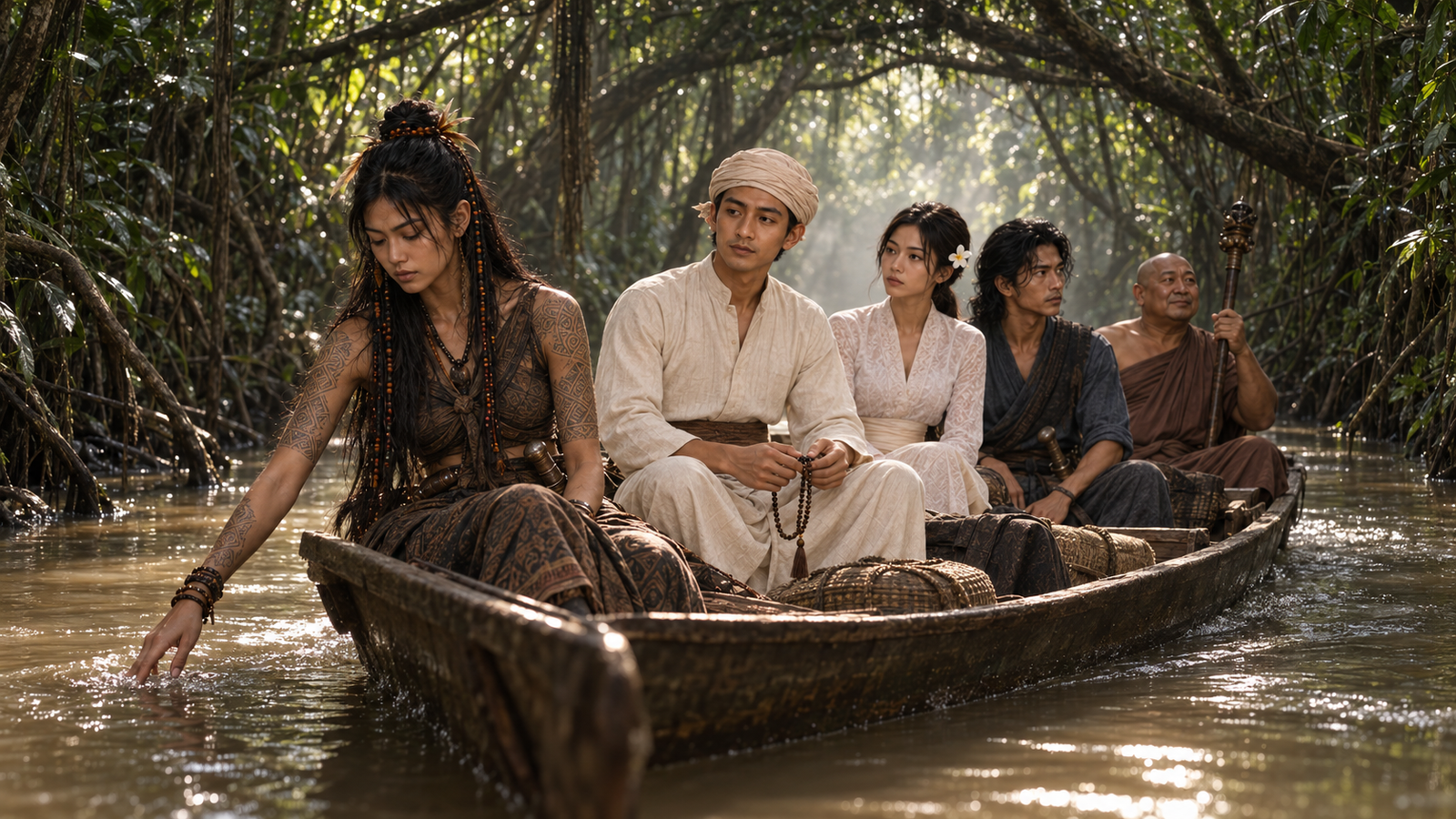
The Batang Hari was a different river from the Musi. The width was similar, but the current was faster, and the jungle on both sides was denser. Where the Musi drifted slowly across a plain, the Batang Hari carried the character of a highland river all the way to its mouth. Trade vessels moved constantly on the water—the large prahu going downstream were carrying small pouches of gold, the boatman said, mined from the Minangkabau highlands; those going up carried salt and unbleached cloth. One trade vessel passed close and a Minangkabau merchant on deck held up a small pouch of gold and grinned as if to show it off.
“That much gold?” Intan asked quietly.
“Minangkabau has been a land of gold since a thousand years ago. Through this river it has gone out to the world since the days of Srivijaya. That is why the VOC wants Jambi—a river where gold and pepper flow together.” Surya answered.
“Does the seal eat gold?” Intan asked.
“What the seal eats is the tuah of the land—its vital spirit. Gold is that spirit made solid. A land rich in gold is a land strong in tuah. Exactly the kind of place a seal favors.” Surya said.
“All this land’s wealth—flowing out like that,” Hasan said, watching a downriver vessel carrying gold in small pouches.
“Batavia, Palembang—all of it. The river is showing us which direction things are moving.” Surya said.
“Dewi—anything reading from this river?” Arya asked, turning to her. It was the second time he had spoken to someone first.
“Lighter than Palembang. Not because there’s no seal—this river’s own tuah is strong, so the seal hasn’t been able to sink its roots as deep yet. Just as Bhante said: a land with much gold has strong tuah.” Dewi said, watching the water.
“Then Toba will be heavier?” Hasan asked.
“Much heavier. But now that we know the Palembang seal and the Toba seal share the same root—this time we can go in knowing which side to approach from.” Dewi answered, plainly.
After several days the river narrowed. Trees on both sides hung branches over the water, making a tunnel, and the river color cleared until the pebbles on the bottom were visible.
“Like the Kapuas River back home. Any river that gets close to mountains is the same.” Intan said, trailing her hand in the water.
Surya glanced at her. The side of her face as she thought of the rivers of the Dayak forest lightened for a moment, then returned to her usual expression. He said nothing.
The boat spent two weeks making its slow way upriver. By day they rowed; by night they moored along the bank and slept; when rain came they sheltered inside the jungle. Surya chanted a short mantra each morning and evening, and Hasan never missed any of his five prayers.
On the fifteenth day they reached the place where the river would take them no farther. The channel had grown too narrow—the trees met overhead on both sides, and the boat’s hull kept striking the riverbed pebbles. The boatman brought them to the bank.
“This is as far as I go. From here, head north over the mountain and you’ll find Toba. There’s a Minangkabau village over that way.”
Surya looked where the boatman pointed. Beyond the riverbank and up a hillside there was a village—and the first thing the eye found was the roof. Both ends swept upward, sharp as horns against the sky, shaped like the horns of a water buffalo. The traditional rumah gadang of the Minangkabau people. The village was distant, and the five had no time to stop. The road to Toba was still long.
“We walk from here. North over the mountains. It’s a long way, but there will be an old path between the Minangkabau and the Batak15Catatan ↗ lands.” Surya said.
“How long?” Dewi asked.
“A little over twenty days on foot, depending on the paths and the weather.” Surya answered.
“A little over twenty days on foot?” Intan said.
“Yes. The boat doesn’t walk for us.”
The five sorted their packs. Intan fastened her mandau at her belt and moved ahead to check the forest edge. Arya rested his hand on Nagaraja and gauged the direction of the mountain. Then the five stepped into the inland jungle of Sumatra.
The forest was different. Intan felt it first. The Kalimantan forest was wide and flat; the trees there rose straight up toward the sky. The Sumatran forest had slope. The ground was climbing steadily toward the Bukit Barisan Range16Catatan ↗, and the trees had twisted their roots into the tilting earth just to stand. The air changed too. The heavy wet air of Jambi grew lighter, and a cooler wind from higher up began mixing in, and Intan’s nose separated the change layer by layer. Less mud, more moss; beneath the bark smell, something bitter like pine; below everything, the damp scent of very old forest.
“The air is different. We’re going up—completely different forest from Jambi.” Intan said from the front, cutting a path as she went.
Behind her, Surya followed with his tongkat candi, and walking uphill through jungle was not the same as walking flat ground for a round-bellied middle-aged monk. He was winded. Sweat had gathered at his brow.
“More than two weeks on the boat—the legs that were supposed to climb mountains have forgotten how. Legs are like meals: if you don’t use them, they forget their strength.”
“Bhante,” Intan said from ahead, a smile in her voice, “do you compare everything to food?”
“Food is the most precise comparison there is. Is there anything more reliable in the world? Hungry—no strength, nothing means anything. Full—strength, everything is possible. If you can show me a more universal truth than that, I’m listening.” Surya answered, still breathing hard.
“Then right now—hungry, or full?” Hasan asked from behind.
“In between. In between is when the focus is sharpest.” Surya said.
“Should we rest? We need water too.” Intan said, falling in beside Surya and brushing leaves from his back without thinking about it.
“If Intan says so.” Surya sat down immediately on a large tree root.
“I’m not the one who wants to rest—Hasan wanted to rest.” Intan glanced back with a small grin, and Hasan laughed.
Surya sat on the tree root, laid his tongkat candi across his knees, and lifted his water flask. He looked up at the ridgeline of the Bukit Barisan above the trees. The mountain was high. Cloud hung at its waist, and above the cloud more peaks stood in layers, blue.
“Dewi—anything reading from this forest?” Surya asked, setting the flask down.
“The niskala here is different from Jambi or Java. The boundary between sekala and niskala is much thinner. As if there’s only a single layer of skin between them.” Dewi said, the Kipas Sakti against her chest as she walked.
“I felt it too. This land has always been close to the spirit realm. It isn’t because of the seals.” Surya said.
“Then why are the seals here?” Hasan asked.
“Plant a seal where the niskala is close, and it sinks its roots deeper. The stronger this land’s tuah—the more the seal can absorb. That is why whoever placed them chose places like this.” Surya said.
“Going up, Nagaraja keeps vibrating. There is a direction—north.” Arya said, leaning against a tree, eyes toward the mountain.
“Toward Toba. Nagaraja knows the way.” Surya nodded.
“A blade knows the way?” Intan asked.
“Nagaraja is not just a blade. It is a keris that has held the tuah of these islands for centuries—it feels what is where, and where we need to go, before we do.” Surya said.
The mountain journey took a little over twenty days. The Bukit Barisan ridge was the spine of Sumatra, and the five were going over it. The higher they climbed, the colder the air became, and the trees changed with it. Tropical broad-leaves thinned and gave way to conifers, and the ground below was thick with moss that swallowed their feet. Mist drifted between the trees, and in passages where visibility dropped to a few dozen meters, Intan navigated by smell. The direction of water meant a canyon; the direction of dry earth meant a ridge; the direction of strong tree-sap meant old forest.
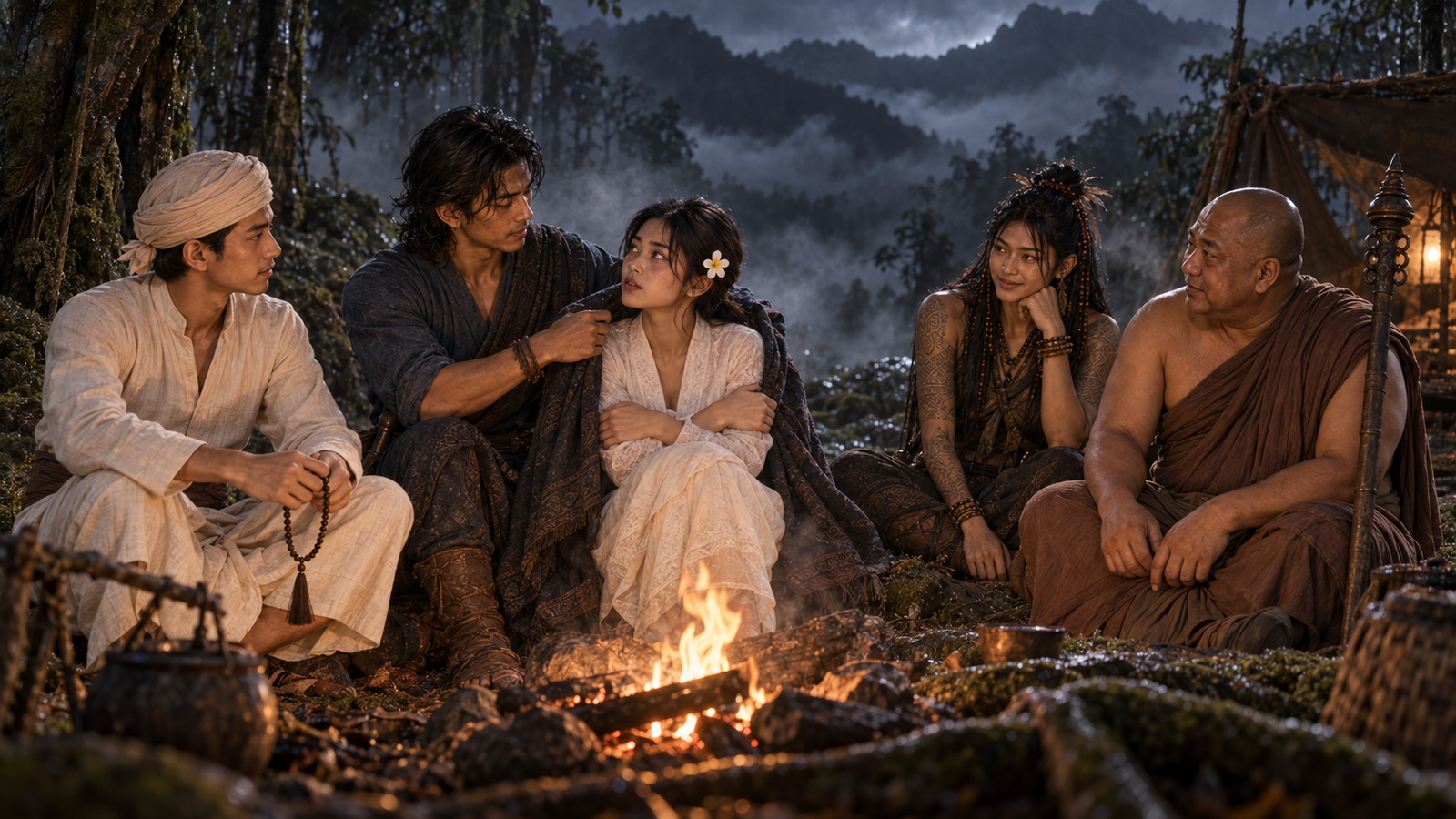
The nights in the forest were cold. The nights in Jambi and Java had been hot and wet, but here in the mountains they were different. As the temperature fell and dew came, Dewi shivered. Arya wordlessly took off his outer garment and placed it over Dewi’s shoulders—and this was the second time. He had done the same at the Palembang riverbank. Dewi looked up at him.
“The mountains,” Arya said briefly, and turned back to face the fire.
Intan had seen it and held a smile at the corner of her mouth, but said nothing.
“Dewi—are you all right?” Hasan asked from across the fire.
“I’m all right. Thanks to Arya.” Dewi said quietly.
Intan had gone into the forest and come back with food: wild yam stems, freshwater shrimp caught from a forest stream, and some unnamed berries. She set them down beside the fire.
“In the Dayak forest, these alone carry you for ten days.” Intan said.
“Intan—how do we cook these?” Surya examined the yam stems.
“Peel the skin and roast over the coals.” When Intan told him, Surya immediately laid the yam stems over the coals and wrapped the shrimp in leaves to grill.
The five ate roasted yam and shrimp on the mountain. It was not an elaborate meal, but eating something hot loosened the cold from their bones.
“Intan,” Surya said, chewing a shrimp, “these are small, but the flavor is there. The water up here is cold—so the shrimp grow firm.”
“My teacher said the same. Cold-water shrimp are the best.” Intan said. That she mentioned Manang Iban at all was unusual, and Surya noticed—but said nothing more.
“A wise person,” Surya said, reaching for another shrimp.
“Intan—finding food in the forest like this, is that something you learned from childhood?” Hasan asked from across the fire, turning his tasbih.
“Yes. Dayak children who can’t find food in the forest can’t become warriors. My teacher left me alone in the forest for a week the first time. I was eleven. He said he’d come back in a week—and if I was still alive, he’d teach me the next thing.” Intan said, looking at the fire.
“Eleven?” Hasan’s voice held both surprise and something that might have been worry.
“That’s the Dayak forest. But I wasn’t afraid. The forest taught me. Stay quiet—the forest tells you where everything is.” Intan said.
“Does this Sumatran forest tell you?” Dewi asked, gently.
“Some. Not as clearly as Kalimantan. This is still a strange forest to me. But it speaks the same language.” Intan said.
“Language?” Arya said. Brief and solid.
“Smell and sound—that’s how the forest talks. Any forest. That’s the base of it. Arya—isn’t Nagaraja the same? You said Nagaraja tells you the direction.” Intan answered, looking at the fire.
“Yes.” Arya glanced at Intan briefly, then away. That was the end of it. But the five were around the same fire, looking at each other.
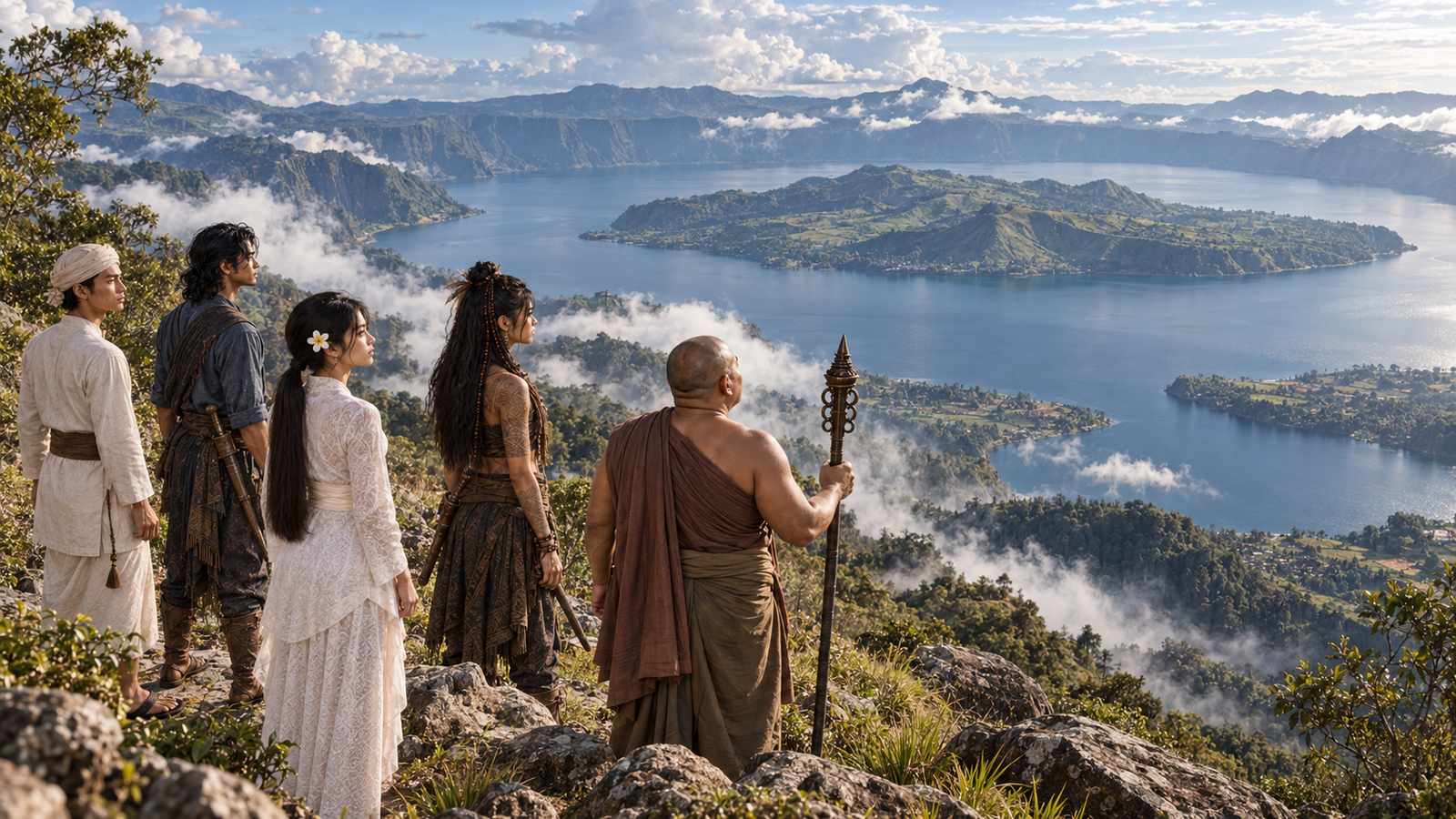
After a little over twenty days on foot, the trees began to thin and the wind grew stronger. Suddenly, through a gap in the forest, they saw light. It was not sunlight. It was the lake.
Notes
12. Jambi Sultanate (Kesultanan Jambi)
Jambi Sultanate (Kesultanan Jambi) — A seventeenth-century Islamic sultanate controlling the eastern coast of Sumatra at the mouth of the Batang Hari River. It stood at the gateway through which gold and pepper from the Minangkabau highlands reached the wider world. The VOC had maintained a trading post here since 1615; by 1683, Dutch influence had sunk deep into the sultanate's affairs.
Catatan Nusantara: The Sultanate of Jambi →
↩ Back to text13. Batang Hari River (Sungai Batang Hari)
Batang Hari River (Sungai Batang Hari) — Sumatra's longest river at roughly 800 kilometers, rising in the Minangkabau highlands and flowing east through Jambi to the coast. The artery connecting the interior to the sea since the Srivijaya era, it once carried so much gold downstream that it was called the river of gold.
Catatan Nusantara: The Batang Hari River →
↩ Back to text14. Minangkabau
Minangkabau — The people of the central Sumatran highlands, keepers of what is believed to be the world's largest matrilineal society: property and clan names pass from mother to daughter, generation after generation. Islam arrived in the sixteenth century and was woven into daily life alongside older customs. Their traditional house, the rumah gadang, is recognized by its roof sweeping upward at both ends like the horns of a water buffalo—the people's name for themselves, Minangkabau, means exactly that: "winning buffalo."
Catatan Nusantara: Minangkabau →
↩ Back to text15. Batak is an umbrella term commonly used for several communities in North Sumatra, including Toba, Ka
Batak is an umbrella term commonly used for several communities in North Sumatra, including Toba, Karo, Simalungun, Pakpak, Angkola and Mandailing. Their languages, customs and histories differ; no single belief about Lake Toba represents them all.
Catatan Nusantara: Toba Batak and Dalihan Na Tolu →
↩ Back to text16. Bukit Barisan
Bukit Barisan: the long chain of mountains and volcanoes extending through Sumatra, often called the island’s backbone. Its name refers to a line of hills or mountains. The group’s journey through the highlands is a fictional itinerary.
Catatan Nusantara: The Bukit Barisan Mountains →
↩ Back to text