
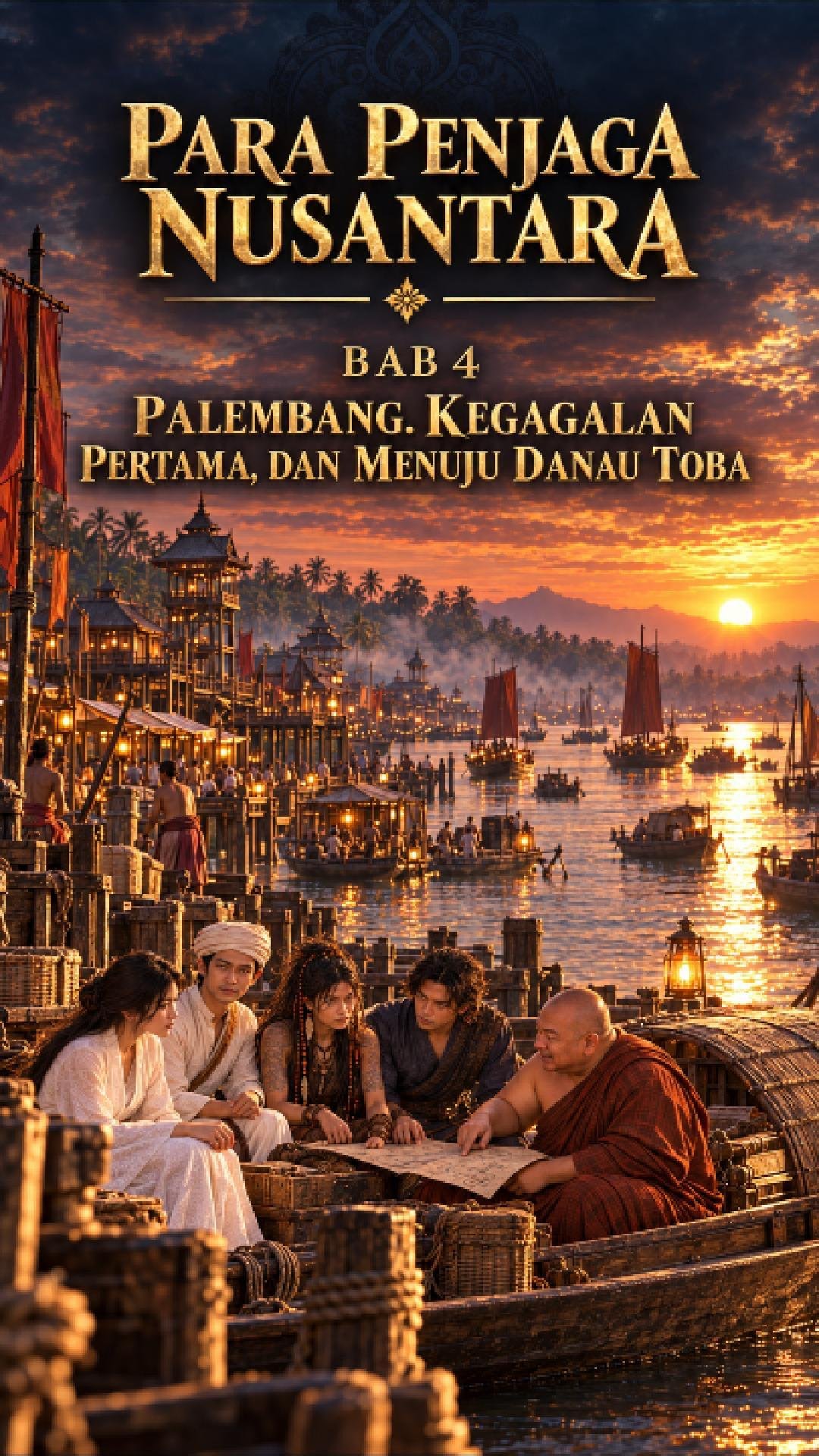
CHAPTER 4 · EPISODE 3/3
The Primordial Spirit of Lake Toba
Lake Toba could not simply be called large. Even the word sea was not enough: a sea had no visible bounds, while mountains enclosed this water on every side. They held the lake without making it seem confined.
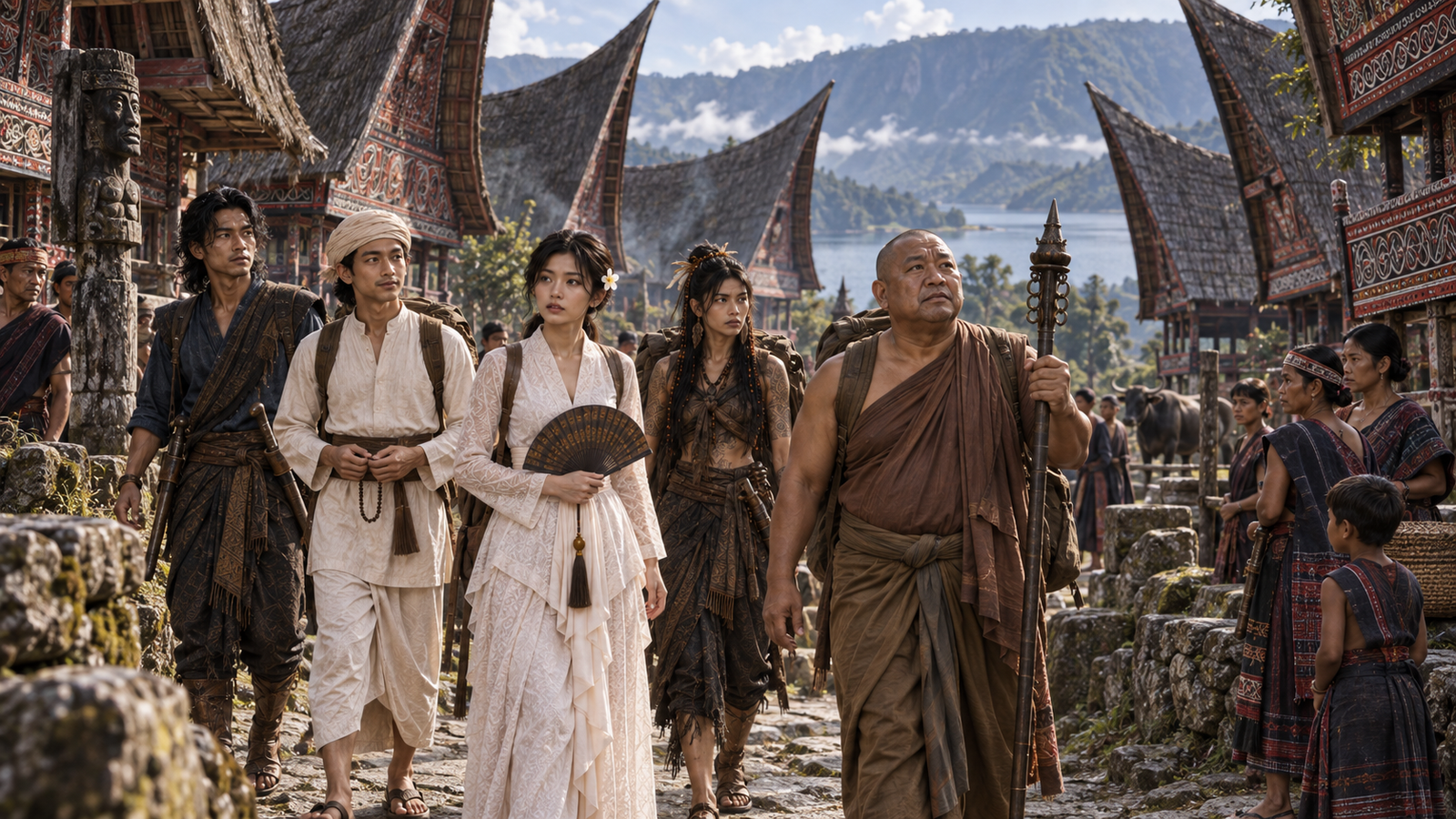
They descended toward a Batak village on the southern shore. Intan stopped and pointed ahead through the trees.
“Smoke.” She pointed ahead through the trees. Thin pale cook-fire smoke rose through the canopy.
A village. On the hillside, rumah bolon17Catatan ↗—the traditional Batak houses—stood in a line. Their roofs swept to sharp points at both ends, so that from a distance they looked like boats turned upside down. Gorga18Catatan ↗ carvings in red, black, and white covered the beams and walls, and Intan looked at the patterns. Different from the Dayak tattoos on her own arms—but the same kind of language. A language that reaches for what lies beyond the visible.
“What are these patterns guarding?” Intan said, studying them.
“Against evil spirits—and a prayer for ancestral protection. Different from Javanese batik, different from Balinese carving. These patterns are rougher, more direct. They don’t conceal—they declare. There’s something like it in your Dayak tattoos, Intan. Both are the will to speak to the spirit realm, inscribed in physical form.” Surya looked closely at the carvings as he answered.
People came out from the village and looked the five over: the shaved monk, the Dayak tattoos, the young Muslim man in white and the young woman in white, the Javanese man with his keris. The village elder stepped forward and spoke in Batak. Surya answered in Malay, and the elder nodded and brought them inside. In the Batak lands, feeding a traveler was an old custom—and that custom was still alive in this village.
In the evening the villagers brought food. It came on large leaves, and the smell came first—strong and dense and full of meat, with something above it unlike anything they had smelled before. Sharp like Sichuan pepper, but fiercer; a bitterness like citrus peel; an electric numbing that moved from the tip of the nose all the way to the tongue, present in the smell alone. Surya’s eyes changed.
“Naso nadipaang,”19Catatan ↗ the village woman said.
Surya received the bowl. Pork slow-braised with andaliman20Catatan ↗ until the dark red broth had sunk deep into every piece, the pale-green grains of andaliman visible floating throughout.
“Lha.” He said it as softly as before—almost only breath. Chewed. Stopped. Reached for a second piece.
“What is this spice? The strongest I have ever tasted—and yet while my tongue goes numb it also tastes of citrus. Nothing like this in Java. Nothing in Jambi.” Surya said.
“That is andaliman. We use it here in these mountains. Batak food without andaliman is not Batak food.” The woman answered.
Intan received her bowl, took a piece, tasted it. The andaliman hit hard—assertive—but underneath was the depth of the meat, and the weight of long slow braising spread across her tongue.
“Strong. Good.” Intan said while chewing. Surya laughed.
For Hasan, something different had come. The village woman, reading his white garment and tasbih, had understood he was Muslim and brought him ihan arsik21Catatan ↗—local freshwater fish braised dry with spices.
“Thank you,” Hasan said, bowing as he received the bowl. The woman said:
“We don’t have many Muslims in our village. But feeding a guest is the same either way.”
“This fish also has the spice—andaliman. The same spice in the meat dish and the fish dish, but the taste is completely different. In the meat it’s heavy; in the fish it’s light.” Hasan said as he ate.
Intan picked a piece of meat from her plate and set it on Hasan’s. Hasan looked at her. Intan was already eating hers. Hasan looked at the piece for a moment, the tasbih moving once in his hand—and then he did not eat it. It was pork. But he had received her intention.
“Thank you,” he said quietly.
“Oh—right.” Intan glanced back, brief. Surya, who had seen it all, smiled—and reached across and lifted the piece from Hasan’s plate.
“I’ll take responsibility for this. We don’t waste food.” Surya said.
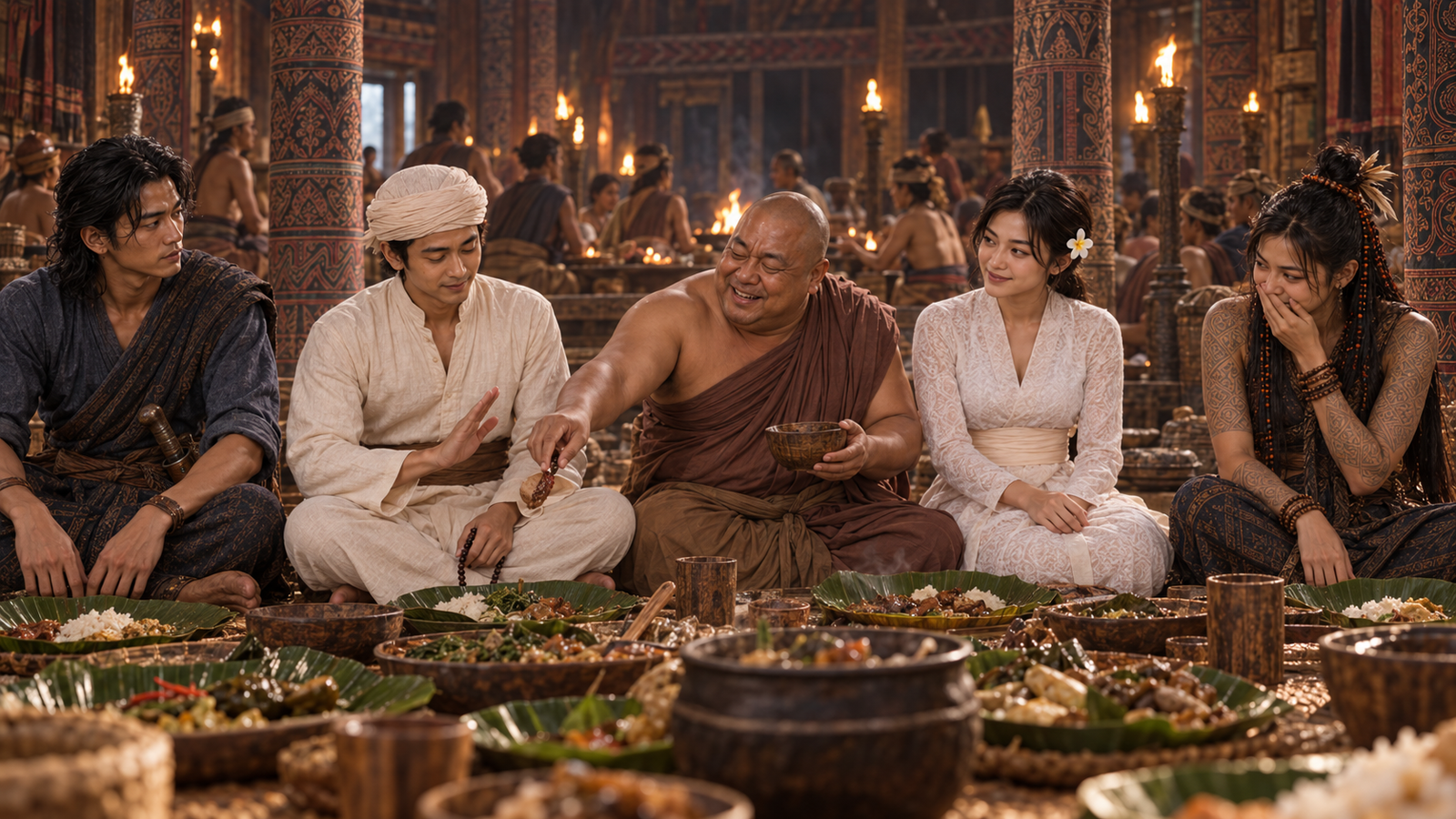
Dewi laughed quietly over her arsik. Arya was eating his naso nadipaang when he looked once at Dewi. Seeing her laugh, the corner of his mouth rose—briefly, barely—and came back down. Surya had seen that too, and said nothing, again.
After everyone else had fallen asleep. Surya went first, as always—fast. Hasan drifted off with the tasbih still in his hand. Dewi was last to close her eyes; her body was not yet fully recovered from the Palembang niskala, and crossing the mountains on top of that had carried its own weight. Only Intan lay awake, looking up at the old carved ceiling of the rumah bolon.
She couldn’t sleep. There was something. Not a sound. Not a smell. A feeling. What Manang Iban had told her when she was learning to hunt in the Dayak forest—stay quiet, and the forest tells you where everything is. What she was feeling now was the same kind of thing. Outside. Toward the lake.
Intan picked up her mandau and rose without a sound.
Lake Toba22Catatan ↗ was close—not far from the village. She came through the trees and the lake appeared, and Intan stopped walking.
About forty days after leaving Palembang, she was finally close enough to feel the cold of Toba.
Large was not the right word. Like a sea was not right either. The sea had no end; this thing had an end—mountains closed it in on all sides. Those mountains held the lake, and the lake rested inside them, but it was not trapped—the mountains were keeping watch. Seventy-four thousand years ago this land had erupted and left a vast hollow, and water had risen to fill it, and in the middle of that water an island called Samosir23Catatan ↗ had pushed itself back up. There was no moon, and yet the lake shone—as if the surface itself was holding light. The night air at nine hundred meters elevation was cold, but the presence rising from the lake was not cold.
Intan walked slowly to the edge of the water. She felt the ground shift from soil to sand beneath her feet, crouched, and put her hand in. Cold. She stayed still with her hand submerged, and the water moved through the lines of her palm.
Then—something moved in the water. It was not a fish. Fish had direction; this had no direction—it was simply in the deep, and it came toward Intan’s hand unhurried, very slowly.
Intan did not pull her hand back. The hand gripping the mandau went tense, but she did not pull back. This was not like what the Palembang seal had done to Dewi—that had been dark, cold, pulling. This simply came. The same kind of thing as when an animal she had never seen before walked toward her in the Dayak forest. The water moved, and something surfaced—shapeless. No eyes, and yet she felt it looking.
It was looking at the tattoos on Intan’s arm. The Dayak traditional tattoos—from the Kaharingan24Catatan ↗ tradition, marks of protection that connect to the spirit realm. Manang Iban had made them; Intan had received them the night she was sixteen, the night in the forest when she drove out a spirit for the first time. The thing regarded those marks and was simply there. What had been approaching stopped. It did not retreat. It stayed, facing Intan’s tattoos.
Intan breathed out slowly and spoke in Dayak, low.
“Who are you?” It didn’t sound like a question. The thing responded—not with an answer, but a response. It knew she was speaking to it, and came closer. Slower this time, coming until it was just short of touching Intan’s arm—and stopped just before contact.

“Intan.” Surya’s voice. Intan turned. Surya was standing between the trees with the vajra in his hand. Dewi was beside him. Neither of them wore the face of someone just woken—they had the eyes of people who had been waiting.
“Look,” Intan said, gesturing toward the lake.
“A primordial spirit,”25 Surya said, watching the water. He lowered the vajra slightly, closed his eyes, and opened them again. His voice was quiet.
Dewi looked at the lake. “Old. This is not the seal—this belongs to the lake itself. It has been here from the beginning.” As she read deeper, her expression changed. “But it is trapped. It isn’t guarding. It can’t leave. The seal pressed down on the lake, and because the lake is held down, the spirit can’t get out. The lake is its home—and the lake has become its cage.”
No one spoke. The thing remained on the surface. Surya and Dewi’s arrival had made it pull back slightly, but it had not gone. It was still watching Intan’s arm.
“Why did it come to me?” Intan asked, looking at Surya.
“The tattoos, I think. Dayak tattoos are marks of protection that connect to the spirit realm in the Kaharingan tradition—this primordial spirit read that. Among the five of us, only you carry those marks. If the Batak gorga patterns are inscribed on a house, the Dayak tattoos are inscribed on the body. A primordial spirit responds more strongly to what is written on the body than to what is written on a wall.” Surya said.
Intan looked at her arm. She had seen these marks all her life. Manang Iban had made them. And now—here, in a lake in the mountains of northern Sumatra—this thing had read them. Meaning they carried across that distance, from Kalimantan all the way to here.
“Ask it something, Intan.” Surya said.
Intan walked back to the water’s edge, sat, and put her hand in again—and this time the thing came faster. She spoke in Dayak, low and slow.
“Why are you here? There is a seal in the lake—are you guarding it? Or are you trapped because of it?”
It responded. Not in words, not in any language—but in feeling. Something came down toward her chest: heavy. Too old to be grief. Too exhausted to be rage. The weight of something that has been waiting a very long time.
“You are trapped,” Intan said.
It responded again, and this time differently. It went down—not up to the surface but toward the bottom of the lake. Toward where the seal was. And from there it showed something. Not an image, not a map—but a sense of the seal’s shape reached her, a faint impression of how the seal was pressing on the lake, and from which side a fracture might begin. Different from how Dewi read through the niskala—this was sensation. Through the body, not the spirit realm. The same way she had first felt a spirit in the Dayak forest.
“I understand,” Intan said, opening her eyes.
Walking back to the lodgings through the trees, Surya asked: “Intan—did you feel something?”
“Yes.”
“The seal?”
“Something like it. Not visible. Just a sense of where to start from. Not certain.” Intan said.
Surya stopped and turned to look at her. Something passed across his face—the ease gone from it, something from a long time ago surfacing—and then it was gone in an instant, and Surya smiled, brief.
“Well done, Intan.”
When they entered the lodgings, Hasan and Arya were awake. Neither said anything, but they had the eyes of people who had been waiting.
“Tomorrow,” Surya said. “Sleep now.”
Intan lay down and looked at the ceiling. The same ceiling as before, the same smoke-stained wood—and yet it looked different. She raised her arm in front of her eyes, but it was too dark to see. She didn’t need to see to know where the marks were; she had known them all her life. And now she knew that something else had seen them too. She didn’t know yet what these tattoos would mean by the time this journey ended. Intan lowered her arm and closed her eyes.
Morning came. Surya was the first to rise, as always, and went out and looked toward the lake.
Low dawn mist lay over the water. The primordial spirit was no longer visible, but Surya knew it was there. They had reached a Batak village on the southern shore. Beyond the lake, mountain ridges closed the distant view; the northern waterfall was far out of sight. The lake was a vessel the earth had shaped for itself, too vast to take in at once.
Palembang had been a failure. But that failure had brought them here. Intan had gone alone to the lake in the night. The primordial spirit had responded to Intan’s tattoos. And through the body—not the niskala—she had felt the shape of the seal.
Surya gripped the vajra briefly. The failure at Palembang had become the preparation for this morning.
He turned back toward the lodgings. As he walked, the smell of morning cook-fire reached him from the lapo26 nearby. Andaliman was in the morning air, and Surya inhaled it and smiled.
“Wake up,” he said, stepping inside. “Let’s eat and talk. There’s work to do today.”
Notes
17. Rumah bolon
Rumah bolon — The traditional longhouse of the Toba Batak. Its roof sweeps to sharp upturned points at both ends, giving it the appearance of an inverted boat from a distance. The beams and walls are carved with gorga patterns in red, black, and white—each figure carrying the meaning of the cosmos and the ancestors.
Catatan Nusantara: Rumah Bolon →
↩ Back to text18. Gorga
Gorga: ornamental carving and painting in Batak Toba traditions, especially on houses. Red, black and white are prominent. Interpretations of colours and motifs differ among sources and communities; a single fixed meaning should not be imposed on every design.
↩ Back to text19. Naso nadipaang
Naso nadipaang: the dish in this scene is interpreted as pork seasoned with andaliman. Its precise name, recipe and use in 1683 have not been independently established; the culinary description is a fictional reconstruction.
Catatan Nusantara: Andaliman →
↩ Back to text20. Andaliman (Zanthoxylum acanthopodium)
Andaliman (Zanthoxylum acanthopodium): a spice associated with Batak cooking, with a citrus fragrance and a tingling, numbing sensation. Its botanical distribution extends beyond North Sumatra; it is not endemic only to these mountains.
Catatan Nusantara: Andaliman →
↩ Back to text21. Ihan arsik
Ihan arsik: local freshwater fish prepared with arsik seasonings in this scene. The term ihan has local usage; an exact historical species and recipe are not asserted. The meal offered to Hasan is prepared separately from the pork.
Catatan Nusantara: Ihan Fish with Arsik Seasoning →
↩ Back to text22. Lake Toba
Lake Toba: a large volcanic caldera lake in North Sumatra, formed by an eruption about 74,000 years ago. It is approximately 100 kilometres long, with Samosir rising within it. Batak cultural traditions connected to the lake should be distinguished from dated historical evidence.
↩ Back to textCatatan Nusantara: Lake Toba: Caldera, Samosir, and Batak Lands →
23. Samosir Island (Pulau Samosir)
Samosir Island (Pulau Samosir) — The vast island rising from the center of Lake Toba, comparable in area to Singapore. In Batak mythology, the first human descended from Pusuk Buhit mountain onto this island; from him all Batak lineages trace their origin.
Catatan Nusantara: Samosir Island →
↩ Back to text24. Kaharingan
Kaharingan — The indigenous belief system of the Dayak peoples of Kalimantan. It holds that nature and the spirits of the ancestors are sacred and intertwined; when a person dies, their soul returns to the living world. Traditional Dayak tattoos are marks of protection within the Kaharingan system, connecting the bearer to the spirit realm.
Catatan Nusantara: Kaharingan →
↩ Back to text25. Primordial spirit
Primordial spirit — As used in this story: a spiritual presence that has dwelt in a specific place since before human memory. It is not created by a seal or a curse; it is the ancient will of the land—or in this case, the water—itself.
↩ Back to text26. Lapo means a shop or eating place in Batak usage. Here it functions as a place for food and gatherin
Lapo means a shop or eating place in Batak usage. Here it functions as a place for food and gathering. Its exact form and menu in 1683 are uncertain; the scene is a fictional reconstruction.
↩ Back to text