
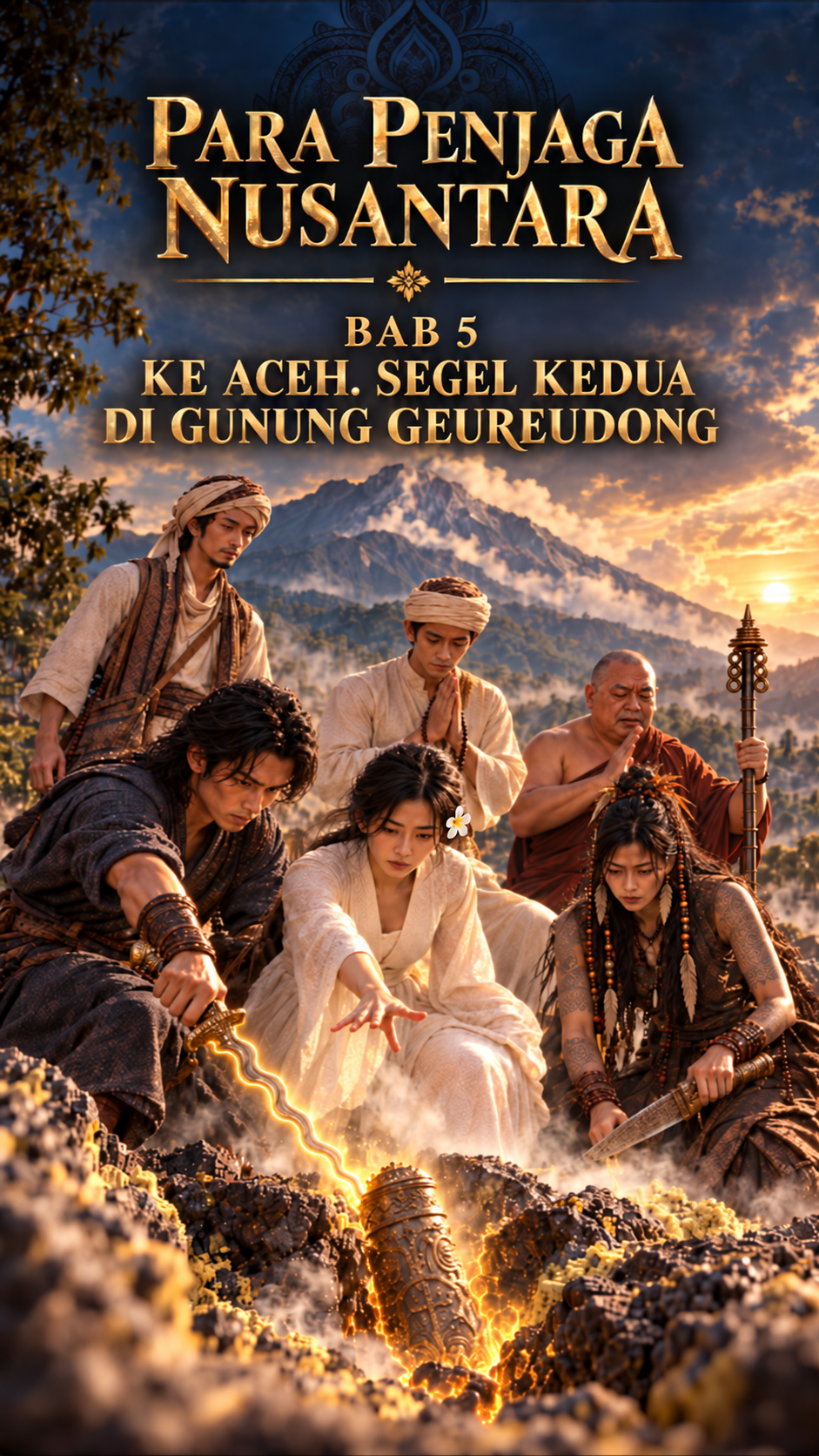
CHAPTER 5 · EPISODE 1/3
Northward
After their meeting with the primordial spirit on the southern shore, the five guardians continued north. For five days they followed paths between villages along the eastern side of Lake Toba, stopping for food, rest and directions. At last morning came to the northern lakeshore.1Catatan ↗
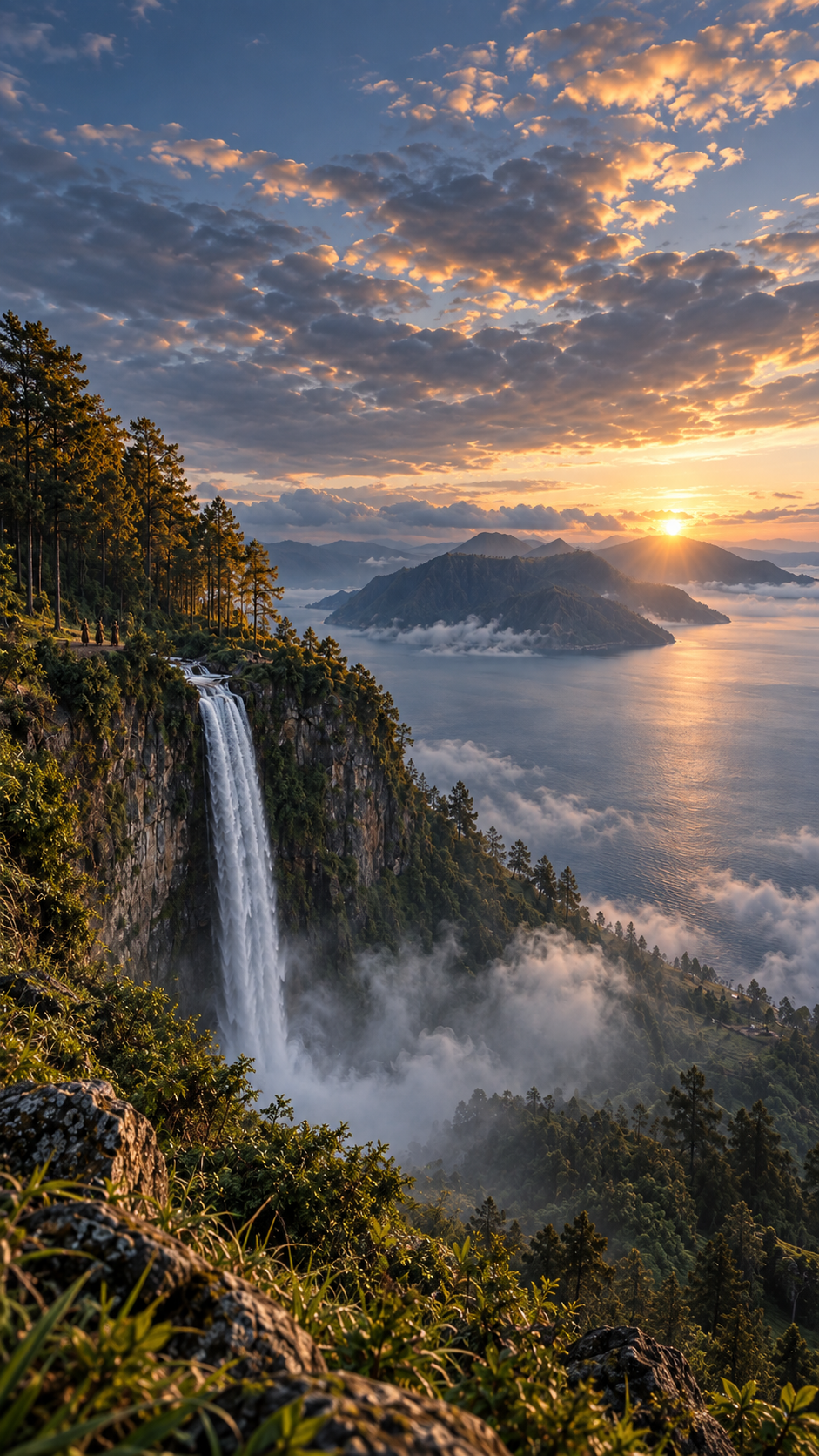
The waters of Sipiso-piso Falls had not stopped through the night, and the sound of water striking rock rang louder and more still in the mist—as though the sound fed on the fog and grew, while the lake received it all in silence below.
The color of the lake changed slowly with the dawn. From deep ash to gray-blue, from gray-blue to a pale and spreading light—and the mist covered and uncovered each shift in color, one layer at a time. Samosir Island still lay submerged in darkness, but the pine forest above the Sipiso-piso cliffs had already caught the outermost edge of sunlight. Intan’s nose found a thread of unfamiliar scent—the smell of water chilled beneath the falls and then slowly warming again, and beneath that, the bitter note of pine resin that pricked at her nostrils for a moment and was gone.
All five had gathered at the water’s edge.
Dewi stood at the shoreline with the Kipas Sakti open in her hands. The golden fan cut through the dawn air, and Dewi’s eyes moved between the sekala and the niskala at once.
The seal was here. That much was certain. At the deepest point of the lake bed, beneath where the waters of Sipiso-piso fed in, the seal’s roots had been driven deep—and for decades it had been drawing the vital essence of the lake into itself.
“Something’s changed since last night,” Dewi said. Her voice was careful—more careful than usual. “The seal is here, but there are two connections. One goes south—toward Palembang. But there’s another—north.”
“North?” Surya tightened his grip on the vajra.
“Far,” Dewi said. “Whatever is to the north is much weaker than what was in Palembang. But the connection is real. The seal has roots on both ends.”
Intan crouched at the water’s edge and dipped her hand in. Cold.
The primordial spirit came—immediately, as it had the night before. But this time the pull was different. The spirit was drawing upward, not down—and Intan closed her eyes and followed where it led. North. Very far north. The ghost of a volcanic smell.
“I feel it too.” Intan pulled her hand free and stood. “The primordial spirit knows something is there—north. I can’t tell you what until we go ourselves, but there’s another root beyond this lake’s seal.”
Hasan turned his tasbih and looked north. Mountains layered behind the mist, and beyond them—the Sultanate of Aceh.
“That’s toward Aceh. Aceh holds some of the strongest sacred Islamic presence in these islands. If there’s a seal there—we have to go.”

Surya was quiet for a moment, the vajra held at his chest, his eyes closing and opening again.
“To cut a rope, you must pull from both ends. If we only take this root, the other will simply pull it back. If the Aceh seal is weakest—we go there first, then return here.”
Then Intan raised her head. Her nose moved before she did—it wasn’t the wind. Someone.
“Someone’s there,” Intan said quietly. “Close. Incense.”
Arya’s hand went to Nagaraja. All five turned at once toward the rocks to the north.
From behind the rocks stepped a young man. He appeared to be in his thirties, wearing a worn white jubah2 with a tasbih looped around his neck. He walked out without hesitation—but he pressed his hand to his chest in greeting before anything else.
“Assalamu’alaikum—forgive me for startling you. I was waiting for you to come. I simply did not expect you quite this soon.”
Hasan stilled his tasbih and studied the man. No fear in the eyes. No hostility. The eyes of a scholar—someone who had spent long years with books.
Hasan pressed his own hand to his chest. “Wa’alaikumsalam. Who are you?”
“My name is Faris bin Idris.” His Malay carried an Acehnese lilt beneath it.
“I am a student of Sheikh Abdul Rauf al-Singkili.3Catatan ↗ My teacher sent me to this lake a week ago. He told me five people would come. Last night I felt the lake’s energy shift—so I came here.”
Surya lowered the vajra and walked toward Faris, inclining his head in greeting.
“Sheikh Abdul Rauf al-Singkili—he already knew about the seal in this lake?”
“More than that—he has been studying it for over twenty years,” Faris said. “There is also a seal in Aceh. At the foot of Mount Geureudong.4 My teacher has long been suppressing that seal through the power of Islamic scripture—but he has never been able to remove it entirely. Because this lake holds the root. In the world of these seals, the two are linked through unseen channels beneath the earth.”
Dewi slowly closed the Kipas Sakti and looked at Faris.
“So we go to Aceh first. If we remove the weakened one there, it creates a fracture in this one here.”
“My teacher believes that together with you, complete removal will be possible.”
A brief silence. Surya glanced at Faris, then caught Dewi’s eye—asking without words. Then he closed his hand once around the vajra.
“How long to Aceh?”
“About two weeks—we head northeast from here, cross the Karo Highlands,5 and descend to the eastern coast, where there is a small fishing village. From there, north along the Strait of Malacca,6 and we reach Aceh’s eastern shore.”
“Two weeks is forty-five meals,” Surya said, after a moment.
Intan let out a short breath of laughter behind him. Hasan’s tasbih began moving again as he smiled quietly. Arya’s hand left Nagaraja. He said nothing.
“Then let us go. You know the way?” Surya said, taking up his tongkat candi.
“I walked this road coming here. And I have friends among the Karo.” Faris nodded.
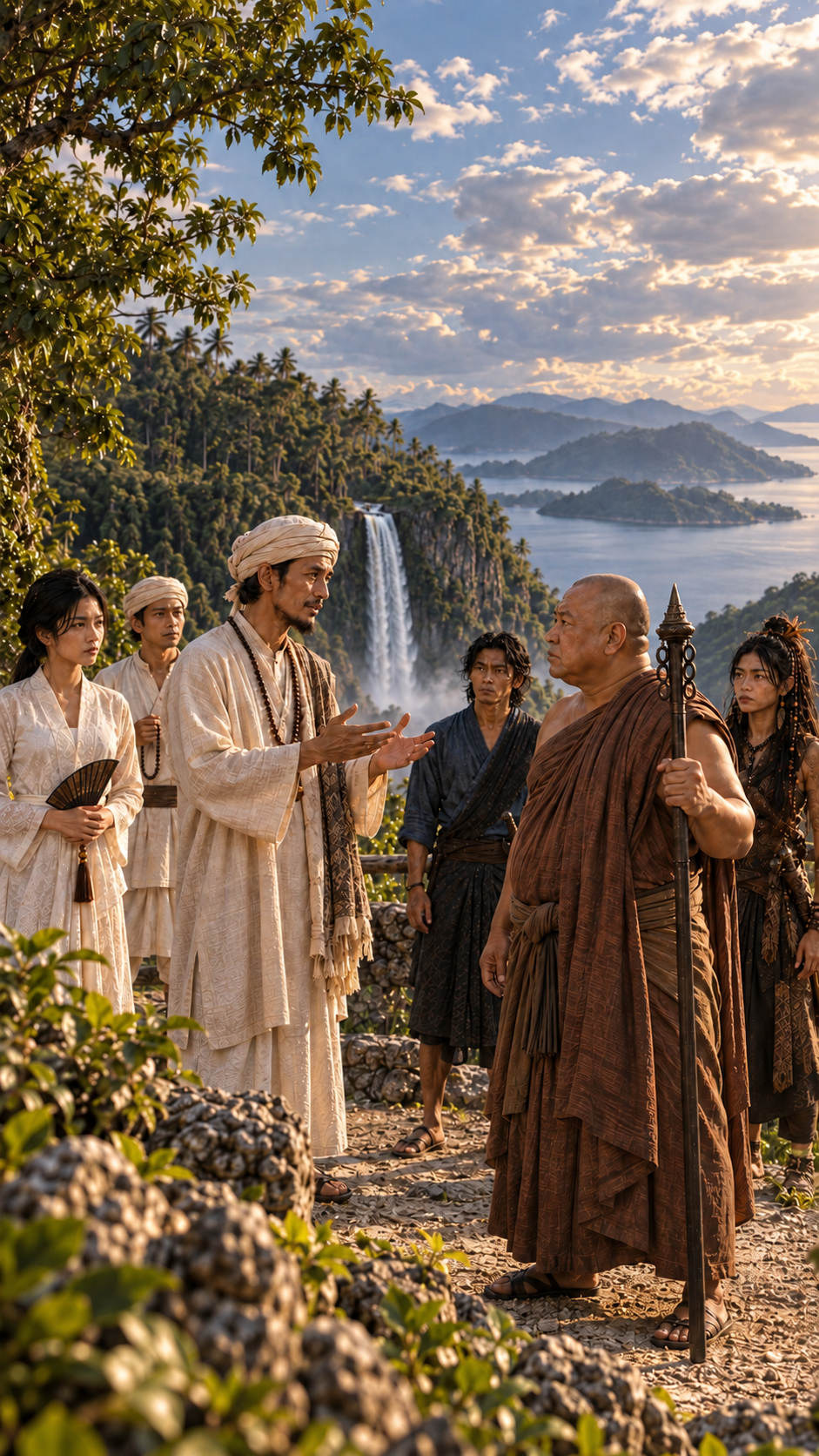
They left Sipiso-piso and turned northeast.
They followed the lakeshore east for a time, and then, passing through the village of Tongging,7 the path curved sharply upward. The Karo Highlands. Once they had climbed above the Sipiso-piso cliffs, the lake dropped away beneath them—spread out below the mist like a single sheet of mirror.
Intan stopped and looked down.
“Back in Kalimantan, you could see all the rivers from above. Here you can see all the lake. From up here, something that vast—it looks so small.”
“Everything looks smaller from above, no matter how large,” Surya said, coming to stand beside her. “People too. What seems enormous when you’re inside it—from a height, it is often a very small thing.”
“Where did you learn that, Bhante?” Intan turned to look at him.
“My teacher used to send me up a mountain whenever I was angry about something. After two trips, there was usually nothing left to be angry about.”
“A wise teacher.”
“A good one,” Surya said.
The road through the Karo Highlands felt nothing like the southern slopes of the Barisan Mountains they had crossed from the Minangkabau side. That had been steep jungle, dark and close. Here, open grassland alternated with pine forest, the air sharper and colder, the wind holding longer on each gust. Land that belonged to Sumatra’s upper reaches.
The smells Intan caught were different here too—grass and pine resin over earth, and underneath both, the faint smell of cattle and cooking smoke.
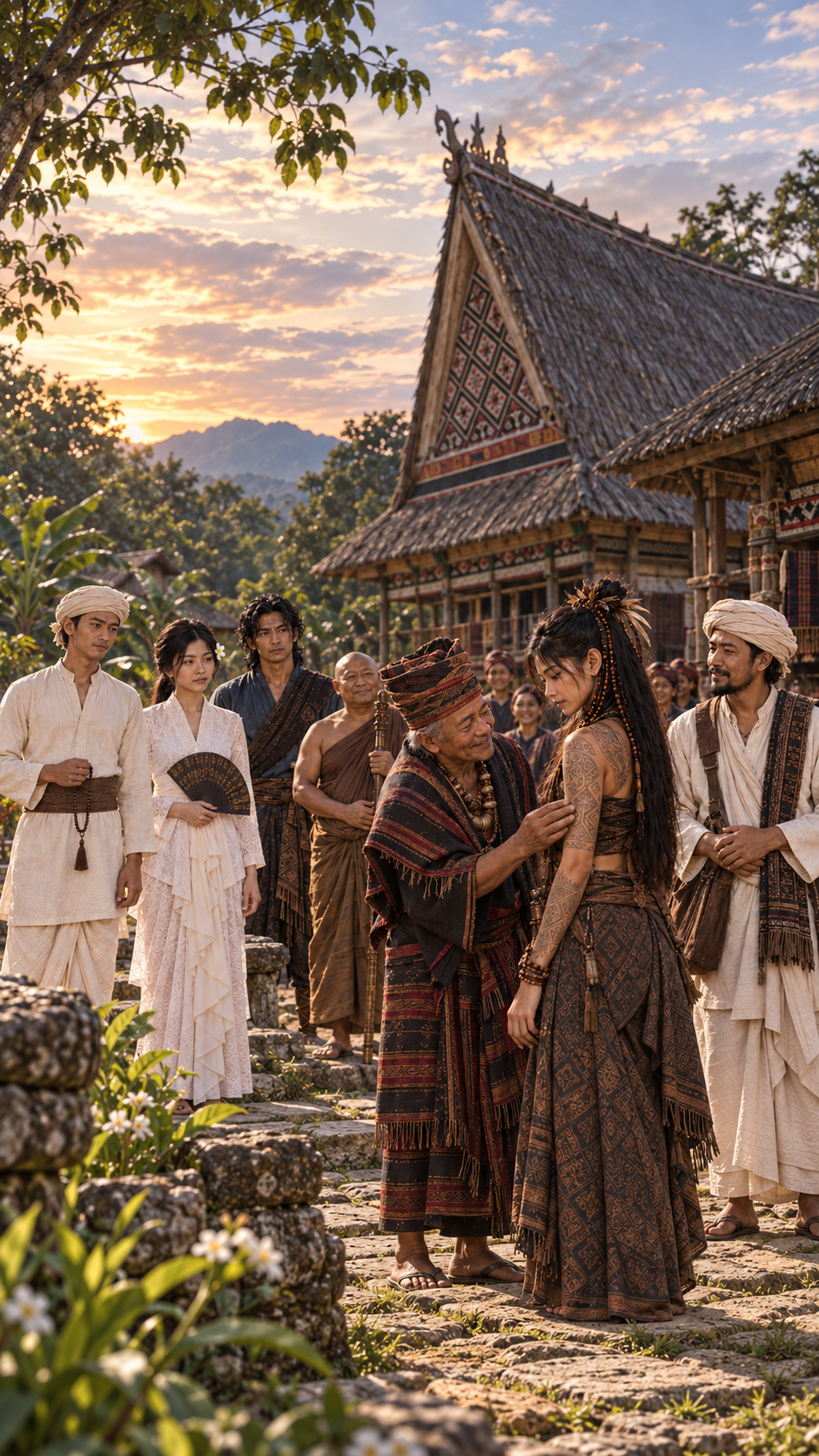
They reached the Karo village by the following evening. The traditional longhouses—called rumah siwaluh jabu8—stood in a line along the ridge, and Faris explained that eight families lived together beneath a single roof.
The village elder came out and recognized Faris, exchanging a short greeting in Karo. The five each bowed in turn. The old man’s eyes settled on the Dayak tattoos marking Intan’s arm and stayed there.
“You’ve come from far away,” the elder said, shifting from Karo to Malay.
“Kalimantan,” Intan said.
“A Kalimantan person in a Karo village—it doesn’t happen often. Come in, then.” His voice had warmed.
Inside the rumah siwaluh jabu, it was dark but warm. A hearth burned at the center, a large pot suspended above it. From the ceiling hung bundles of spices and dried corn—and the moment they stepped in, the smell reached them before anything else did.
A Karo woman made room for the five and lifted a ladle from the pot.
“Sour chicken broth,9” the woman said. A tart fruit had been crushed and simmered with the chicken, garlic and mountain spice.
Surya received his bowl and brought it close to his face.
“This is different again from what we had at Toba. Is this andaliman too?”
“Andaliman,” the woman said. “We use it here in the Karo highlands too.”
Surya took a spoonful. Sour and citrus and the deep flavor of chicken came up together, and his eyes closed once.
“The more of these islands I travel, the more I notice—the same mountain herb, from a different mountain, and the taste is entirely different.”
“Trees, people, food—change the mountain, and everything changes,” the elder said.
That night, beside the hearth, the elder spoke of Karo villages and customs. The Karo and Toba had ties across the highlands, but their languages and traditions were not the same. The people of the plateau had their own ways of addressing the divine and living with the mountains.
Hasan listened quietly, his tasbih turning. Surya nodded slowly.
“It seems that is how all the people of these islands came to be. The same beginning, and then a mountain separates them, a river separates them, a sea separates them. But when they meet again—they recognize each other. The way you recognized Intan’s tattoos.”
“You are Javanese, Bhante, yet you understand the Karo heart.” The elder smiled briefly.
“I lived long enough in mountains that they taught me. Wherever you go, mountains seem to speak the same language.”
The elder stirred the fire once, held a silence, then asked.
“Why are you making this journey, Bhante?”
Surya looked at the elder. This was not a place for anything less than truth.
“The life of this land is draining away. Beneath the earth and water, in places unseen—the vital essence is being drawn out. We are going to return it,” Surya said slowly.
The elder studied Surya for a long moment, then looked back at the fire.
“Our elders have spoken of this. They say the mountains were more alive once. In the Karo highlands, if you called for rain—rain came. If you called illness away from the mountain—it went. These days that no longer works. Our dibata10 have grown distant, the elders say. They grieve it.” The weight in his voice was not performed.
Hasan’s tasbih turned without a sound.
“Not distant,” Surya said. “Blocked. That is what we are going to undo.”
The elder bowed his head deeply, then raised it.
“Then if our village can be of any help—tell us. And that Dayak woman from Kalimantan finding her way into a Karo village—I think our mountain called her here.”
Intan glanced at the elder but said nothing. Only the hand on her mandau, for a moment, grew warm.
The next morning, the elder showed them a route toward the eastern coast. They would avoid the busier port of Labuhan Deli11 and make for a smaller fishing village. After Batavia, the five did not wish to draw the attention of Company men.
“That blade is Javanese,” the elder said, looking at Nagaraja. “Keep it close. The time when blades weep in these islands—it is coming again.”
“I will,” Arya said, and gave a short bow. “Thank you.”
Notes
1. Lake Toba
Lake Toba: a large volcanic caldera lake in North Sumatra. The northern shore near Tongging and Sipiso-piso opens toward the Karo Highlands. The waterfall falls into a valley before its water reaches the lake.
↩ Back to textCatatan Nusantara: Lake Toba: Caldera, Samosir, and Batak Lands →
2. Jubah
Jubah — A full-length, long-sleeved robe worn by Muslim men. Of Arabic origin, the jubah was standard dress for Islamic scholars and religious figures in seventeenth-century Aceh.
↩ Back to text3. Sheikh Abdurrauf as-Singkili, also known as Teungku Syiah Kuala, was an important seventeenth-centur
Sheikh Abdurrauf as-Singkili, also known as Teungku Syiah Kuala, was an important seventeenth-century Acehnese scholar and a senior religious and judicial official of the sultanate. His works include Tarjuman al-Mustafid and Mir’at al-Thullab, and he helped spread the Shattariyya order. His meeting with the guardians, journeys to Geureudong and research on supernatural seals are fictional.
↩ Back to text4. Mount Geureudong, or Bur ni Geureudong
Mount Geureudong, or Bur ni Geureudong: a volcanic complex in Aceh, with a summit around 2,885 metres high. Hot springs are recorded. Bur ni Telong, to the south, is a different volcano. The supernatural channels connecting seals in this novel are fictional, not a proven magma network.
↩ Back to text5. Karo Highlands (Dataran Tinggi Karo)
Karo Highlands (Dataran Tinggi Karo) — A highland plateau north of Lake Toba, home to the Karo Batak people. Though sharing deep ancestral roots with the Toba Batak, the Karo developed distinct language, customs, and spiritual traditions over the centuries following their geographical separation. Before the arrival of Islam and Christianity, the Karo maintained their indigenous animist faith known as Pemena.
↩ Back to text6. Strait of Malacca (Selat Malaka)
Strait of Malacca (Selat Malaka) — The narrow passage between Sumatra and the Malay Peninsula, linking the Indian Ocean to the South China Sea. One of the world's most strategically vital waterways, it has carried the trade of Arabia, India, and China for two millennia. After the VOC seized Malacca from the Portuguese in 1641, control of the strait shifted fundamentally, disrupting the trade routes of Malay merchants throughout the archipelago.
↩ Back to text7. Tongging
Tongging — A small Karo Batak village at the northernmost point of Lake Toba, directly beneath the Sipiso-piso Falls. The path from Tongging leads up onto the Karo Highlands plateau.
↩ Back to text8. Rumah Siwaluh Jabu
Rumah Siwaluh Jabu — The Karo Batak traditional communal longhouse. Siwaluh jabu means "eight families" in Karo—a reference to the eight households that share the structure, dividing the interior into individual hearth spaces while living under a single roof. The architecture embeds Karo principles of collective life and mutual obligation.
↩ Back to text9. Sour chicken broth
Sour chicken broth: a fictional dish using a tart fruit and andaliman. Tamarillo, or terung belanda, is South American in origin; without evidence of its presence in Karo in 1683 it is not used here. Andariaman is not presented as an identified plant.
↩ Back to text10. Dibata
Dibata — Among the Karo Batak, the word used for sacred beings or divine forces. The indigenous Karo faith, Pemena, describes three Dibata governing the celestial, earthly, and underworld realms respectively. As Islam arrived in coastal regions and moved inland, many Karo communities maintained Pemena alongside their adopted faith. The elder's account of the mountains' declining spiritual responsiveness—the Dibata growing distant—reflects a grief that predates any single religion: the sense that something in the land itself has been blocked.
↩ Back to text11. Labuhan Deli
Labuhan Deli: the old port and political centre of the Deli Sultanate. Medan’s official history associates Panglima Perunggit’s declaration of independence from Aceh in 1669 with a centre at Labuhan. The group’s concerns about Company men and its choice of a smaller landing are fictional plot details.
↩ Back to text