

CHAPTER 5 · EPISODE 2/3
The Strait of Malacca
It took three more days to descend the mountain.
The cool air of the Karo Highlands faded as they descended the eastern slopes, the air thickening with every hour, and palm trees began to appear again. They crossed one river, then another—narrow channels, but pepper fields lined both banks, and Faris explained that the Karo grew them and sold to Malay traders on the coast.
“Where does this pepper go?” Intan asked.
“Malay traders load it onto ships—it goes to Labuhan Deli. From there, most of it passes into the hands of the VOC.12“
“The port we’re avoiding,” Intan said.
“That’s right. Which is why we’re avoiding it.”
By the third evening, with the sun already tilting west, they reached the small fishing village. A settlement north of Labuhan Deli, where a river met the sea—a mosque minaret rose at the mouth of the river, and wooden houses ran along the bank beneath it. Palm trees lined the water, and fishing nets hung drying in the last of the sun.
Faris made his way toward the mosque, where someone knew him.
Surya’s nose found it first. From somewhere inside the village—coconut. But not just coconut. Something being boiled down with spices, turmeric’s golden weight mixing with the brightness of lemongrass, riding the current of the river toward them.
“I know what that is. Coconut rice—I haven’t smelled coconut rice in so long—” Surya picked up his pace.
“That is nasi lemak,13” Faris said, smiling. “What the Malay people here eat.”
Inside the village was a small warung. A low platform bench sat in the shade of riverside trees, and a middle-aged woman stood stirring a large pot. The steam rising from it was all coconut milk and turmeric and lemongrass, and beside it, a mound of white rice on banana leaf breathed its own warmth—the rice itself smelled of coconut. Clean and sweet.
Surya sat and offered the woman a greeting. She looked up, took in the round-bellied monk and then the four behind him, one at a time. A strange group. She was curious but asked nothing.
The nasi lemak arrived—rice cooked in coconut milk mounded on banana leaf, with a small pile of ikan bilis (crispy anchovies), sambal, and a few slices of cucumber alongside it. Surya leaned over his portion and inhaled.
“The rice itself is fragrant with coconut—just from cooking it in the liquid, and the smell is this deep?”
“Coconut milk and pandan leaf, steamed together,” Faris said. “This is the rice of the river people here.”

Surya took a spoonful and chewed slowly. The rice gave its coconut softness first, then the green brightness of pandan came up behind it, and last of all a trace of salt settled on the tongue. He opened his eyes.
“This rice is already its own side dish. There is no line between the rice and the accompaniment.”
Gulai ayam14 came next—chicken submerged in a yellow broth of coconut milk, the combined scent of lemongrass and turmeric filling the platform around them. Hasan received his portion with both hands, inclining his head. No pork anywhere in this meal. The halal consideration had been made without anyone having to ask for it, and Hasan recognized this.
“The food here is warm,” Hasan said. “There is human care in it.”
“For the Malay people, feeding a guest is how you welcome them,” Faris said. “The same is true for us in Aceh.”
Intan added another spoonful of sambal to her gulai ayam. She did not usually favor spice, but this sambal was both sweet and hot—once you started, it was hard to stop. Arya ate his gulai ayam without a word. Dewi lifted a piece of ikan bilis from the nasi lemak and chewed it carefully. The salt and nuttiness meeting the coconut rice—better than she had expected.
Over the meal, Faris laid out the plan for the next day. That evening they would arrange with a boatman, and leaving before dawn, they could reach Aceh’s eastern shore within three or four days. From there, climbing into the Gayo Highlands,15Catatan ↗ four more days of walking would bring them to the foot of Mount Geureudong. Faris knew a man—Muhammad Rustam, an Acehnese Muslim trader who ran a prahu north along the Strait of Malacca carrying pepper and dried fish. It seemed Faris had already spoken with him.
“My teacher will already be there,” Faris said. “He left for the mountain a week ago. By now he is alone near the seal, still studying it.”
Hasan finished his nasi lemak and looked up. “Sheikh Abdul Rauf al-Singkili already knew we were coming.”
“There is much my teacher knows. Once he explains, it always makes sense—but how he came to know it in the first place, I honestly cannot say,” Faris said, after a pause.
“There are people like that,” Surya said, nodding with a smile. “My own teacher at Mount Semeru was the same. He knew things he could not have explained how he knew.”
They boarded before dawn.
The prahu was small, but sacks of pepper were packed tightly inside, and bundles of dried fish hung from the side of the hull. Fish smell and pepper smell mingled—and depending on which way the wind blew, one or the other would come forward.
The moment they passed into the Strait of Malacca—sea. Sumatra’s eastern coastline unfurled to the left, and to the right, water stretched to the horizon. The strait wind was nothing like the sea wind between Batavia and Palembang—quieter, shifting direction more often. Rustam handled the sail with practiced ease, catching wind that had already changed direction by the time another man would have noticed. Rough hands. Quick ones.
“This strait has been loud for more than forty years,” Rustam said from the deck—mixing Malay and Acehnese, but all five understood him. “Since the VOC took Malacca, all the Malay traders scattered. Some lost their ports altogether. Some—like me—avoid the big harbors and move only through the small ones.”
“Aceh hasn’t fallen to the VOC yet?” Hasan moved from the bow to stand beside Rustam.
“Sultanah Zakiatuddin16Catatan ↗ is holding it. Aceh trades more with Arabia and India—uses the western sea more than the eastern. That’s why it’s still standing, I think.” Rustam paused. “But who can say, given time. The war in Banten has strengthened the Company’s hand too.”
Hasan nodded, his tasbih turning. At the name Banten, his hand stilled—then began again.
Three days. Moving north along the coastline, fishing villages appeared at every river mouth—small harbors, boats coming and going. Intan stood at the bow watching the coastline and reading the air.
“Every stretch of land has a different smell. Near Toba it was pine resin. Here it’s becoming more tropical by the hour. Different earth.”
“The rainforest deepens as you go north,” Faris said, coming to stand beside her. “On the Aceh side, the Leuser range17Catatan ↗ keeps things in mist—the smells are stronger there.”
The second night on the water, they ate the nasi bungkus they had packed in the morning—wrapped rice, made by Rustam’s wife. When the banana leaf was unfolded, there was a portion of gulai ayam and sambal laid over the rice.
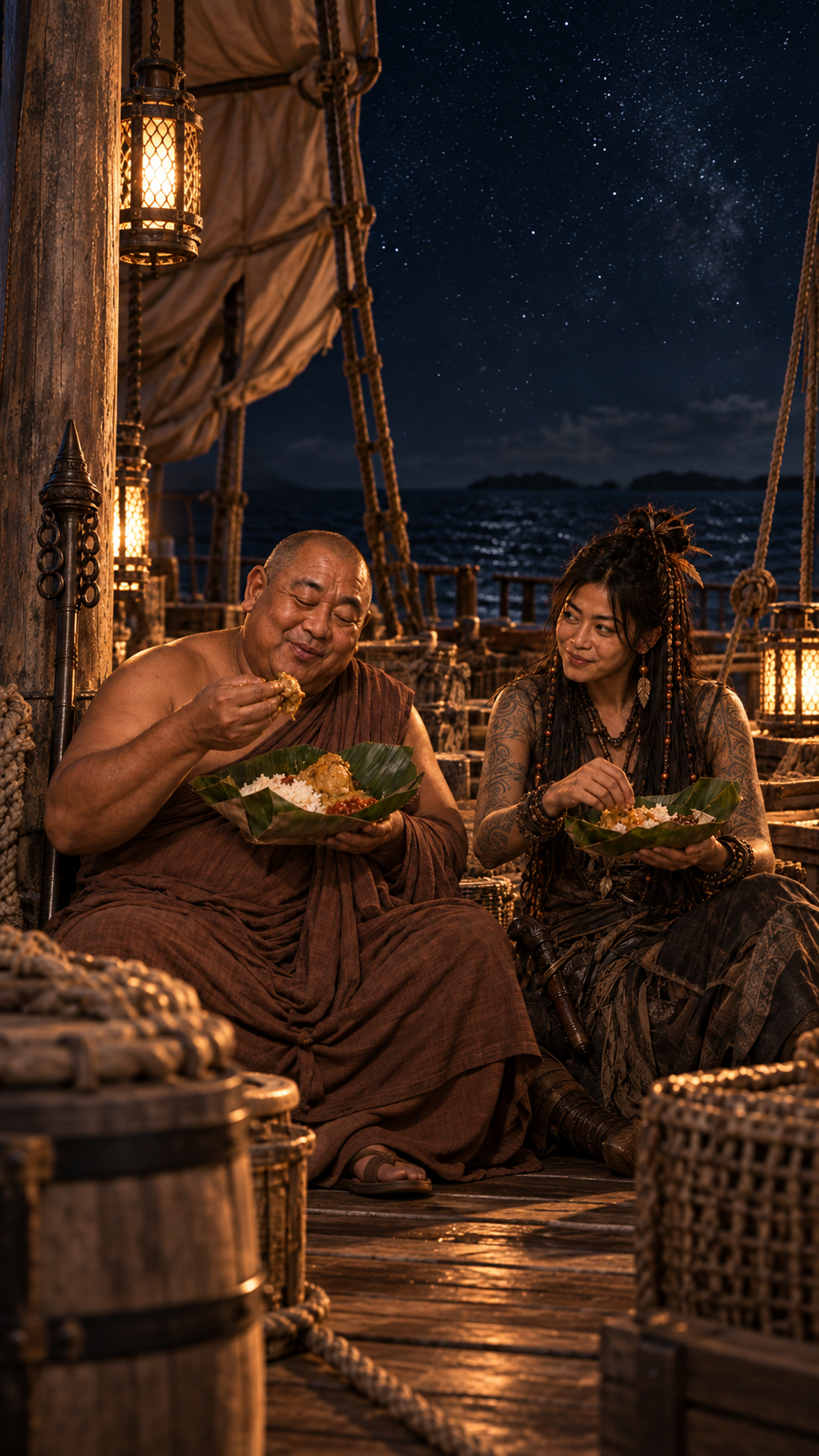
Surya sat eating his nasi bungkus above the dark water and spoke.
“This is better than what we ate at noon. The banana leaf held all the smells—rice, chicken, sambal—together for half a day. Time makes the flavors go deeper.”
“Bhante, you talk about food wherever we are,” Intan said, receiving hers.
“There is nothing else to do on a boat,” Surya said, entirely in earnest.
Stars filled the night above the water. The moon was thin, and the stars seemed to have spread themselves into the space it left behind. Intan lay on the deck looking up. Dewi came and lay beside her.
“Do you like looking at stars?” Dewi asked.
“Back in Kalimantan, the river reflects them. Stars rise twice—once in the sky, once on the river. Here the sea moves too much. Just the light.”
“In Bali, the niskala comes close among the stars. When I look at the stars, I see them together.”
Intan was quiet for a moment, then asked:
“Is that why you look at the sky so often?”
“Yes.”
“The two of you lying there like that—you look like sisters.”
Surya, listening nearby, let out a small laugh.
“Bhante, Intan gets angry when people say that,” Dewi said, sitting up.
“Why would I be angry?” Intan said, sitting up. “But—one of us is Dayak, and one is Balinese. Sisters?”
“What is strange about people from the same islands being sisters?” Surya said.
At the far end of the deck, Arya watched the exchange for a moment. Starlight lay across the side of Dewi’s face. He looked at it briefly, then looked away—but Intan had seen the look. She said nothing to Dewi.

They reached Aceh’s eastern coast on the third afternoon. A small port—a fishing village east of Pasai,18Catatan ↗ boats moored along the bank, fishermen folding their nets.
Rustam put Faris and the five ashore here. Faris said his farewell to Rustam in Acehnese, gripping his hand. Rustam said something to Surya in Acehnese. Faris translated.
“He says this land has been waiting for you.”
“Tell him we are grateful,” Surya said, bowing to Rustam.
The road inland began at the port’s edge. From coastal plain the path climbed gradually into highland country, and in the lower stretches, pepper fields and sugarcane spread on either side. Faris led the way. Hasan walked beside him and asked about the Acehnese sultanate.
“Sultanah Zakiatuddin rules Aceh now?”
“Yes. Under the Sultanah, my teacher’s research has had more freedom than ever before. She is deeply engaged with Islamic scholarship. A female ruler who supports scholars—it means a great deal to those who study.”
“The sultans of Banten were once like that,” Hasan said, quietly. “They supported scholars too. My father grew up in those years.”
Faris glanced at Hasan. He did not ask further—but the question was visible at the edge of his expression.
Notes
12. VOC
VOC: the Dutch East India Company, founded in 1602, with chartered powers extending beyond ordinary trade. Its influence was substantial but varied across ports and regions; not every local trade transaction can be assumed to have ended in VOC hands.
↩ Back to text13. Nasi Lemak
Nasi Lemak — Rice steamed in coconut milk and pandan leaf, producing a fragrant, lightly sweet grain that functions as both staple and side dish in itself. Traditionally served with ikan bilis (crispy dried anchovies), sambal, cucumber slices, and boiled egg. A foundational food of Malay communities along both sides of the Strait of Malacca.
↩ Back to text14. Gulai Ayam
Gulai Ayam — Chicken cooked in a yellow broth of coconut milk, turmeric, lemongrass, and galangal. Halal by nature. Variations exist across Sumatra—each community adds or omits according to local spice availability and tradition.
↩ Back to text15. Gayo Highlands (Dataran Tinggi Gayo)
Gayo Highlands (Dataran Tinggi Gayo) — The central highland region of Aceh, home to the Gayo people, a community of Malay descent with cultural ties to both Aceh and the Batak peoples to the south. The highlands contain Mount Geureudong and several other peaks, and are characterized by frequent mist and a cooler, moisture-heavy climate. The Gayo were among the earlier peoples of the archipelago to adopt Islam, though their practice blends with older highland traditions.
↩ Back to text16. Sultanah Zakiatuddin (Sultanah Zakiatuddin Inayat Syah, reigned 1678–1688)
Sultanah Zakiatuddin (Sultanah Zakiatuddin Inayat Syah, reigned 1678–1688) — The third female ruler of the Acehnese Sultanate in the seventeenth century, a period of remarkable matriarchal governance in Aceh's history. Like her predecessors, she was a committed patron of Islamic scholarship and Sufi learning. Under her reign, Abdul Rauf al-Singkili's prolific scholarly output continued unimpeded.
↩ Back to text17. Leuser
Leuser: a modern geographical reference for mountains spanning Aceh and North Sumatra. The name is used here to orient readers, not to assert that characters in 1683 used today’s name and regional boundaries.
↩ Back to text18. Pasai
Pasai — The site of the Samudera-Pasai Sultanate, founded in the thirteenth century and among the very first polities in the archipelago to adopt Islam. After its annexation by the Acehnese Sultanate in 1524, Pasai remained an important harbor on Aceh's eastern coast. The area corresponds to the present-day vicinity of Lhokseumawe.
↩ Back to text