

PROLOGUE · EPISODE 1/2 · BANDA, 1621
Coen’s Fleet and the Forty-Four Orang Kaya
Death reached the waters of Banda Neira1 before anything else. It came riding on a stench. Gunpowder, tar, wet rigging—smells that smothered the fragrance of nutmeg2 and swept across the shoreline, and before any of it could be named, on the line of the horizon, the prow of the first ship rose from the sea. Not one. Two, five, nine—then the fleet filled the dawn horizon of Banda. The triangular sails of the Dutch East India Company parted the morning mist one by one, and on each ship the cannon ports gaped open. The island's gulls lifted as one. The sound they made together was no longer a cry. It was a scream.
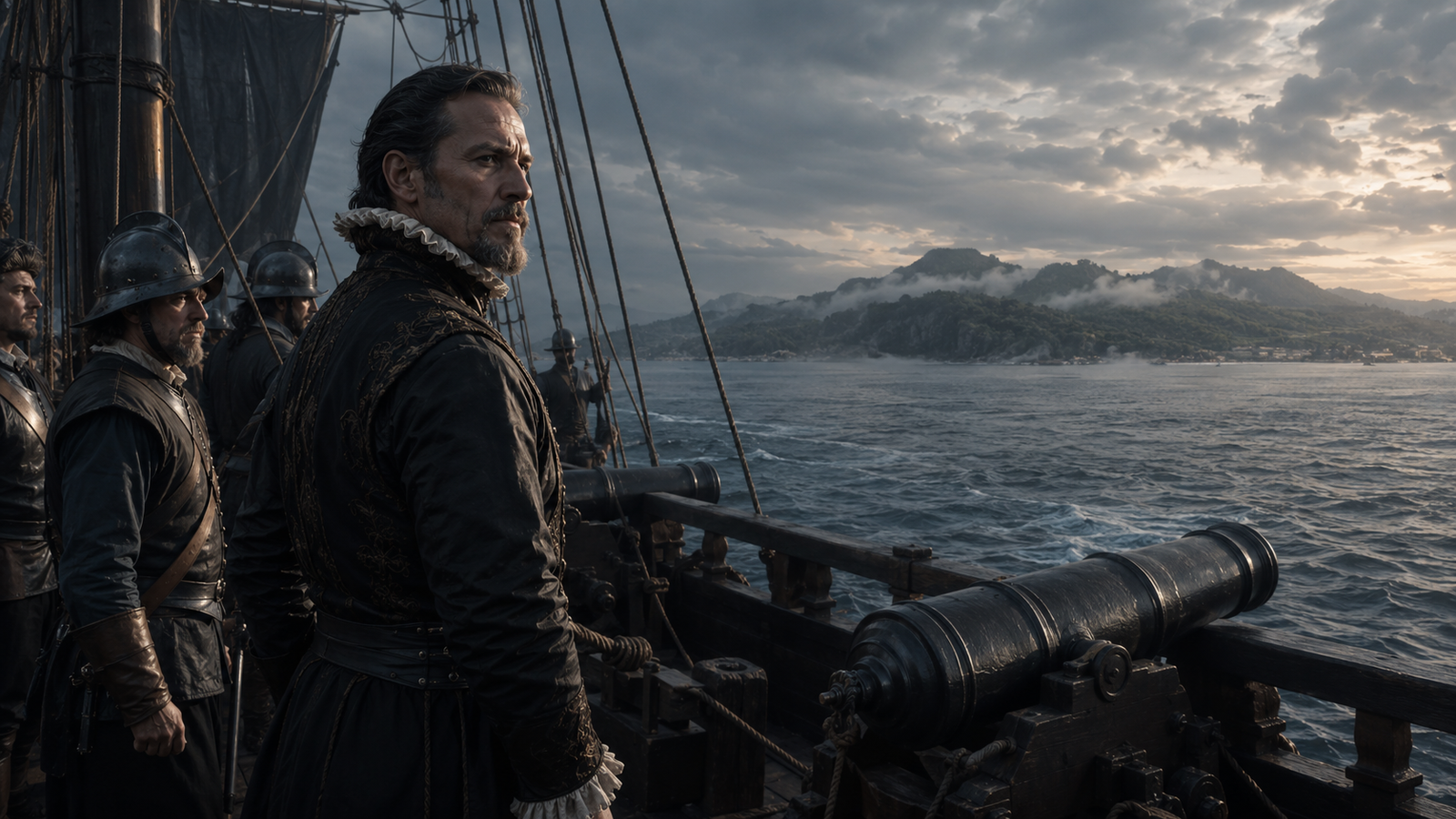
Jan Pieterszoon Coen3 commanded the fleet himself. About one thousand six hundred and fifty-five Europeans in the fleet, some eighty to a hundred mercenaries4 from Japan, and two hundred and eighty-six Javanese prisoners forced to work—a force of that magnitude crossed the sea toward an island of fifteen thousand souls living in peace. The only land on earth where nutmeg grew. That was the fleet that came to trample it.
There were still mothers asleep when the first cannon shook the heart of the island.
The first cannon fired moments before sunrise. No rooster's cry woke the sleeping island. The shriek of iron breaking, the splintering of wood, the screams of human beings—all of it erupted at once. Banda Neira's dawn was born inside fire.
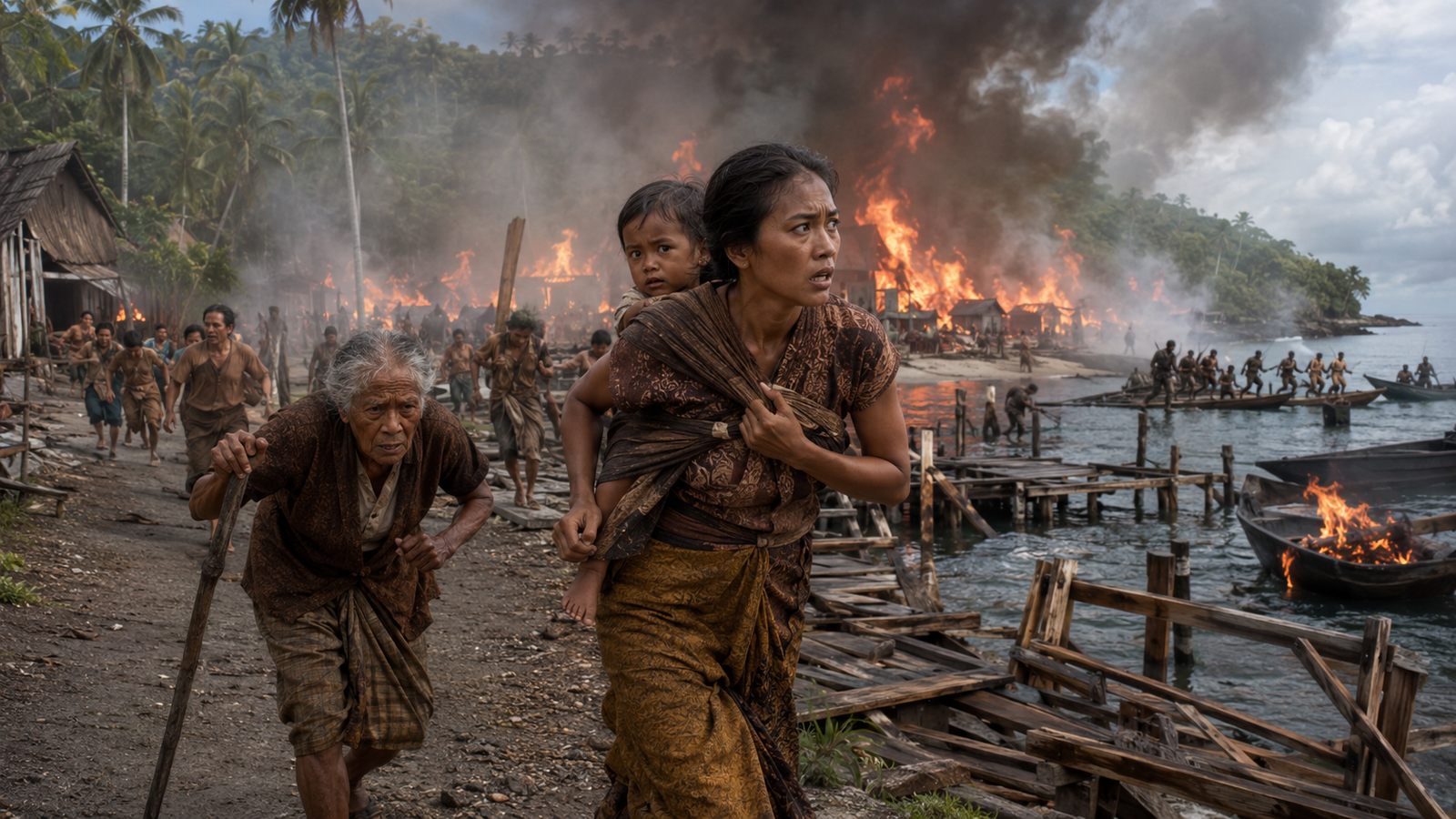
The buildings around Fort Nassau5 caught fire. Coconut-leaf roofs lit and went up in moments, and the flames leapt with the wind from one alley to another, devouring old spice warehouses, the fish market, and the square in front of the prayer house in turn. Smoke rose. The sky over Banda blackened. At the harbor, ships were swallowed by flame and people threw themselves into the water—some swam, some did not, and fell on the wharf to the cut of a sword. Mothers ran with children on their backs. Old men staggered on canes. The ronin did not stop—they cut down those who fled, found those who hid, took the harbor, then pushed into the alleys.
By sunrise the cannon had quieted. Only smoke remained.
After weeks of military operations and repression, on 8 May 1621, forty-four Orang Kaya6Catatan ↗ were executed in front of Fort Nassau.
They were the noble leaders of Banda. Driven into a circular space ringed with bamboo, they held one another's hands until the moment before they died. No one had ordered it. They were people who, in life, had led the spice trade together—who had sat together to deliberate the future of this island. Even before death, they did not let go of one another.
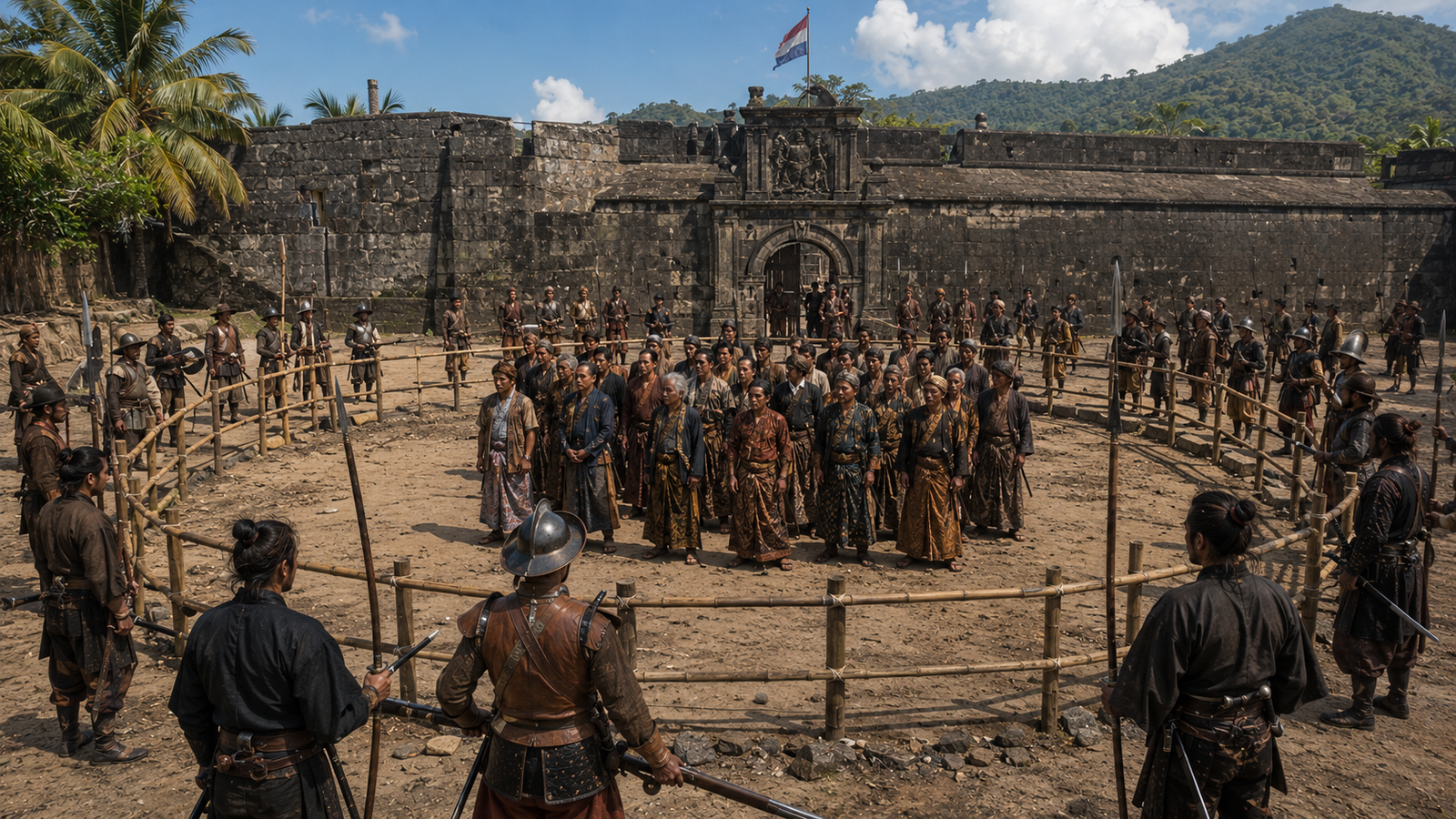
Six ronin stood before them with drawn swords. The eight most influential were cut at the waist first, then at the neck, and their bodies dismembered into four parts. Then the other thirty-six, the same way. The severed heads were spiked onto bamboo points and set in a row along the shore—so that from anywhere on the island, the sight could not be avoided.
When the executions were done, Governor-General Coen received the report inside the fort. An interpreter read out the count of the dead, and the governor nodded and signed the document with a quill. On the page were written the words: Pacificatie van de Banda-eilanden voltooid—pacification of the Banda Islands complete.
Outside, the gulls did not fly. That was the first day they had vanished from the island.
Notes
1. Banda Neira
Banda Neira: A principal island of the Banda archipelago in central Maluku, long a centre of the nutmeg trade. At the beginning of the seventeenth century, a voyage to Banda could make a merchant a fortune, making the islands a target of Dutch colonial ambition.
↩ Back to text2. Nutmeg (Myristica fragrans)
Nutmeg (Myristica fragrans): In the early seventeenth century, the Banda Islands were its principal source for long-distance trade. Nutmeg was valued as a supposed defence against plague, a medicine, and a luxury. The VOC pursued its monopoly through the destruction and displacement of much of Banda’s indigenous population.
↩ Back to text3. Jan Pieterszoon Coen (1587–1629)
Jan Pieterszoon Coen (1587–1629): The fourth and sixth Governor-General of the VOC, founder of Batavia in 1619, and commander of the Banda campaign of 1621. He bears central responsibility for the destruction of Bandanese society through killing, expulsion, enslavement, war, and hunger. His statue in his birthplace of Hoorn remains contested.
↩ Back to text4. Ronin
Ronin: Masterless samurai. Japanese mercenaries employed by the VOC took part in the execution of forty-four Orang Kaya on 8 May 1621. The number of Japanese troops in the expedition should not be confused with the number who carried out the executions, and not every individual’s status as a ronin can be established.
↩ Back to text5. Fort Nassau
Fort Nassau: The fortress the VOC built at Banda Neira in 1609, on the foundations of an earlier Portuguese stronghold, in order to enforce its monopoly on nutmeg. It was the silent witness to the execution of the forty-four Orang Kaya on May 8, 1621. Its remnants still stand, beside the monument at Parigi Rante.
↩ Back to text6. Orang Kaya
Orang Kaya: The hereditary leaders of the Banda Islands, who for centuries presided over a trade network that reached across the Indian Ocean. The phrase means "the wealthy ones," but their position went well beyond wealth: they were arbiters, customary judges, and the guarantors of Banda's social order. The execution of the forty-four Orang Kaya on May 8, 1621, was not a killing of men so much as the destruction of an entire architecture of leadership.
Read the illustrated Nusantara note →↩ Back to text